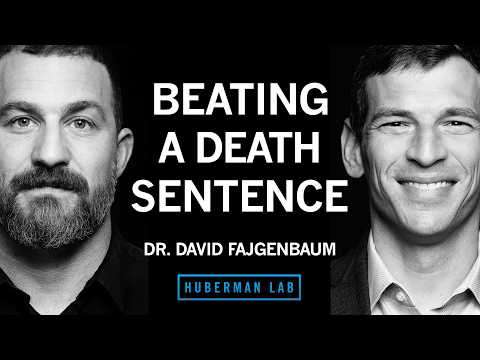
How A Doctor Cured His Own Terminal Disease | Dr. David Fajgenbaum
Dr. David Fajgenbaum (guest), Andrew Huberman (host)
In this episode of Huberman Lab, featuring Dr. David Fajgenbaum and Andrew Huberman, How A Doctor Cured His Own Terminal Disease | Dr. David Fajgenbaum explores old Drugs, New Cures: Repurposing Medicines To Save Overlooked Lives This episode features physician-scientist Dr. David Fajgenbaum, who nearly died multiple times from Castleman disease before identifying an existing drug, sirolimus/rapamycin, that put him into long-term remission. His experience exposed a major blind spot in medicine: thousands of FDA‑approved drugs affect many biological pathways but are only formally used for a small fraction of diseases they could help.
Old Drugs, New Cures: Repurposing Medicines To Save Overlooked Lives
This episode features physician-scientist Dr. David Fajgenbaum, who nearly died multiple times from Castleman disease before identifying an existing drug, sirolimus/rapamycin, that put him into long-term remission. His experience exposed a major blind spot in medicine: thousands of FDA‑approved drugs affect many biological pathways but are only formally used for a small fraction of diseases they could help.
Fajgenbaum describes how he built a lab and the nonprofit Every Cure to systematically scan all approved drugs against all known diseases, using AI and global biomedical data to find the most promising repurposing opportunities. He shares concrete examples where cheap, generic drugs have dramatically improved or saved lives in cancers, rare diseases, and cardiovascular disease but remain underused because of patent, economic, and information barriers.
The conversation also explores how patients and families can self‑advocate—connecting with disease organizations, seeking true experts, and asking informed questions about off‑label or repurposed treatments—while balancing innovation with safety. Underneath the science is a story about agency, systems-level failure, and the psychological circuitry of hope, action, and impact that kept Fajgenbaum alive and is now driving a global effort to match every effective drug to every patient who could benefit.
Key Takeaways
Thousands of existing drugs likely have powerful, untapped uses for other diseases.
There are roughly 4,000 FDA‑approved drugs for about 4,000 diseases, but ~18,000 human diseases exist and most drugs act on 20–30 targets or pathways, not just the one they’re approved for. ...
Get the full analysis with uListen AI
Economic and structural incentives, not malice, are the main reason repurposed treatments are overlooked.
Once a drug goes off patent, no single company has sufficient financial incentive to invest in large trials, guideline lobbying, and physician education for new uses. ...
Get the full analysis with uListen AI
Every Cure is building an AI-driven, system-level approach to drug repurposing.
Rather than hunting disease by disease, Every Cure builds biomedical knowledge graphs and machine learning models to score how likely every drug is to help every disease. ...
Get the full analysis with uListen AI
Patients and families must actively self‑advocate, especially in rare or severe illness.
Fajgenbaum stresses three concrete steps: (1) connect with the disease-specific organization (e. ...
Get the full analysis with uListen AI
N-of-1 repurposing can save lives but must be handled carefully to avoid harm.
Many of Fajgenbaum’s and Every Cure’s early wins were Hail Mary off‑label tries—e. ...
Get the full analysis with uListen AI
Medical progress is highly uneven because our research and care models are fragmented, not unified around problems.
Most biomedical labs operate under the ‘independent investigator’ model, chasing novel findings branded to a PI’s name rather than converging around a specific disease or puzzle. ...
Get the full analysis with uListen AI
Psychological circuits of hope, action, and impact are central to surviving and fighting disease.
Fajgenbaum attributes his perseverance to a repeated cycle: hold a concrete hope (e. ...
Get the full analysis with uListen AI
Notable Quotes
“You can't tell me we’ve tried all 4,000 drugs. We've just tried the drugs that maybe we've thought to try.”
— Dr. David Fajgenbaum
“I just believe that the 4,000 drugs we have today should help all the patients who can benefit from them. Period.”
— Dr. David Fajgenbaum
“No one should suffer if there's a drug at your CVS that could help you.”
— Dr. David Fajgenbaum
“There isn’t a workshop of scientists and doctors sitting together to figure out solutions. And if they are, it’s not at the pace you’d hoped.”
— Dr. David Fajgenbaum
“You can do anything for one minute, or one hour, or one day—but you can’t do six months all at once.”
— Dr. David Fajgenbaum
Questions Answered in This Episode
In the DADA2 and Castleman cases, were there specific biomarkers or immune signatures that, if routinely measured, could systematically flag which patients are most likely to benefit from TNF inhibitors or sirolimus rather than relying on individual clinician insight?
This episode features physician-scientist Dr. ...
Get the full analysis with uListen AI
For lidocaine’s apparent 29% reduction in breast cancer mortality, what mechanistic hypotheses (e.g., immune modulation, reduced circulating tumor cells) are you seeing in the lab, and what additional evidence threshold would you want before telling every breast cancer patient to demand it pre‑operatively?
Fajgenbaum describes how he built a lab and the nonprofit Every Cure to systematically scan all approved drugs against all known diseases, using AI and global biomedical data to find the most promising repurposing opportunities. ...
Get the full analysis with uListen AI
Given that rapamycin is both life-saving for your Castleman disease and a potent immunosuppressant, what do you see as the biggest misconceptions in current ‘longevity’ conversations around rapamycin, and what kind of human trial would you actually support to test its aging-related benefits or harms?
The conversation also explores how patients and families can self‑advocate—connecting with disease organizations, seeking true experts, and asking informed questions about off‑label or repurposed treatments—while balancing innovation with safety. ...
Get the full analysis with uListen AI
If you were put in charge of restructuring NIH or major grant agencies tomorrow, how specifically would you shift funding and lab organization away from the ‘independent investigator’ model toward problem-centered consortia without stifling scientific creativity?
Get the full analysis with uListen AI
In your ‘hope–action–impact’ framework and Huberman’s description of the anterior mid‑cingulate cortex, what practical practices (e.g., specific mental exercises, goal-setting structures, or environmental designs) would you recommend to patients and families to actively strengthen that perseverance circuit during long, uncertain medical battles?
Get the full analysis with uListen AI
Transcript Preview
... my doctor explained to me that we were out of options. He said, "David, we've tried everything. You know, we tried these chemotherapies, we tried this one experimental drug. Um, there's nothing more that we can do." There was, uh, a few-minute period where my dad and my sisters and, and my girlfriend around me, and we were just, um, just bawling our eyes out. You know, we're, "This is the world's expert." And I kept probing him, like, "Is there any cell type or signaling pathway or is there something we can target?" Like, and then he said, "David, there's nothing." "Is there anything in an early stage of development?" "David, there is nothing." I, I heard what he was saying, but then I thought to myself, "You just gave me seven chemotherapies that were made for lymphoma and my- multiple myeloma, and they've saved my life now three times. They're not... It's not long-term. Like, I know I keep relapsing, but, like, if these seven chemotherapies are working, how do we know there's not an eighth chemotherapy or a ninth drug for something else? Like, you can't tell me... We haven't tried all 4,000 drugs. We've just tried the drugs that maybe we've thought to try." And so I just locked in right then, and I turned to my family and just sort of wiped away my tears and said, "I'm gonna dedicate the rest of my life, however long that's gonna be, it might be a couple of days, maybe it'll be a couple of months, but however long I've got to try to find out, is there a drug out there that could help me and other patients with my disease that's made for another condition?" I just believe that the 4,000 drugs we have today should help all the patients who can benefit from them.
Mm-hmm.
Period. Like, no one should suffer if there's a drug at your CVS that could help you.
Welcome to the Huberman Lab Podcast, where we discuss science and science-based tools for everyday life. I'm Andrew Huberman, and I'm a professor of neurobiology and ophthalmology at Stanford School of Medicine. My guest today is Dr. David Fajgenbaum. Dr. David Fajgenbaum is a professor of translational medicine and human genetics at the University of Pennsylvania. His work focuses on finding novel cures to both rare and common human diseases by using drugs and other treatments that already exist and that are approved for use in humans for other purposes. As it turns out, most approved drugs impact at least 40 different pathways and mechanisms across the human brain and body, but these drugs are generally approved for use in just one or two of those pathways. David shares with us the many commonly unknown yet powerful benefits of drugs that are already approved for things like heart health, combating cancer, neurodegeneration and more. From his own near-death experience with Castleman's disease, David discovered that the medical profession already has in hand excellent treatments and perhaps even cures for many of the childhood and adult diseases that the medical profession deems uncurable or untreatable. In addition to running his laboratory, where they search for novel treatments and cures using already approved drugs, David has started a not-for-profit called Every Cure, which helps people find treatments and cures to diseases that the medical field has essentially deemed untreatable. And that work has already saved countless lives. Our discussion today is about how to navigate your health journey and how to approach the treatment of any illness that you or a relative may face. It's also about the fact that while the fields of medicine and science are truly incredible and well-intentioned, they do have a giant blind spot built into them, which is that many effective treatments, and in some cases, cures, exist to diseases that we are told are hopeless to treat, and that even the best-trained and well-meaning MDs are often unaware of those treatments, not because they are lazy or that they have some other agenda, but simply because of how medications are studied, patented, and categorized. As you'll soon learn, Dr. Fajgenbaum is on a mission to educate doctors, scientists, and most importantly, you, the general public, about these facts. He has lived them directly. He's an MD who got very sick with what he was told was a terminal disease, and when the existing system left him at a cliff, he went about curing that disease using old medications in new ways, and he is now helping others who need to do the same. Before we begin, I'd like to emphasize that this podcast is separate from my teaching and research roles at Stanford. It is, however, part of my desire and effort to bring zero-cost-to-consumer information about science and science-related tools to the general public. In keeping with that theme, today's episode does include sponsors. And now for my discussion with Dr. David Fajgenbaum. Dr. David Fajgenbaum, welcome.
Install uListen to search the full transcript and get AI-powered insights
Get Full TranscriptGet more from every podcast
AI summaries, searchable transcripts, and fact-checking. Free forever.
Add to Chrome