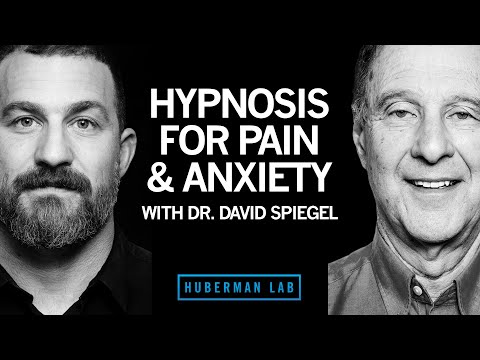
Using Hypnosis to Enhance Health & Performance | Dr. David Spiegel
Andrew Huberman (host), Dr. David Spiegel (guest)
In this episode of Huberman Lab, featuring Andrew Huberman and Dr. David Spiegel, Using Hypnosis to Enhance Health & Performance | Dr. David Spiegel explores harnessing Hypnosis: Rapid, Drug-Free Tools For Mind-Body Transformation Andrew Huberman interviews Stanford psychiatrist Dr. David Spiegel about clinical hypnosis as a highly focused brain state that enhances neuroplasticity and mind–body control. They differentiate research‑backed clinical and self‑hypnosis from stage hypnosis, and detail how hypnosis can rapidly reduce pain, stress, anxiety, phobias, and improve sleep and medical procedure outcomes.
Harnessing Hypnosis: Rapid, Drug-Free Tools For Mind-Body Transformation
Andrew Huberman interviews Stanford psychiatrist Dr. David Spiegel about clinical hypnosis as a highly focused brain state that enhances neuroplasticity and mind–body control. They differentiate research‑backed clinical and self‑hypnosis from stage hypnosis, and detail how hypnosis can rapidly reduce pain, stress, anxiety, phobias, and improve sleep and medical procedure outcomes.
Spiegel explains the neural circuitry of hypnosis (anterior cingulate, dorsolateral prefrontal cortex, insula, default mode network) and why about two-thirds of adults are hypnotizable, with roughly 15% being highly responsive. He introduces the Spiegel eye‑roll test as a quick screen for hypnotizability and describes standardized lab measures.
The conversation covers how hypnosis can be self‑applied via protocols and the Reveri app, often in just a few minutes, and when working directly with a trained clinician is important. They also explore trauma, dissociation, EMDR, grief, children and hypnosis, and how breathing and vision help shift brain states.
Throughout, Spiegel emphasizes that hypnosis is not loss of control but increased control over attention, perception, and bodily states, and that confronting—rather than avoiding—stressful or traumatic experiences is essential for adaptive change.
Key Takeaways
Clinical hypnosis is a state of highly focused, flexible attention—not mind control.
Spiegel defines hypnosis as narrowing attention “like a telephoto lens” where experience is vivid but context and self‑evaluation are reduced. ...
Get the full analysis with uListen AI
Hypnotizability is a stable trait; about two-thirds of adults can benefit.
Roughly one-third of adults are low in hypnotizability, two-thirds are responsive, and ~15% are highly hypnotizable. ...
Get the full analysis with uListen AI
Hypnosis can dramatically reduce pain, drug use, and procedure time in medical settings.
In a randomized trial of patients undergoing arterial interventions, those taught self‑hypnosis had ~80% less pain after 90 minutes, used about half the opioids, had fewer complications, and cut procedure time by ~17 minutes compared to standard care. ...
Get the full analysis with uListen AI
Confronting, not avoiding, stress and trauma—under controlled conditions—is crucial for healing.
Spiegel repeatedly stresses that avoidance and “trigger protection” often prolong suffering. ...
Get the full analysis with uListen AI
Self-hypnosis tools can be short, repeatable, and highly practical for daily life.
Spiegel describes teaching patients a few core scripts (floating imagery, screen imagery, altering temperature/ sensation) then having them practice on their own. ...
Get the full analysis with uListen AI
Breathing and vision are powerful levers into hypnotic and autonomic states.
Hypnosis inductions often start by directing gaze (upward, internal, or narrowed) and modulating respiration (deep inhalation, very slow exhalation). ...
Get the full analysis with uListen AI
Hypnosis is especially suited to focused problems (pain, phobias, sleep, procedures), less so for some rigid conditions like OCD.
Spiegel emphasizes hypnosis works best as a problem‑focused tool—acute and chronic pain, stress, insomnia, phobias, procedure anxiety, some trauma presentations. ...
Get the full analysis with uListen AI
Notable Quotes
“Hypnosis is a state of highly focused attention… like looking through the telephoto lens of a camera in consciousness.”
— Dr. David Spiegel
“Self-hypnosis is a way of enhancing your control over your mind and your body. You’re not losing control—you’re gaining it.”
— Dr. David Spiegel
“If we had a drug that did what hypnosis did in that Lancet trial, every hospital in the country would be using it.”
— Dr. David Spiegel
“The essence of trauma is helplessness. It’s not fear. It’s not pain. It’s helplessness.”
— Dr. David Spiegel
“We’re born with this brain, but we don’t have a user’s manual for it—and we don’t use it nearly as well as we can.”
— Dr. David Spiegel
Questions Answered in This Episode
For someone who tests as only moderately hypnotizable on the Spiegel eye‑roll test, what specific strategies do you recommend to get the most benefit from self-hypnosis sessions on Reveri—should they emphasize certain scripts, frequencies, or contexts (e.g., time of day, pre‑breathwork)?
Andrew Huberman interviews Stanford psychiatrist Dr. ...
Get the full analysis with uListen AI
In your Lancet trial on interventional radiology procedures, did any particular hypnotic imagery (e.g., cooling vs. dissociative ‘leaving the body’ imagery) correlate with greater reductions in pain or opioid use, and have you adapted the Reveri pain modules based on those individual differences?
Spiegel explains the neural circuitry of hypnosis (anterior cingulate, dorsolateral prefrontal cortex, insula, default mode network) and why about two-thirds of adults are hypnotizable, with roughly 15% being highly responsive. ...
Get the full analysis with uListen AI
Given your fMRI findings on DLPFC–insula and DLPFC–posterior cingulate connectivity during hypnosis, do you see a future where real‑time neurofeedback could be combined with hypnotic scripts to teach people how to recognize and voluntarily enter their own ‘optimal’ brain configuration for pain, stress, or performance?
The conversation covers how hypnosis can be self‑applied via protocols and the Reveri app, often in just a few minutes, and when working directly with a trained clinician is important. ...
Get the full analysis with uListen AI
How do you clinically decide when hypnosis is appropriate for trauma processing versus when it might be destabilizing—for example in patients with severe dissociative disorders, complex PTSD, or active substance use—and what safeguards do you build into hypnotic trauma work in those populations?
Throughout, Spiegel emphasizes that hypnosis is not loss of control but increased control over attention, perception, and bodily states, and that confronting—rather than avoiding—stressful or traumatic experiences is essential for adaptive change.
Get the full analysis with uListen AI
You’ve argued that trigger‑heavy topics like sexual assault should not automatically be protected from discussion; based on your cancer group data and primate stress‑inoculation studies, what concrete changes would you make to university or workplace ‘trigger warning’ policies to better promote resilience without trivializing real trauma?
Get the full analysis with uListen AI
Transcript Preview
(uptempo music) Welcome to the Huberman Lab Podcast, where we discuss science and science-based tools for everyday life. I'm Andrew Huberman, and I'm a professor of neurobiology and ophthalmology at Stanford School of Medicine. Today, my guest is Dr. David Spiegel. Dr. Spiegel is the Associate Chair of Psychiatry and Behavioral Sciences at Stanford University School of Medicine. He is also the Director of the Stanford Center on Stress and Health. Dr. Spiegel is both a researcher and a clinician, meaning he runs a laboratory that studies the brain and the body and neural mechanisms of how the brain and body interact, and he sees patients as a psychiatrist at Stanford. His work is incredibly unique in that it bridges mind and body, but it also has a particular focus on the clinical applications of hypnosis. As you'll learn today, hypnosis is a unique brain state in which neuroplasticity, the brain's ability to change in response to experience, may be heightened, and indeed, the use of clinical hypnosis by Dr. Spiegel and colleagues has been shown to improve symptoms of stress, chronic anxiety, chronic pain, and various other illnesses, including many psychiatric illnesses and even outcomes in cancer. Today, we discuss hypnosis in the context of what's called self-hypnosis to distinguish it from stage hypnosis. Many of you are probably familiar with stage hypnosis, which is really about a hypnotist getting a person to do things they would not otherwise do. In contrast, clinical hypnosis and the use of hypnosis for the treatment of various ailments of mind and body is vastly different. It involves getting people to change their brain state and to use that brain state as a portal to make adjustments in their brain and body and other aspects of their biology and psychology that benefit them. And it's been shown over and over again in studies by Dr. Spiegel and colleagues that those changes can occur extremely quickly. Now, not everybody can be hypnotized as readily as the next, and so today, we also discuss a simple test developed by Dr. Spiegel that can help you determine whether or not you have a high, medium, or low degree of what we call hypnotizability. Dr. Spiegel is truly an expert in this area. He has published over 480 journal articles, 170 book chapters on hypnosis, and on things like psychosocial oncology, which is the interaction of mind and body in the treatment of cancer and cancer outcomes, on stress physiology, trauma, and other aspects of psychotherapy. He's published 13 books, so he's truly the world expert in hypnosis and clinical applications of hypnosis for mind and body. I'm certain that in listening to today's episode, you're going to learn a tremendous amount about how the brain and body interact, about various treatments for all sorts of common ailments of mind and body, and you're going to get access to tools, in particular, a tool that was developed by Dr. Spiegel, which is the Reveri app, R-E-V-E-R-I. The Reveri app is currently only available for Apple, but will soon also be available for Android. It does carry a nominal cost, but there is a seven-day free trial. If you'd like to try it, we're providing a link in the show notes. The Reveri app is special in that it is based on clinical studies and research done in the Spiegel lab at Stanford. So, unlike a lot of hypnosis apps out there and resources for hypnosis, it was developed with clinical treatments in mind. Today, we also discuss the use of breathwork, and I'm very fortunate that my research lab at Stanford has been collaborating very closely with Dr. Spiegel in testing and developing specific breathwork protocols to adjust mind and body for things like anxiety, improving mood, and improving sleep. Based on his incredible and unique expertise and the clarity with which Dr. Spiegel communicates information, I anticipate that you will really enjoy today's episode and that you'll come away from it with a lot of actionable tools. Some of you might be curious what a clinical hypnosis session looks like, and for that reason, we had Dr. Spiegel hypnotize me. A clip of that hypnosis session is going to be posted to the Huberman Lab Clips channel, which is available on YouTube. Before we begin, I'd like to emphasize that this podcast is separate from my teaching and research roles at Stanford. It is, however, part of my desire and effort to bring zero-cost-to-consumer information about science and science-related tools to the general public. In keeping with that theme, I'd like to thank the sponsors of today's podcast. Our first sponsor is Athletic Greens. Athletic Greens is an all-in-one vitamin mineral probiotic drink. I've been taking Athletic Greens since 2012, so I'm delighted that they're sponsoring the podcast. The reason I started taking Athletic Greens and the reason I still take Athletic Greens once or twice a day is that it covers all of my foundational vitamin mineral probiotic needs. There is now ample evidence that probiotics can be very helpful for supporting what is called the gut microbiome. The gut microbiome is an aspect of our biology in which little gut microbiota live all along our digestive pathway and help support various aspects of our biology, including our immune system, our metabolic system, our hormones or endocrine system, as well as what's called the gut-brain axis, which is literally communication between the gut and the brain to support things like mood, motivation, and various other aspects of brain health. With Athletic Greens, I get the probiotics that I need to support a healthy gut microbiome and the vitamins and minerals tap off any deficiencies I might have based on lack of certain foods and lack of certain nutrients in my diet. If you'd like to try Athletic Greens, you can go to athleticgreens.com/huberman to claim a special offer. They'll give you five free travel packs plus a year's supply of vitamin D3 K2. There's a lot of evidence now that vitamin D3 is critically important for various aspects of immediate and long-term health. And while many people get enough vitamin D3, many people do not. So, the year's supply of vitamin D3 ought to be very useful for many people, and K2 has been shown to be important for calcium regulation, various aspects of metabolic health, and so forth. So again, if you'd like to try Athletic Greens and get that special offer of the five free travel packs and year's supply of vitamin D3 K2, go to athleticgreens.com/huberman. Today's episode is also brought to us by Thesis. Thesis makes custom nootropics.Now, nootropic is a smart drug and personally, I'm not a big fan of the concept of a smart drug, at least not the way that most people talk about smart drugs or nootropics, for the following reason: Being smart involves various things. There is creativity, there's focus, there's task switching, and so on, and each one of those involves different operations in the brain, different neural circuits, different neurochemicals have to be deployed in order for us to, for instance, be very focused, or for us to be very creative, or for us to be able to switch tasks easily. Thesis understands this and for that reason, they've developed custom nootropics that are aimed at getting your brain and body into particular states for particular types of work or physical activity. In order to accomplish that, they've created unique blends of high-quality ingredients and each of those blends is designed to get your brain and body into a particular mode, such as focus, clarity, or motivation. I've been using Thesis nootropics for over six months now and I have to say, it's been a total game changer and very unique from the experience of using sort of what I call catchall nootropics so with Thesis, it's really directed toward particular brain/body states. I should also mention that they tailor those custom blends to you, so by taking a quiz on their site, they will tailor the blend to you and your specific needs and the things you don't want. So if you want to try your own personalized nootropic starter kit, you can go online to takethesis.com/huberman. You'll take a three-minute quiz and Thesis will send you four different formulas to try in your first month and then based on the outcomes with those, they can update your formulations for you. That's takethesis.com/huberman and use the code Huberman at checkout to get 10% off your first box. Today's episode is also brought to us by ROKA. ROKA makes eyeglasses and sunglasses that I believe are of the utmost quality. The company was founded by two all-American swimmers from Stanford and everything about the design of ROKA eyeglasses and sunglasses was created with performance in mind. There are a number of things about ROKA sunglasses and eyeglasses that I particularly like. First of all, they're extremely lightweight. You basically forget that you're wearing them. Second of all, you can wear them for work, for going out to dinner, et cetera, they have great aesthetics so you can wear them anywhere, but also for exercise. You can wear them when running or cycling and even if you get sweaty, they're designed so that they don't slip off your face. Another terrific feature of ROKA eyeglasses and sunglasses is that they were designed with the biology of the visual system in mind. We all have the experience of being in a shaded area and then going to a bright area, it takes some time for your eyes to adjust or to adapt. Many sunglasses make it hard to see as you move from one environment to the next and therefore you have to take on and off your sunglasses. With ROKA sunglasses you don't have to do that. You don't even notice the transitions between those bright areas and those dimmer areas so you can wear them anywhere, anytime and again, most of the time you don't even realize that they're on your face. If you'd like to try ROKA eyeglasses and sunglasses go to roka.com, that's roka.com, and enter the code Huberman to save 20% off your first order. Again, that's ROKA, roka.com and enter the code Huberman at checkout. And now for my discussion with Dr. David Spiegel. David, thank you so much for being here.
Install uListen to search the full transcript and get AI-powered insights
Get Full TranscriptGet more from every podcast
AI summaries, searchable transcripts, and fact-checking. Free forever.
Add to Chrome