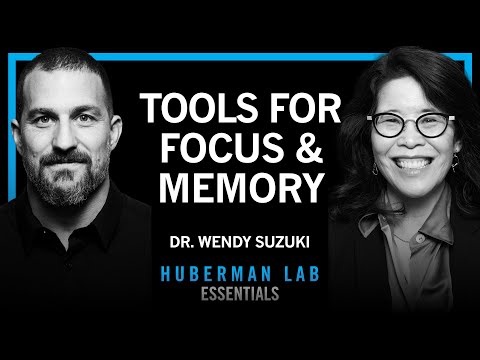
Essentials: Tools to Boost Attention & Memory | Dr. Wendy Suzuki
Andrew Huberman (host), Dr. Wendy Suzuki (guest)
In this episode of Huberman Lab, featuring Andrew Huberman and Dr. Wendy Suzuki, Essentials: Tools to Boost Attention & Memory | Dr. Wendy Suzuki explores exercise-driven neurochemistry and habits to sharpen attention, mood, memory. Suzuki outlines four features that make experiences memorable—novelty, repetition, association, and emotional resonance—and emphasizes the hippocampus as central to forming long-term memories and even imagination (recombining past information to simulate the future).
Exercise-driven neurochemistry and habits to sharpen attention, mood, memory.
Suzuki outlines four features that make experiences memorable—novelty, repetition, association, and emotional resonance—and emphasizes the hippocampus as central to forming long-term memories and even imagination (recombining past information to simulate the future).
She explains why emotionally intense events can create “one-trial learning,” largely as a survival mechanism in which the amygdala boosts hippocampal encoding for threatening or salient situations.
A major focus is how aerobic exercise improves mood and cognitive control acutely (for up to ~2 hours) and supports longer-term improvements in prefrontal function and hippocampal memory through neurochemicals and BDNF.
Practical thresholds are highlighted: as little as 10 minutes of walking can improve mood; for cognitive/hippocampal gains, regular cardio (e.g., ~2–3 sessions/week in low-fit adults) is effective, with “every drop of sweat” potentially adding benefit in already mid-fit individuals.
Key Takeaways
Memorability is engineered by attention plus meaning.
Novelty draws attention, repetition strengthens traces, association links new info to existing networks, and emotional resonance recruits the amygdala to enhance hippocampal encoding.
Get the full analysis with uListen AI
The hippocampus supports future thinking, not just past recall.
Beyond storing facts and events, hippocampal circuitry helps recombine stored elements to simulate scenarios—why hippocampal damage can impair imagination as well as memory.
Get the full analysis with uListen AI
Fear memories “stick” because they’re protective.
One-trial learning often leverages evolved threat systems: a highly salient negative event can be encoded strongly so you remain vigilant in similar contexts later.
Get the full analysis with uListen AI
A single cardio session can sharpen mood and attention for hours.
A 30–45 minute aerobic bout reliably boosts mood and improves prefrontal-dependent performance (e. ...
Get the full analysis with uListen AI
10 minutes of walking is a realistic entry point for brain benefits.
Even brief walking—especially outside—can shift mood via catecholamines and serotonin/dopamine-related pathways, lowering friction for people averse to intense workouts.
Get the full analysis with uListen AI
For hippocampal and attention gains, heart-rate-elevating cardio matters.
Suzuki emphasizes that sustained cardiovascular effort is the key ingredient for longer-term improvements in prefrontal function and hippocampal memory, regardless of the specific modality (spin, running, power walking, etc.).
Get the full analysis with uListen AI
Exercise likely boosts BDNF via muscle and liver signaling.
Proposed routes include a muscle-released myokine crossing the blood–brain barrier to stimulate BDNF, and liver-derived beta-hydroxybutyrate (a ketone) also crossing into the brain and promoting BDNF.
Get the full analysis with uListen AI
Adults can still generate hippocampal neurons into old age—likely aided by exercise.
While human adult neurogenesis has been debated, Suzuki cites newer evidence suggesting neuron birth persists into the ninth decade, aligning with the idea that exercise supports hippocampal plasticity.
Get the full analysis with uListen AI
Consistency over perfection: modest weekly cardio improves cognition in low-fit adults.
In 30–50-year-olds who were low-fit, ~3 months of 2–3 cardio sessions/week (about 35 minutes of work time within a 45-minute class) improved mood and hippocampal-dependent memory tasks versus an active social control (video Scrabble).
Get the full analysis with uListen AI
If you’re already exercising, increasing volume can further improve mood and memory.
In mid-fit adults, allowing increases up to ~7 sessions/week over 3 months showed dose-related improvements—summarized as “every drop of sweat counted.”
Get the full analysis with uListen AI
Pairing movement with positive affirmations may amplify mood and self-image effects.
Suzuki describes IntenSati, which combines vigorous movement with spoken affirmations; affirmations alone have mood effects, and combined with exercise may reinforce positive self-talk habits.
Get the full analysis with uListen AI
Brief daily meditation can improve stress reactivity and cognition.
An ~8-week practice of ~12 minutes/day guided body-scan meditation reduced stress responses to an acute stress test and improved mood and cognitive performance, likely by training present-moment attention.
Get the full analysis with uListen AI
For attention, the core trio is exercise, meditation, and sleep.
Suzuki frames these as the most immediately actionable levers to improve focus, learning, creativity, and overall cognitive function.
Get the full analysis with uListen AI
Notable Quotes
“There are four things that make things memorable: novelty… repetition… association… and… emotional resonance.”
— Dr. Wendy Suzuki
“Anytime you need to associate something together, either for your past, your present, or your future, you are using your hippocampus.”
— Dr. Wendy Suzuki
“Every single time you move your body, it’s like giving your brain this wonderful bubble bath of neurochemicals.”
— Dr. Wendy Suzuki
“Studies have shown that just 10 minutes of walking outside can shift your mood.”
— Dr. Wendy Suzuki
“Every drop of sweat counted.”
— Dr. Wendy Suzuki
Questions Answered in This Episode
On the “four features of memorability,” how would you translate novelty/repetition/association/emotion into a concrete study strategy for a difficult subject (e.g., math or law)?
Suzuki outlines four features that make experiences memorable—novelty, repetition, association, and emotional resonance—and emphasizes the hippocampus as central to forming long-term memories and even imagination (recombining past information to simulate the future).
Get the full analysis with uListen AI
You describe the hippocampus as crucial for imagination: what specific everyday problems (planning, decision-making, creativity) best reveal hippocampal involvement beyond memory tests?
She explains why emotionally intense events can create “one-trial learning,” largely as a survival mechanism in which the amygdala boosts hippocampal encoding for threatening or salient situations.
Get the full analysis with uListen AI
For acute cognitive benefits (the ~2-hour window), is there an optimal intensity zone (e.g., moderate vs. HIIT) that best improves Stroop/flanker performance?
A major focus is how aerobic exercise improves mood and cognitive control acutely (for up to ~2 hours) and supports longer-term improvements in prefrontal function and hippocampal memory through neurochemicals and BDNF.
Get the full analysis with uListen AI
Your minimums differ by outcome (10-minute walk for mood vs. cardio for hippocampus). What markers should people use to know they’ve reached the “cardio threshold” if they don’t track heart rate?
Practical thresholds are highlighted: as little as 10 minutes of walking can improve mood; for cognitive/hippocampal gains, regular cardio (e. ...
Get the full analysis with uListen AI
In your low-fit study (2–3x/week spin for 3 months), which hippocampal memory improvements were largest—recognition discrimination vs. spatial episodic—and why might one respond more?
Get the full analysis with uListen AI
Transcript Preview
Welcome to Huberman Lab Essentials, where we revisit past episodes for the most potent and actionable science-based tools for mental health, physical health, and performance. I'm Andrew Huberman, and I'm a professor of neurobiology and ophthalmology at Stanford School of Medicine. And now for my discussion with Dr. Wendy Suzuki. Wendy, great to see you again and to have you here. It's been a little while.
It's been a while. So great to be here, Andrew. Thank you so much for having me.
Yeah, delighted. I'd like to start off by talking about memory generally, and then I'd love to chat about your incredible work discovering how exercise and memory interface, and what people can do to-
Yeah
... improve their memory and brain function generally.
Yes.
Maybe you could just step us through the basic elements of memory.
Well, I like to say there are four things that make things memorable. Number one is novelty. If it's something new, the very first thing, uh, the very first time we've seen something or experienced something, our brains are drawn to that. Our attentional systems draw us to that, and when you are paying attention to something, that's, that's part of what makes things memorable. Second is repetition. Third is association. So if you meet somebody new that knows lots of people that you know, so you and I share many, many, many, many people that we both know-
Mm-hmm
... it's easy to remem- it's easier to remember you, especially if you were somebody new that I hadn't met before. We have met before. Uh, so association, um, and then the fourth one is emotional resonance. So we remember the happiest and the saddest moments of our lives, and that also includes, you know, funny, surprising things. Uh, that is the interaction between two key brain structures, uh, the amygdala, which is important for processing, uh, lots of emotional, particularly threatening kinds of situations. But, uh, those threatening, surprising kinds of situations, the amygdala takes that information and makes another key structure, called the hippocampus, work better to put new long-term memories in your brain. So that, in fact, is the key structure for long-term memory, this structure called the hippocampus.
Now, step us through kind of what this structure is, what it looks like.
Yeah. The word hippocampus means seahorse. It is visually, anatomically beautiful, with these kind of intertwining subregions within it. So that's anatomically. Functionally, what does it do? Well, it's easiest to understand what it does when you, uh, look at what happens when you don't have a hippocampus anymore. We know this from the most famous neurological pati- patient of all time. Uh, his, uh, initials were H.M., so all psychology and neuroscientists, neuroscience students know him. Uh, he was operated in 1954, and, uh, the paper was published in 1957. Um, they removed both his hippocampi because he had very terrible epilepsy, and, um, they knew that the hippocampus was the genesis of, of epilepsy, and this was experimental. His epilepsy was so bad that they decided not just to remove one hippocampus, but both. And what happened was immediate, um, immediate loss of all ability to form new memories for facts and events. So this hippocampus does something with all of these perceptions that are coming at us every single day, every minute of the day, and not for all of them, but for some of them that have these features that we just talked about. Maybe they're novel, maybe they have associations, maybe they're, they're emotionally relevant, maybe, uh, uh, maybe they've re- been repeated. Some of those things, uh, in the realm of facts or events get, uh, uh, encoded in our long-term memory. The hippocampus and what it does really defines our own personal histories. It means it defines who we are, because if we can't remember what we've done, the information we've learned, and, and the events of our lives, it, it changes us. That, that's what really defines us. But what people have started to realize that it's not just memory, it's not just putting together associations for what, where, and when of, of events that happened in our past, but it's putting together information that is in our long-term memory banks in interesting new ways. I'm talking about imagination. So without the hippocampus, yes, you can't remember things, but actually you're not able to imagine, uh, events or situations that you've never experienced before. So what that says is, the hippocampus i- i- is important for memory, is a too simple a way to think about it. What the hippocampus is important for is what we've already talked about, associating things together writ large. Anytime you need to associate something together, either for your past, your present, or your future, you are using your hippocampus, and it takes on this much more important role in our cognitive lives when we think about it like that. That is kind of the new, the new hippocampus that, that neuroscientists are studying these days.
Install uListen to search the full transcript and get AI-powered insights
Get Full TranscriptGet more from every podcast
AI summaries, searchable transcripts, and fact-checking. Free forever.
Add to Chrome