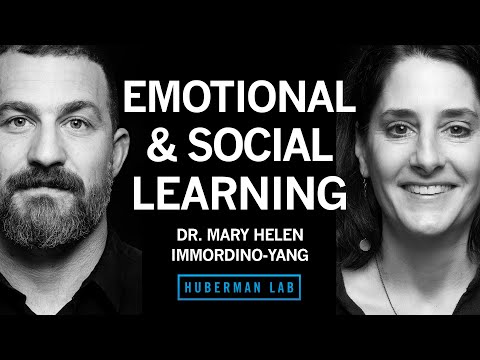
How Emotions & Social Factors Impact Learning | Dr. Mary Helen Immordino-Yang
Andrew Huberman (host), Mary Helen Immordino-Yang (guest), Narrator, Narrator
In this episode of Huberman Lab, featuring Andrew Huberman and Mary Helen Immordino-Yang, How Emotions & Social Factors Impact Learning | Dr. Mary Helen Immordino-Yang explores how Emotions Shape Learning, Identity, And Our Divided Social World Andrew Huberman and neuroscientist-educator Dr. Mary Helen Immordino‑Yang explore how emotions, bodily states, and social context fundamentally drive learning, meaning-making, and identity from childhood through adulthood.
How Emotions Shape Learning, Identity, And Our Divided Social World
Andrew Huberman and neuroscientist-educator Dr. Mary Helen Immordino‑Yang explore how emotions, bodily states, and social context fundamentally drive learning, meaning-making, and identity from childhood through adulthood.
They explain that so‑called “high-level” emotions like awe, inspiration, and compassion are built on ancient survival circuitry shared with other animals, yet become uniquely human when woven into stories and cultural narratives.
Using brain-imaging work on the default mode network, classroom case studies, and developmental examples, they show how story-driven emotions literally reconfigure brain activity, supporting deep understanding, ethical reasoning, and a sense of self.
They argue that modern schooling and social media often misdirect emotional energy toward performance, status, and outrage instead of ideas and civic discourse, and outline how parents, teachers, and individuals can redesign learning to be emotionally meaningful, reflective, and socially constructive.
Key Takeaways
Emotions are not “extra” to thinking; they are the engine of learning and meaning-making.
Whatever you are emotional about is what your brain is allocating resources to think about and remember. ...
Get the full analysis with uListen AI
High-level emotions like awe and inspiration are built on primitive survival systems but elaborated through story.
Dr. ...
Get the full analysis with uListen AI
The default mode network (DMN) supports deep, story-based emotions, self-reflection, and ethical reasoning.
Her fMRI work shows that when people feel admiration or compassion that require constructing a narrative (e. ...
Get the full analysis with uListen AI
Development is a process of elaborating simple bodily states into increasingly complex concepts and identities.
Her daughter’s evolution from “I really love your arm” at age two to “I love you more than I’m glad there’s daytime” at age four illustrates how a basic attachment feeling is cognitively reframed over time. ...
Get the full analysis with uListen AI
Learning environments should direct emotional energy toward ideas and inquiry, not just control and outcomes.
In many schools, emotional stakes are focused on behavior charts, grades, timed tests, and “getting it right,” so students learn to care about compliance and performance. ...
Get the full analysis with uListen AI
Feeling safe is a neurobiological prerequisite for complex reflection, creativity, and civic discourse.
The same DMN that supports perspective-taking and ethical reflection is suppressed when people feel physically or socially unsafe and must stay vigilant to the immediate environment. ...
Get the full analysis with uListen AI
To protect against extremism and dehumanization, we must teach people to deconstruct their own beliefs.
Genocide and atrocities can be understood as failures of meaning-making, where narratives recast others as non-human and justify cruelty. ...
Get the full analysis with uListen AI
Notable Quotes
“Whatever you’re having emotion about is what you’re thinking about. And whatever you’re thinking about, you could hope to learn about.”
— Mary Helen Immordino‑Yang
“Our most high-level complex mind states are also fundamentally hooking themselves into the most basic biological machinery that literally we share with alligators.”
— Mary Helen Immordino‑Yang
“We don’t have mirror neurons; we have a nervous system wired to simulate others using the substrate of our own self.”
— Mary Helen Immordino‑Yang
“Learning is not the goal of education. It needs to be the development of the person. How is the person changing themselves having learned this?”
— Mary Helen Immordino‑Yang
“If we cancel ideas and pretend they don’t exist, all we’re doing is burying them in a place where they can’t be deconstructed.”
— Mary Helen Immordino‑Yang
Questions Answered in This Episode
In your fMRI work, what distinguishes a story that strongly activates the default mode network from one that doesn’t, and how could teachers deliberately design classroom materials to elicit that deeper, DMN-based engagement?
Andrew Huberman and neuroscientist-educator Dr. ...
Get the full analysis with uListen AI
You described how dehumanizing narratives can suppress empathy and enable atrocities; based on your research, what specific classroom practices best inoculate students against those kinds of dangerous reframings over time?
They explain that so‑called “high-level” emotions like awe, inspiration, and compassion are built on ancient survival circuitry shared with other animals, yet become uniquely human when woven into stories and cultural narratives.
Get the full analysis with uListen AI
When a student or child is deeply disengaged from a required subject like math, what concrete steps can a teacher or parent take in the first week to redirect their emotional energy from ‘performance anxiety’ to genuine curiosity about ideas?
Using brain-imaging work on the default mode network, classroom case studies, and developmental examples, they show how story-driven emotions literally reconfigure brain activity, supporting deep understanding, ethical reasoning, and a sense of self.
Get the full analysis with uListen AI
Given that feeling unsafe suppresses the neural systems needed for reflection and creativity, how do you propose we balance the need to protect students from real harm with the need to expose them to disturbing historical events or controversial ideas in a way that still allows deep thinking?
They argue that modern schooling and social media often misdirect emotional energy toward performance, status, and outrage instead of ideas and civic discourse, and outline how parents, teachers, and individuals can redesign learning to be emotionally meaningful, reflective, and socially constructive.
Get the full analysis with uListen AI
You argue that learning outcomes should be subordinated to person development; if you had control over a typical U.S. public high school, what three structural changes would you implement first (e.g., assessment, scheduling, curriculum) to begin that shift without overwhelming teachers?
Get the full analysis with uListen AI
Transcript Preview
(instrumental music) Welcome to the Huberman Lab Podcast, where we discuss science and science-based tools for everyday life. I'm Andrew Huberman, and I'm a professor of neurobiology and ophthalmology at Stanford School of Medicine. Today, my guest is Dr. Mary Helen Immordino-Yang. Dr. Immordino-Yang is a professor of education, psychology, and neuroscience at the University of Southern California. Her laboratory focuses on emotions and the role of emotions in learning, as well as how social interactions impact how we learn. Today's discussion is one that I found absolutely fascinating, because it will reveal to you, in fact all of us, how our temperament, that is our emotionality, combined with our home environment and the school environments that we were raised in shape what we know about the world and our concepts of self. In thinking about that, we also discuss the education system and how different aspects of rules and how we are told to behave and what actually constitutes good behavior or bad behavior shape how we learn information and develop a sense of meaning in life. If any of that sounds abstract, I promise you that today's discussion is incredibly practical. You will learn, for instance, how different styles of learning are going to favor different people, from children into adulthood, and how we ought to think about learning in terms of our emotional systems being our guide for what we learn and the information that we retain and how we apply that information throughout life. For those of you that are parents or who are thinking of becoming parents or who were once children, so I believe that encompasses everybody out there, today's discussion will arm you with an intellectual understanding of psychology and neuroscience as it relates to learning, but also practical tools that you can apply in order to be able to learn more effectively. What I like so much about Dr. Immordino-Yang's research and the discussion today is that she frames up beautifully how those who best learn from traditional forms of classroom learning as well as those who learn from non-traditional forms of learning, either in or out of the classroom, can best use that understanding of self in order to learn in the way that is best for them. Before we begin, I'd like to emphasize that this podcast is separate from my teaching and research roles at Stanford. It is, however, part of my desire and effort to bring zero cost to consumer information about science and science-related tools to the general public. In keeping with that theme, I'd like to thank the sponsors of today's podcast. Our first sponsor is Eight Sleep. Eight Sleep makes smart mattress covers with cooling, heating, and sleep tracking capacity. I've talked many times before on this podcast about the fact that sleep is the foundation of mental health, physical health, and performance of all kinds. One of the key things to getting a great night's sleep is the temperature of your sleeping environment, and that's because your core body temperature actually has to drop by about one to three degrees in order for you to get into and stay deeply asleep. And conversely, your core body temperature increases by about one to three degrees in order for you to wake up and feel refreshed. With Eight Sleep, you can control the temperature of your sleeping environment very easily because of the way that the mattress cover communicates with an app where you can dial in the temperature of your sleeping environment at the beginning, middle, and end of your night as you arrive toward morning. Sleeping on an Eight Sleep mattress cover has greatly enhanced the quality of my sleep. I know that because it also includes a sleep tracker which will tell you how much slow wave sleep and rapid eye movement sleep you're getting and it gives you a sleep score. If you'd like to try Eight Sleep, go to eightsleep.com/huberman and get up to $150 off. Eight Sleep currently ships in the USA, Canada, UK, select countries in the EU, and Australia. Again, that's eightsleep.com/huberman. Today's episode is also brought to us by HVMN Ketone IQ. Ketone IQ is a ketone supplement that increases blood ketones. I know most people are familiar with or at least have heard of the so-called ketogenic diet. It's used for weight loss, it's used to control epilepsy, it's used for mental health reasons. However, most people, including myself, do not follow a ketogenic diet. Nonetheless, increasing your blood ketones can improve the function of your brain and the function of your body, and that's because ketones are a preferred use of fuel for the brain and body. So even though I follow an omnivore diet, that is I'm not in a ketogenic state, I use Ketone IQ to increase my blood ketones prior to doing preparation for podcasts or writing grants or doing research, as well as prior to workouts. Especially if I want to work out fasted, I'll take some Ketone IQ to increase my blood ketones, which gives me a lot of energy during workouts or during bouts of cognitive work even if I haven't eaten in the preceding hours. It really increases my focus and my energy levels. If you'd like to try Ketone IQ, you can go to hvmn.com/huberman to save 20% off. Again, that's hvmn.com/huberman to save 20%. Today's episode is also brought to us by ROKA. ROKA makes eyeglasses and sunglasses that are of the absolute highest quality. The company was founded by two all-American swimmers from Stanford, and everything about ROKA eyeglasses and sunglasses were designed with performance in mind. I've spent a lifetime working on the biology of the visual system, and I can tell you that your visual system has to contend with an enormous number of different challenges in order for you to be able to see clearly. ROKA understands those challenges and has designed their eyeglasses and sunglasses accordingly so that you always see with perfect clarity. Their eyeglasses and sunglasses were initially designed for sports performance, and as a consequence, they are very lightweight, which is great. They also won't slip off your face if you get sweaty. However, even though they were designed for sports performance, they now also include a lot of styles that are designed to be worn to work, out to dinner, essentially recreationally, so that you could wear anywhere. If you'd like to try ROKA eyeglasses or sunglasses, go to ROKA, that's roka.com and enter the code "Huberman" to save 20% off your order. Again, that's ROKA, roka.com and enter the code "Huberman" at checkout. And now for my discussion with Dr. Mary Helen Immordino-Yang. Dr. Immordino-Yang.
Install uListen to search the full transcript and get AI-powered insights
Get Full TranscriptGet more from every podcast
AI summaries, searchable transcripts, and fact-checking. Free forever.
Add to Chrome