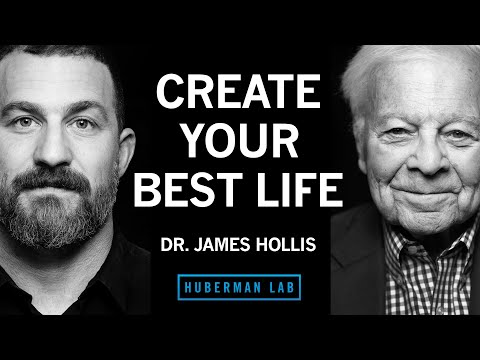
How to Find Your True Purpose & Create Your Best Life | Dr. James Hollis
Andrew Huberman (host), Dr. James Hollis (guest), Narrator
In this episode of Huberman Lab, featuring Andrew Huberman and Dr. James Hollis, How to Find Your True Purpose & Create Your Best Life | Dr. James Hollis explores discovering Soul’s Agenda: James Hollis On Purpose, Shadow, Mortality Andrew Huberman interviews Jungian analyst and author Dr. James Hollis about how to discover one’s true purpose, differentiate ego from Self, and live a more authentic life. Hollis explains how early family dynamics, cultural expectations, and unconscious complexes shape our “provisional” sense of self and often drive repetitive, self‑defeating patterns. He offers concrete practices—daily reflection, attending to dreams, honest dialogue with loved ones, and shadow work—to surface unconscious motives and align life choices with what the psyche (or soul) is actually asking of us. The conversation also explores relationship dynamics, masculinity and femininity, midlife depression, and how facing mortality can deepen meaning rather than simply evoke fear.
Discovering Soul’s Agenda: James Hollis On Purpose, Shadow, Mortality
Andrew Huberman interviews Jungian analyst and author Dr. James Hollis about how to discover one’s true purpose, differentiate ego from Self, and live a more authentic life. Hollis explains how early family dynamics, cultural expectations, and unconscious complexes shape our “provisional” sense of self and often drive repetitive, self‑defeating patterns. He offers concrete practices—daily reflection, attending to dreams, honest dialogue with loved ones, and shadow work—to surface unconscious motives and align life choices with what the psyche (or soul) is actually asking of us. The conversation also explores relationship dynamics, masculinity and femininity, midlife depression, and how facing mortality can deepen meaning rather than simply evoke fear.
Key Takeaways
Distinguish Between Ego Identity and the Deeper Self
Hollis differentiates the ego (our everyday, adaptive consciousness) from the Self (with a capital S), which he describes as an organic, instinct-driven, purposive center—the “acorn” seeking to become an oak. ...
Get the full analysis with uListen AI
Use Patterns and Symptoms as Maps to the Unconscious
We don’t wake up intending to repeat “the same stupid counterproductive things,” yet we do, because autonomous complexes—clusters of emotionally charged experience—get triggered and temporarily “possess” us. ...
Get the full analysis with uListen AI
Create Daily Space to Step Out of Stimulus–Response Mode
Modern life constantly pulls us into reaction—emails, social media, tasks—which drowns out the psyche’s commentary. ...
Get the full analysis with uListen AI
Ask What Your Soul Wants, Not Just What the World Wants
The first half of life is dominated by “What does the world want of me? ...
Get the full analysis with uListen AI
Treat Depression and Anxiety as Calls to Responsibility, Not Just Problems to Erase
Hollis reframes many depressions and anxieties as the psyche autonomously withdrawing support from a life path that is too narrow or inauthentic. ...
Get the full analysis with uListen AI
Own Your Shadow to Reduce Harm in Relationships and Society
The shadow contains all the human potentials we disown—envy, aggression, greed, as well as unlived talents and desires. ...
Get the full analysis with uListen AI
Choose the Path That Enlarges You, Even When It Costs You
At key forks in the road, Hollis suggests a simple but demanding test: “Does this choice enlarge me psycho‑spiritually, or does it diminish me? ...
Get the full analysis with uListen AI
Notable Quotes
“You’re not what happened to you. You’re what is wanting to express itself in the world through you.”
— James Hollis
“Psychopathology literally means the expression of the suffering of the soul. That seems to me obligatory to take seriously.”
— James Hollis
“The greatest burden the child must bear is the unlived life of the parent.”
— James Hollis (quoting Jung)
“Life is short. We’re here a very brief time, and the summons is to live your journey as honestly as you can.”
— James Hollis
“Ask of every major choice: does this path enlarge me or diminish me? Something in you knows the difference.”
— James Hollis
Questions Answered in This Episode
You describe depression as the psyche withdrawing support from our current life path; how can someone distinguish that kind of intrapsychic depression from a purely biochemical or situational depression that mainly calls for medical or environmental change?
Andrew Huberman interviews Jungian analyst and author Dr. ...
Get the full analysis with uListen AI
When working with dreams as guidance from the psyche, what concrete steps or questions do you recommend people use the morning after a vivid dream to extract its ‘point of view’ without getting lost in over-interpretation?
Get the full analysis with uListen AI
You argue that pathologizing is often the psyche’s protest against a life that’s too narrow—how do you respond to critics who might say this underplays severe mental illnesses like schizophrenia or bipolar disorder that have strong biological components?
Get the full analysis with uListen AI
In long-term relationships where one partner begins doing deep inner work and the other resists, what practical boundaries or experiments do you suggest to honor the soul’s agenda without simply blowing up the relationship?
Get the full analysis with uListen AI
You emphasize choosing the path that ‘enlarges’ us; can you give examples from your own life or clinical work where someone misjudged what would be enlarging, and how they later recalibrated their sense of what true enlargement meant?
Get the full analysis with uListen AI
Transcript Preview
Welcome to the Huberman Lab podcast, where we discuss science and science-based tools for everyday life. (instrumental music plays) I'm Andrew Huberman, and I'm a professor of neurobiology and ophthalmology at Stanford School of Medicine. My guest today is Dr. James Hollis. Dr. James Hollis is a Jungian psychoanalyst and author of more than 17 books about the self, relationships and how to create the best possible life. Some of the notable titles and topics of those books include Creating a Life: Finding Your Individual Path, as well as The Eden Project: In Search of the Magical Other, which, as the name suggests, is about relationships. He has also written about how to access our most resilient self in the book entitled Living Between Worlds: Finding Personal Resilience in Changing Times. During today's discussion, Dr. Hollis teaches us what questions we need to ask of ourselves on a regular basis in order to best understand who we really are and what we most desire at the level of vocation, romantic relationships, friendship, and family, and indeed, in relationship to life's journey. What you'll quickly realize during today's discussion with Dr. Hollis is that while, yes, he is trained as a Jungian psychoanalyst, he is also very firmly grounded in practical tools. That is, he teaches us the simple and yet practical tools that we can each and all apply on a daily basis in order to make sure that we are staying on our best path. We discuss how family dynamics that we grew up in, as well as trauma and attachment styles, combine with our unique gifts, and indeed our shadow side as well, in order to drive us down particular trajectories in life that sometimes lead us where we want to go, but other times lead us astray, and when they do, how to get back on track. Today's conversation with Dr. Hollis is truly a special one in that he rarely does podcast appearances. In fact, we traveled to him to record this podcast. That's how motivated I was to be able to sit down with him, because I'm familiar with his many books and his incredible teachings. But I really wanted to get his knowledge collected in one format, in one place. And what I can promise you is that by the end of today's podcast, you will be thinking differently about yourself, about the people in your life, and indeed, life itself. Before we begin, I'd like to emphasize that this podcast is separate from my teaching and research roles at Stanford. It is, however, part of my desire and effort to bring zero-cost-to-consumer information about science and science-related tools to the general public. In keeping with that theme, I'd like to thank the sponsors of today's podcast. Our first sponsor is Mateina. Mateina makes loose-leaf and ready-to-drink yerba mate. Now, I've long been a fan of yerba mate as a source of caffeine, in part because of its high antioxidant content, as well as its ability to elevate glucagon-like peptide 1, or GLP-1, which leads to a slight appetite suppressing effect, as well as its ability to regulate blood sugar and possible neuroprotective effects. I also just happen to love the way that yerba mate tastes. I'll sometimes drink it hot by pouring hot water over the loose-leaf yerba mate, and I'm particularly fond these days of drinking the zero-sugar cold brew Mateina yerba mate that I helped develop. Now, I realize that there are a lot of different brands of loose-leaf and canned and bottled yerba mate out there, but the reason I like Mateina the most is, first of all, it has absolutely the best taste of all of them. Secondly, they only use organic ingredients, and thirdly, because they offer low-sugar and zero-sugar varieties. If you'd like to try Mateina, you can go to drinkmateina.com/huberman. That's spelled drink M-A-T-E-I-N-a.com/huberman. Right now, Mateina is offering a free one-pound bag of loose-leaf yerba mate tea and free shipping with the purchase of two cases of their cold brew yerba mate. Again, that's drinkmateina.com/huberman. Today's episode is also brought to us by Joovv. Joovv makes medical-grade red light therapy devices. Now, if there's one thing that I've consistently emphasized on this podcast, it's the incredible impact that light, meaning photons, can have on our mental health and physical health. Red and near-infrared light has been shown to have profound effects on improving cellular health, which can help with faster muscle recovery, boosting healthier skin, reducing pain and inflammation, enhancing sleep, and much more. What sets Joovv apart is that it uses clinically effective wavelengths, emits a safe and effective dose of red and near-infrared light, and most importantly, offers the only true medical-grade red light panel available. I personally try to use the handheld Joovv Go unit, as it's called, every day, and especially when I'm on the road traveling. If you'd like to try Joovv, you can go to joovv.com/huberman. That's J-O-O-V-V.com/huberman. Joovv is offering an exclusive discount to Huberman Lab podcast listeners with up to $400 off Joovv products. Again, that's joovv.com/huberman. Today's episode is also brought to us by BetterHelp. BetterHelp offers professional therapy with a licensed therapist carried out online. Now, I've been going to therapy for well over 30 years. Initially, I didn't have a choice. It was a condition of being allowed to stay in school. But pretty soon I realized that therapy is extremely valuable. In fact, I consider doing regular therapy just as important as getting regular exercise, including cardiovascular exercise and resistance training, which of course I also do every week. The reason I know therapy is so valuable is that if you can find a therapist with whom you can develop a really good rapport, you not only get terrific support for some of the challenges in your life, but you also can derive tremendous insights from that therapy. Insights that can allow you to better not just your emotional life and your relationship life, but of course, also the relationship to yourself and to your professional life, to all sorts of career goals. In fact, I see therapy as one of the key components for meshing together all aspects of one's life and being able to really direct one's focus and attention toward what really matters. If you'd like to try BetterHelp, go to betterhelp.com/huberman to get 10% off your first month. Again, that's betterhelp.com/huberman. And now for my discussion with Dr. James Hollis. Dr. James Hollis, such a honor and a pleasure to sit down with you. I'm a huge fan of your writing and I'm excited to talk to you today.
Install uListen to search the full transcript and get AI-powered insights
Get Full TranscriptGet more from every podcast
AI summaries, searchable transcripts, and fact-checking. Free forever.
Add to Chrome