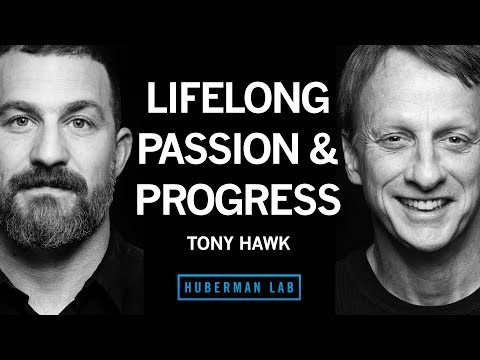
Harnessing Passion, Drive & Persistence for Lifelong Success | Tony Hawk
Andrew Huberman (host), Tony Hawk (guest), Narrator
In this episode of Huberman Lab, featuring Andrew Huberman and Tony Hawk, Harnessing Passion, Drive & Persistence for Lifelong Success | Tony Hawk explores tony Hawk Reveals How Relentless Progress Fuels Lifelong Skateboarding Mastery Andrew Huberman interviews Tony Hawk about the psychology, science, and lived experience behind a 40+ year career at the top of skateboarding. Hawk describes how obsession, late physical development, and relentless incremental progress shaped his path from bullied “nerd” to global icon. They dissect his return from a catastrophic femur break—including a forced surgical redo and disciplined recovery—to finally landing the same 540 that caused the injury. Throughout, Hawk emphasizes intrinsic motivation, deliberate practice, supportive but imperfect family dynamics, and his commitment to expanding skateboarding’s culture and infrastructure via his Skatepark Project foundation.
Tony Hawk Reveals How Relentless Progress Fuels Lifelong Skateboarding Mastery
Andrew Huberman interviews Tony Hawk about the psychology, science, and lived experience behind a 40+ year career at the top of skateboarding. Hawk describes how obsession, late physical development, and relentless incremental progress shaped his path from bullied “nerd” to global icon. They dissect his return from a catastrophic femur break—including a forced surgical redo and disciplined recovery—to finally landing the same 540 that caused the injury. Throughout, Hawk emphasizes intrinsic motivation, deliberate practice, supportive but imperfect family dynamics, and his commitment to expanding skateboarding’s culture and infrastructure via his Skatepark Project foundation.
Key Takeaways
Intrinsic obsession beats natural talent over the long run.
Hawk emphasizes he was not a natural; as a kid he was small, awkward, and often mocked for his unconventional “circus” tricks. ...
Get the full analysis with uListen AI
Break complex skills into known components, then recombine systematically.
For modern, hyper‑technical tricks, Hawk almost never “just hucks it. ...
Get the full analysis with uListen AI
Use small, early wins as a lifetime motivational template.
Hawk describes the first time he landed a simple backside varial below coping at Oasis Skatepark as the most important “buzz” of his career. ...
Get the full analysis with uListen AI
Recovery from major injury demands both humility and personal standards.
After breaking his femur on a low‑speed McTwist attempt, Hawk ignored medical timelines, pushed too early, and unknowingly created a non‑union fracture—his femur halves were drifting apart with each session. ...
Get the full analysis with uListen AI
Ritual, music, and environment can be engineered to unlock high‑risk performance.
For his comeback 540, Hawk treated the attempt like a mission: he adjusted diet, stopped drinking, and used sessions solely to reacquire the spin and spotting without intent to land. ...
Get the full analysis with uListen AI
Skateboarding’s culture thrives on multigenerational, peer‑to‑peer learning.
Hawk regularly shares sessions with top pros, teenagers, and a 10‑year‑old phenom, Reese Nelson. ...
Get the full analysis with uListen AI
Philanthropy and infrastructure turn a personal passion into social impact.
Through The Skatepark Project (skatepark. ...
Get the full analysis with uListen AI
Notable Quotes
“If you saw me skate when I first started, there’s no way you’d think I was natural or had any future in it.”
— Tony Hawk
“That first backside varial below coping—I’ve been chasing that exact feeling ever since.”
— Tony Hawk
“I fucked around and found out. I did a McTwist with no speed like I was still 20—and broke my femur.”
— Tony Hawk
“I hate that it means that much to me, but I had to get back to 540s. I just had to do it.”
— Tony Hawk
“Everything I’m doing now is kind of just gravy. I can’t believe I still ride my skateboard as a career at 55.”
— Tony Hawk
Questions Answered in This Episode
You described that first backside varial below coping as the ‘buzz’ you’ve chased your whole life. If you could design a training protocol to reliably give young skaters that same feeling early on, what would it look like in terms of tricks, environment, and coaching?
Andrew Huberman interviews Tony Hawk about the psychology, science, and lived experience behind a 40+ year career at the top of skateboarding. ...
Get the full analysis with uListen AI
When you realized your femur was a non‑union and that your own impatience had made it worse, what specific mental tools or self‑talk did you use to stay disciplined during the second, stricter recovery—especially in those two months of near total rest?
Get the full analysis with uListen AI
You mentioned that some tricks you’ve only ever landed once are too technically demanding to repeat consistently. If contest formats changed to reward ‘one‑off’ creativity over consistency, how do you think it would change how pros train and what kind of tricks we’d see?
Get the full analysis with uListen AI
Given your experience declining the $500,000 buyout on Pro Skater royalties, how do you now advise younger skaters to think about long‑term equity versus upfront money when negotiating with brands, game studios, or streaming platforms?
Get the full analysis with uListen AI
You’ve seen skateboarding evolve from a bullied subculture to an Olympic sport with corporate backing and parents pushing kids into it. What concrete safeguards or cultural practices do you think the skate community needs to adopt to prevent over‑coaching, burnout, or loss of the DIY spirit that made skating unique in the first place?
Get the full analysis with uListen AI
Transcript Preview
Welcome to the Huberman Lab Podcast, where we discuss science and science-based tools for everyday life. I'm Andrew Huberman, and I'm a professor of neurobiology and ophthalmology at Stanford School of Medicine. Today, my guest is Tony Hawk. Tony Hawk is one of the most celebrated and accomplished professional skateboarders of all time. For more than 40 years, he has been at the forefront of the sport. And I don't mean just doing a sport for more than 40 years. I truly mean he has been at the forefront of skateboarding, developing new maneuvers, AKA tricks, that include incredible feats like the 900, a 900-degree spin in the air, as well as numerous other maneuvers that have really pushed the entire sport forward. He's also completely popularized the sport through his video game and through his ambassadorship for skateboarding. In fact, few, if any, names are as synonymous with skateboarding in the general public as Tony Hawk. And he is, oh, so deserved of that title because for more than 40 years he has shown up as the consummate professional. He is kind, he is respectful, and he is completely committed to his craft, and that shows up in every aspect of his life. He still, to this day, skateboards daily and as you'll soon learn, he recently suffered a major injury, a complete break of his femur. That is the bone in his upper leg, and this is what many people would consider a career-ending injury. Not only did Tony come back from that injury, but he went back to the very trick on which he broke his femur and recently completed that trick. That is a 540 or so-called McTwist. I mention this because at every level of his life, Tony has demonstrated himself to be somebody with incredible drive, incredible vision, and incredible persistence. And today we talk about that drive, vision, and persistence, and we talk about what it takes to set a goal and to continually evolve one's goal and to continually progress as a basically young pre-teen, as a teenager, as a young adult, as an adult and, well, let's face it, as a 55-year-old man. He is now hitting a little bit past middle age, although we do hope that he lives forever. Tony Hawk, AKA The Birdman, really does seem to be superhuman. But as you'll learn today, he is, oh, so human in the way that he shares his own experience and shares with you the ways in which we can each and all look at what we do and think about what we want to achieve and put our minds and our bodies to those goals and achieve them. I confess that today's discussion with Tony Hawk was a particularly thrilling one for me to have. I grew up in the sport of skateboarding. So I had met Tony previously, although he doesn't remember it. That was many years ago. In fact, I met his parents. You'll learn more about that story, uh, during today's episode. But I was aware, of course, of Tony's accomplishments. I was also aware of his philanthropy. So he has a skate park foundation. I also listened to his podcast with another professional skateboarder, Jason Ellis, called Hawk Versus Wolf. We provided a link to that podcast in the show note captions as well. But never before have I had the opportunity to sit down and talk to the Tony Hawk and learn from him. So I was absolutely delighted to have this conversation and it far exceeded my already lofty expectations. Before we begin, I'd like to emphasize that this podcast is separate from my teaching and research roles at Stanford. It is, however, part of my desire and effort to bring zero cost to consumer information about science and science-related tools to the general public. In keeping with that theme, I'd like to thank the sponsors of today's podcast. Our first sponsor is LMNT. LMNT is an electrolyte drink that has everything you need and nothing you don't. That means plenty of electrolytes, sodium, magnesium, and potassium, but no sugar. The electrolytes and hydration are absolutely key for mental health, physical health, and performance. Even a slight degree of dehydration can impair our ability to think, our energy levels, and our physical performance. LMNT makes it very easy to achieve proper hydration, and it does so by including the three electrolytes in the exact ratios they need to be present. I drink LMNT first thing in the morning when I wake up. I usually mix it with about 16 to 32 ounces of water. If I'm exercising, I'll drink one while I'm exercising, and I tend to drink one after exercising as well. Now, many people are scared off by the idea of ingesting sodium because obviously we don't want to consume sodium in excess. However, for people that have normal blood pressure, and especially for people that are consuming very clean diets, that is, consuming not so many processed foods or highly processed foods, oftentimes we are not getting enough sodium, magnesium, and potassium, and we can suffer as a consequence. And with LMNT, simply by mixing with water, it tastes delicious, it's very easy to get that proper hydration. If you'd like to try LMNT, you can go to DrinkLMNT, that's L-M-N-T.com/huberman to claim a free LMNT sample pack with your purchase. Again, that's Drink LMNT, L-M-N-T.com/huberman. Today's episode is also brought to us by ROKA. ROKA makes eyeglasses and sunglasses that are of the absolute highest quality. I've spent a lifetime working on the biology of the visual system and I can tell you that your visual system has to contend with an enormous number of challenges in order for you to be able to see clearly. ROKA understands this and has developed their eyeglasses and sunglasses so that you always see with perfect clarity. In addition, they are extremely lightweight and they won't slip off your face if you get sweaty. Indeed, ROKA eyeglasses and sunglasses were initially designed for performance in sports, but now they include aesthetics and styles that are really designed to be worn anytime. I, for instance, wear readers at night. I'll sometimes wear sunglasses during the day when I drive and of course, I do not wear sunglasses when I do my morning sunlight viewing, which I highly recommend everyone do their morning sunlight viewing. If you'd like to try ROKA eyeglasses or sunglasses, you can go to ROKA, that's R-O-K-A.com and enter the code Huberman to save 20% off your first order. Again, that's ROKA, R-O-K-A.com and enter the code Huberman at checkout. And now for my discussion with Tony Hawk. Tony Hawk, welcome.
Install uListen to search the full transcript and get AI-powered insights
Get Full TranscriptGet more from every podcast
AI summaries, searchable transcripts, and fact-checking. Free forever.
Add to Chrome