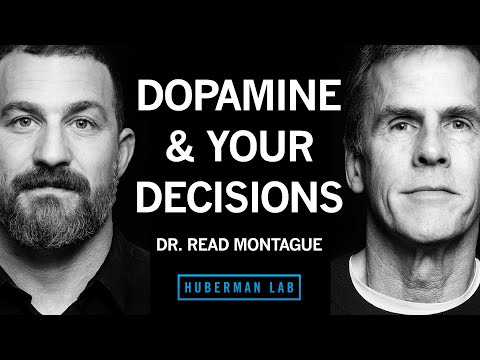
How Dopamine & Serotonin Shape Decisions, Motivation & Learning | Dr. Read Montague
Dr. Read Montague (guest), Andrew Huberman (host)
In this episode of Huberman Lab, featuring Dr. Read Montague and Andrew Huberman, How Dopamine & Serotonin Shape Decisions, Motivation & Learning | Dr. Read Montague explores dopamine and serotonin as learning signals shaping motivation and behavior The conversation reframes dopamine away from “pleasure” toward a computational learning signal that updates expectations continuously, not just at reward receipt.
Dopamine and serotonin as learning signals shaping motivation and behavior
The conversation reframes dopamine away from “pleasure” toward a computational learning signal that updates expectations continuously, not just at reward receipt.
Montague emphasizes temporal-difference reinforcement learning: dopamine tracks differences between successive predictions across long stretches of “no reward,” like foraging, dating, and long projects.
They discuss tonic (baseline) vs phasic (rapid) dopamine, how disrupted dopamine signaling contributes to Parkinson’s, and how “explorer vs exploiter” modes relate to ADHD-like behavior and modern short-form media.
Serotonin is presented as largely opponent to dopamine in human recordings, with implications for waiting, aversive learning, SSRIs, and why measuring neuromodulators in humans (brain surgery and nasal probes) could transform psychiatry and personalized training.
Key Takeaways
Dopamine is primarily a learning signal, not a pleasure meter.
Montague argues the strongest evidence supports dopamine fluctuations as part of a reinforcement-learning rule that updates behavior based on prediction errors; subjective “feeling good” can dissociate from dopamine changes.
Get the full analysis with uListen AI
The popular “expectation vs reward” story is incomplete.
In real life there are long stretches without explicit feedback; dopamine often reflects the difference between your current expectation and your next expectation (temporal-difference errors), enabling learning across chains of events.
Get the full analysis with uListen AI
Foraging is a better metaphor than “rewards at the finish line.”
Humans (and animals) constantly move through uncertain environments—dating, careers, investing attention online—where dopamine helps maintain forward drive by updating expectations step-by-step.
Get the full analysis with uListen AI
Baseline (tonic) dopamine sets the stage for motivation and action selection.
Phasic “spikes” ride on top of a slower baseline; when baseline signaling collapses (e. ...
Get the full analysis with uListen AI
Attention may toggle between explorer and exploiter modes—within and across individuals.
Using bee analogies, Montague describes a spectrum where some states/people explore broadly (distractible, novelty-seeking) while others exploit known paths (task-focused); both modes can be adaptive depending on context.
Get the full analysis with uListen AI
Short-form, rapid-switch media may “train the explorer muscle.”
While human evidence is not definitive, the concern is that constant fast updating strengthens rapid-context switching at the expense of sustained goal pursuit—similar to overtraining an artificial agent on the wrong objective mix.
Get the full analysis with uListen AI
Serotonin and dopamine often act as opponent signals in humans.
Montague reports subsecond human recordings showing that dopamine rises when serotonin falls (and vice versa), consistent with opponency themes across sensory systems and with rodent work suggesting opponency is required for learning.
Get the full analysis with uListen AI
SSRIs may blunt reward partly by rerouting serotonin into dopamine terminals.
He cites evidence that when serotonin reuptake is blocked, serotonin can be taken up by dopamine transporters, potentially reducing rewarding impact at “dopamine synapses” and complicating simplistic ‘more serotonin = better mood’ narratives.
Get the full analysis with uListen AI
State (e.g., hunger/stress) can flip what dopamine encodes.
In extreme hunger/emergency states, rodent work suggests dopamine can switch toward aversive/punishment prediction errors, prioritizing survival and avoidance learning over reward pursuit.
Get the full analysis with uListen AI
Breathing and neuromodulators appear tightly coupled—especially during simple breathing.
Early data described show dopamine/norepinephrine rhythms tracking inhale–exhale cycles, while instructed breathing introduces cognitive-control demands that disrupt clean coupling; this may connect physiology, attention, and learning updates.
Get the full analysis with uListen AI
Measuring dopamine/serotonin in real time could change mental health and training.
Montague’s DBS-surgery recordings and Zelano-inspired nasal probes suggest a path toward minimally invasive monitoring in healthy people, enabling personalized concentration/learning interventions and better characterization of psychiatric heterogeneity.
Get the full analysis with uListen AI
Notable Quotes
“If any goal that you achieved… if that was enough for you right then… you wouldn’t keep living.”
— Dr. Read Montague
“It’s not just expectation and outcome, it’s expectation, next expectation, current outcome.”
— Dr. Read Montague
“You’ve got multiple bees inside your head.”
— Dr. Read Montague
“Dopamine equals pleasure… is not true.”
— Dr. Read Montague
“Science is a contact sport.”
— Dr. Read Montague
Questions Answered in This Episode
Can you illustrate temporal-difference learning with one concrete “ordinary life” sequence (e.g., job search) and map where dopamine prediction errors occur before any final outcome?
The conversation reframes dopamine away from “pleasure” toward a computational learning signal that updates expectations continuously, not just at reward receipt.
Get the full analysis with uListen AI
What specific neural mechanism sets and stores “expectations” in the first place—what brain circuits provide the value predictions that dopamine then updates?
Montague emphasizes temporal-difference reinforcement learning: dopamine tracks differences between successive predictions across long stretches of “no reward,” like foraging, dating, and long projects.
Get the full analysis with uListen AI
In your human recordings, does serotonin look more like ‘negative valence’ or more like ‘active waiting/inhibition,’ and how can experiments distinguish those functions?
They discuss tonic (baseline) vs phasic (rapid) dopamine, how disrupted dopamine signaling contributes to Parkinson’s, and how “explorer vs exploiter” modes relate to ADHD-like behavior and modern short-form media.
Get the full analysis with uListen AI
If SSRIs push serotonin into dopamine terminals, what would be the cleanest human experiment to test whether this causes emotional blunting vs improved stress tolerance?
Serotonin is presented as largely opponent to dopamine in human recordings, with implications for waiting, aversive learning, SSRIs, and why measuring neuromodulators in humans (brain surgery and nasal probes) could transform psychiatry and personalized training.
Get the full analysis with uListen AI
How do tonic dopamine changes differ from phasic changes in terms of subjective experience—can someone feel ‘motivated’ with low phasic signaling if tonic levels are high (or vice versa)?
Get the full analysis with uListen AI
Transcript Preview
If any goal that you achieved, whatever it is, taking a drug, eating a food, um, getting a, a partner or whatnot, um, if that was enough for you right then, you wouldn't keep living. You want that system to keep tracking, and once it gets to one place, you want it to have another place to which it could go, otherwise you wouldn't live. [upbeat music]
Welcome to the Huberman Lab Podcast, where we discuss science and science-based tools for everyday life. I'm Andrew Huberman, and I'm a professor of neurobiology and ophthalmology at Stanford School of Medicine. My guest today is Dr. Read Montague. Dr. Read Montague is the director of the Center for Human Neuroscience Research at Virginia Tech. He is also an expert in the science of motivation, decision-making, and learning, and a pioneer in developing methods to directly measure levels of dopamine and other neuromodulators in humans in real time. Today, you'll learn how dopamine really works, not just to regulate your levels of motivation, we've all heard that before, but also to teach you things. Dopamine is involved in learning, as well as persistence or lack of persistence. As Read will teach you, most of what we hear and know about dopamine is based on the idea that dopamine levels go up or down, depending on our levels of expectations and then what happens. But as he explains, most aspects of life, work, school, relationships, our pursuit of money, et cetera, involve multiple milestones. We work, we wait, then we get an outcome that in turn informs the thing we do next. Or maybe dopamine arrives suddenly with no work involved at all. In other words, dopamine levels are constantly changing, and that shapes not just what you do now, but how you think about your recent past and what you will do next. So when we say dopamine is involved in learning, today you are going to realize that dopamine is teaching you how to adjust your behavior. We, of course, discuss how this knowledge can be leveraged for better motivation and decision-making, even better social interactions, and we also discuss serotonin and how dopamine and serotonin work in sort of seesaw fashion, and how serotonin, in particular, teaches you about unwanted outcomes. We also have a discussion about SSRIs that you're going to find fascinating. As Read points out, SSRIs increase levels of serotonin, but often that serotonin gets used at the dopamine synapses to reduce the rewarding properties of dopamine. So today's discussion about dopamine and serotonin is going to be vastly different than any that you've heard or read about elsewhere. You're going to learn how those neuromodulators work, and you're going to learn how they impact your everyday life and decision-making. As we all know, discussions about dopamine and serotonin are everywhere nowadays, but in today's episode, you're going to learn from a top expert in the field what these molecules truly do, and that's going to help you better leverage your efforts, introduce what we call deliberate delays, and how to use tools like AI to improve your levels of motivation and your ability to learn through neuroplasticity. Before we begin, I'd like to emphasize that this podcast is separate from my teaching and research roles at Stanford. It is, however, part of my desire and effort to bring zero cost to consumer information about science and science-related tools to the general public. In keeping with that theme, today's episode does include sponsors. And now for my discussion with Dr. Read Montague. Dr. Read Montague, great to see you after all these fifteen years.
Install uListen to search the full transcript and get AI-powered insights
Get Full TranscriptGet more from every podcast
AI summaries, searchable transcripts, and fact-checking. Free forever.
Add to Chrome