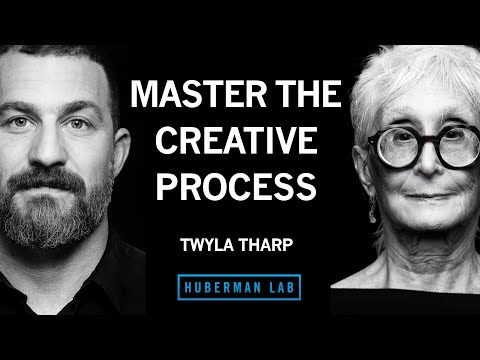
Master the Creative Process | Twyla Tharp
Andrew Huberman (host), Twyla Tharp (guest)
In this episode of Huberman Lab, featuring Andrew Huberman and Twyla Tharp, Master the Creative Process | Twyla Tharp explores twyla Tharp Reveals Relentless Discipline Behind World-Class Creative Mastery Andrew Huberman interviews legendary choreographer Twyla Tharp about the real mechanics of a creative life—discipline, physical rigor, and clear intention over inspiration or ritual. Tharp explains the idea of a “spine” in any work: a central focus that organizes everything else and prevents creative drift. They explore how movement functions as a primary language, how bodily practice shapes thinking, and why self-imposed standards and long-term practice matter more than external validation. The conversation also covers aging, sustaining excellence over 60+ years of work, and how to keep pushing against fear and contraction as the body changes.
Twyla Tharp Reveals Relentless Discipline Behind World-Class Creative Mastery
Andrew Huberman interviews legendary choreographer Twyla Tharp about the real mechanics of a creative life—discipline, physical rigor, and clear intention over inspiration or ritual. Tharp explains the idea of a “spine” in any work: a central focus that organizes everything else and prevents creative drift. They explore how movement functions as a primary language, how bodily practice shapes thinking, and why self-imposed standards and long-term practice matter more than external validation. The conversation also covers aging, sustaining excellence over 60+ years of work, and how to keep pushing against fear and contraction as the body changes.
Key Takeaways
Treat discipline as reality, not ritual or motivation-based.
Tharp dismisses the idea of enjoying her 5 a. ...
Get the full analysis with uListen AI
Every serious creative project needs a clear “spine.”
The spine is the central organizing idea that all decisions must pass through—like a single main conclusion in a scientific paper or the hidden solution in a mystery novel. ...
Get the full analysis with uListen AI
Start with schedule and constraints, then let the work emerge.
Tharp insists that creativity begins with concrete logistics—time, place, who’s there, what they bring—rather than inspiration. ...
Get the full analysis with uListen AI
Practice failing in private—but focus on “useful,” not “good or bad.”
In rehearsal, Tharp doesn’t label attempts as failures; she asks whether they generate a new question or direction. ...
Get the full analysis with uListen AI
Respect the body’s intelligence and train fundamentals first.
Classical ballet technique, especially barre work, is a centuries-refined map for organizing the body around center and alignment. ...
Get the full analysis with uListen AI
Success is harder to follow than failure; reset your orientation.
After a highly successful 60th-anniversary tour, Tharp found it harder to decide “now what? ...
Get the full analysis with uListen AI
As you age, keep moving and keep seeking friction—without denial.
Tharp describes each decade as a different body with different limits; by 80, restriction is undeniable. ...
Get the full analysis with uListen AI
Notable Quotes
“If you don’t work when you don’t want to work, you’re not going to be able to work when you do want to work.”
— Twyla Tharp
“Spine means focus. Spine means concentration… until you know where you are grounded, you’re at sea.”
— Twyla Tharp
“You can’t just throw things off. They’ve got to be set before you can throw them off.”
— Twyla Tharp
“The more you know, the bigger your challenge.”
— Twyla Tharp
“We can’t make life totally nice. It is partially what it is. Choose something else.”
— Twyla Tharp
Questions Answered in This Episode
How can I identify the true “spine” of my own project before I start, and how do I know if I’ve chosen it well?
Andrew Huberman interviews legendary choreographer Twyla Tharp about the real mechanics of a creative life—discipline, physical rigor, and clear intention over inspiration or ritual. ...
Get the full analysis with uListen AI
What practical steps can I take to build Tharp-level discipline if I’ve relied on motivation and feelings up to now?
Get the full analysis with uListen AI
In my field, what is the equivalent of Tharp’s ballet barre—foundational training that I should master before trying to innovate?
Get the full analysis with uListen AI
How can I keep my creative work centered on internal standards and love of the craft while still using audience feedback and metrics constructively?
Get the full analysis with uListen AI
As my body and circumstances change with age, what concrete adjustments can I make to keep pushing against meaningful friction instead of slowly withdrawing?
Get the full analysis with uListen AI
Transcript Preview
You have a reputation for having risen early and gotten to the gym by 5:00 AM for two hours, day in after day out. Tell us about that ritual, and, uh, do you still enjoy it?
It's not a ritual, and I never enjoyed it. It's a reality, and, uh, you do it because you need an instrument that you can challenge. Just set the mechanism for the day you're gonna have to do it. It's kind of boring, and it's kind of loathsome.
Could you give us a bit of insight into your inner dialogue around days when you don't want to go? Is there a self-talk, or have you learned to push aside the, the voice that says, "Maybe not today"?
It's simple. I- if you don't work when you don't wanna work, you're not gonna be able to work when you do wanna work.
Welcome to the Huberman Lab Podcast, where we discuss science and science-based tools for everyday life. I'm Andrew Huberman, and I'm a professor of neurobiology and ophthalmology at Stanford School of Medicine. My guest today is Twyla Tharp. Twyla Tharp is a world-renowned dancer and choreographer. Her onstage and film works easily place her not just in the top 1% of all choreographers of all time, but also among the top tier of all creative artists past and present. I knew I wanted to host Twyla on this podcast after listening to her book, The Creative Habit, where she spells out how to build a schedule, habits, and routines that make your best creative expressions come to life. What I love about it is it's direct and it's action-oriented. There's nothing mystical about it. She explains in her book how even for people that have just one hour a day to write or sing or draw or paint or whatever to get the most from that time in terms of creative output. Then as I learned more about her, I was also super impressed that even in her 60s, by the way she's 84 now, she could deadlift more than 200 pounds, which is more than twice her body weight, bench-press her body weight for three clean repetitions, and was taking up boxing to keep her movement and reflexes sharp. As you'll see today, she is a phenom, and it comes by way of hard work. She is still in the gym every single morning at 5:00 AM for two full hours. Today we discuss how to build self-discipline in and around your creative mind, and we discuss movement as a language. There's this new idea emerging in neuroscience that bodily movement, then music, and then speech is how humans came to communicate with each other. We discuss that and how movement can help us process and explain our emotions and our ideas. We also discuss Twyla's life growing up on a farm and how that shaped her mindset about work and community, and we also talk about what it means to have and express your unique creativity and how to evolve your sense of taste. Oh yeah, and we also discuss telepathy. You'll notice the rapport between Twyla and I is very different than is typical for other Huberman Lab Podcasts I've done. She is a real firecracker, and we had a ton of fun exploring and challenging ideas, mostly her challenging me. It was a true honor and pleasure to learn from such a virtuoso of the arts and frankly of life, and as you'll soon learn, we can all learn a lot from Twyla. Before we begin, I'd like to emphasize that this podcast is separate from my teaching and research roles at Stanford. It is, however, part of my desire and effort to bring zero-cost-to-consumer information about science and science-related tools to the general public. In keeping with that theme, today's episode does include sponsors. And now for my discussion with Twyla Tharp. Twyla Tharp, welcome.
Install uListen to search the full transcript and get AI-powered insights
Get Full TranscriptGet more from every podcast
AI summaries, searchable transcripts, and fact-checking. Free forever.
Add to Chrome