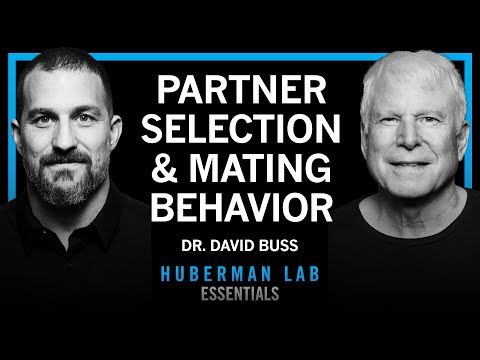
Essentials: How Humans Select & Keep Romantic Partners in the Short & Long Term | Dr. David Buss
Andrew Huberman (host), Dr. David Buss (guest)
In this episode of Huberman Lab, featuring Andrew Huberman and Dr. David Buss, Essentials: How Humans Select & Keep Romantic Partners in the Short & Long Term | Dr. David Buss explores evolutionary Secrets Behind How Humans Choose, Keep, And Lose Partners Andrew Huberman and evolutionary psychologist Dr. David Buss discuss how Darwin’s theory of sexual selection explains modern human mate choice, from first attraction through long‑term partnership and breakup. They outline universal traits both sexes value, key sex differences in preferences, and how context shifts what people seek in short‑term versus long‑term relationships.
Evolutionary Secrets Behind How Humans Choose, Keep, And Lose Partners
Andrew Huberman and evolutionary psychologist Dr. David Buss discuss how Darwin’s theory of sexual selection explains modern human mate choice, from first attraction through long‑term partnership and breakup. They outline universal traits both sexes value, key sex differences in preferences, and how context shifts what people seek in short‑term versus long‑term relationships.
Buss details how deception, online dating dynamics, jealousy, stalking, and dark‑triad personality traits shape real-world mating behavior, including its darker outcomes such as coercion and intimate partner violence. He also explains mate value—how people assess their own and others’ desirability—and how discrepancies drive jealousy, breakups, and sometimes violence.
The conversation closes with reflections on attachment styles, how accurately people judge their own mate value, and how evolutionary psychology and neuroscience can integrate. Buss recommends his books for deeper dives into mating strategies and sexual conflict.
Key Takeaways
Long‑term and short‑term mating trigger different preference profiles in both sexes.
For long‑term partners, both men and women universally value intelligence, kindness, mutual attraction and love, good health, dependability, and emotional stability (with women emphasizing stability slightly more). ...
Get the full analysis with uListen AI
Sex differences in preferences largely reflect asymmetric reproductive costs.
Women more strongly prioritize a partner’s earning capacity, ambition, status, and especially his resource trajectory, because pregnancy and childrearing impose higher biological and opportunity costs on them. ...
Get the full analysis with uListen AI
Social context and mate choice copying powerfully influence women’s attraction.
Women track the “attention structure”—who gets attention and desire from others—as a status cue, and use mate choice copying: the same man is judged more attractive when seen paired with attractive women or surrounded by female interest (e. ...
Get the full analysis with uListen AI
Deception in mating is systematic and often maps onto the other sex’s preferences.
In online dating, both sexes commonly misrepresent age, appearance, or qualities that they believe the target finds attractive, using flattering photos and curated profiles. ...
Get the full analysis with uListen AI
Jealousy is an evolved mate‑guarding system that ranges from vigilance to violence.
Once long‑term pair bonds exist, jealousy functions to protect one’s investment in a relationship. ...
Get the full analysis with uListen AI
Dark triad traits combined with short‑term strategies are especially dangerous.
Individuals high in narcissism, Machiavellianism, and psychopathy—traits more common in men—tend to be charming, skilled at seduction, sexually deceptive, and more likely to be serial harassers and coercers. ...
Get the full analysis with uListen AI
Mate value is partly consensual, partly idiosyncratic, and people are usually decent judges of their own.
Self-esteem appears to track changes in mate value—rising with promotions and social success, falling with rejection or job loss. ...
Get the full analysis with uListen AI
Notable Quotes
“The preferences of one sex basically set the ground rules for competition in the opposite sex.”
— Dr. David Buss
“It’s not just that men are these superficial creatures who evaluate women on the basis of appearance. There’s an underlying logic to why they do so.”
— Dr. David Buss
“One form of deception which we haven’t mentioned is deception about whether you’re interested in a long-term committed relationship or a short-term hookup.”
— Dr. David Buss
“Jealousy is an evolved emotion that serves several adaptive functions… jealousy serves this mate guarding function, if you will.”
— Dr. David Buss
“People do things that I say range from vigilance to violence.”
— Dr. David Buss
Questions Answered in This Episode
How can someone practically distinguish between a high‑dark‑triad ‘charming seducer’ and a genuinely confident, charismatic partner early in dating?
Andrew Huberman and evolutionary psychologist Dr. ...
Get the full analysis with uListen AI
Given women’s strong use of mate choice copying, what strategies would you recommend to avoid overvaluing a partner simply because many others seem to want them (e.g., celebrities, high‑status figures)?
Buss details how deception, online dating dynamics, jealousy, stalking, and dark‑triad personality traits shape real-world mating behavior, including its darker outcomes such as coercion and intimate partner violence. ...
Get the full analysis with uListen AI
You mentioned that men often misrepresent long‑term interest to obtain short‑term sex; what specific cues or patterns have your studies found that help women detect this particular form of deception?
The conversation closes with reflections on attachment styles, how accurately people judge their own mate value, and how evolutionary psychology and neuroscience can integrate. ...
Get the full analysis with uListen AI
How should couples consciously manage emerging mate value discrepancies—such as one partner’s career suddenly taking off—to minimize the risk of jealousy, infidelity, or relationship dissolution?
Get the full analysis with uListen AI
Attachment theory often emphasizes early caregiving, while your framework highlights evolved mating mechanisms; where do you think these perspectives most sharply conflict, and how might future research reconcile them?
Get the full analysis with uListen AI
Transcript Preview
Welcome to Huberman Lab Essentials, where we revisit past episodes for the most potent and actionable science-based tools for mental health, physical health, and performance. I'm Andrew Huberman, and I'm a professor of neurobiology and ophthalmology at Stanford School of Medicine. And now, my conversation with Dr. David Buss. Well, David, delighted to be here. Excited to ask you a number of questions about these super interesting topics about how people select mates. Just to start off, um, perhaps you could just orient us a little bit, uh, about mate choice, you know, some of the primary criteria that studies show men and women use in order to select mates, transient mates as well as, um, lifetime mates.
Right. Well, that's a critical distinction, because what people look for in a long-term committed mateship like a marriage partner or a long-term romantic relationship is different from what people look for in a hookup or casual sex. So that's actually critical. I wonder if we could maybe just back up a second and just talk a little bit about the theoretical framework for understanding mate choice.
Sure.
It basically stems from Darwin's theory of sexual selection. Darwin noticed that there were phenomena that couldn't be explained by the so-called survival selection, so he came up with the theory of sexual selection, which deals not with the evolution of characteristics due to their survival advantage, but rather due to their mating advantage. And he identified two causal processes by which mating advantage could occur. One is intrasexual competition, and the logic was whatever qualities led to success in these same-sex battles, those qualities get passed on in greater numbers, and so you see evolution, which is change over time, and increase in frequency of the characteristics associated with winning these, what Darwin called contest competition. And we know that the logic of that is more general now, and involves things like in our species competing for position and status hierarchies. But the second most relevant to your question about mate choice is preferential mate choice. That was the second causal pathway, and the logic there is that if members of one sex agree with one another about the qualities that are desired, then those of the opposite sex who possess the desired qualities or embody those desired qualities, they have a mating advantage. Those lacking desired qualities get banished, shunned, ignored, or in the modern environment become incels. The logic there is very simple but also very powerful, and that is that, uh, whatever qualities are desired, consensually desired, if there's some heritable basis to those, then those increase in frequency over time. And, and in, in the human case, these two causal processes of sexual selection are related to each other in that the preferences of, the mate preferences of one sex basically set the ground rules for competition in the opposite sex. So, if for example, hypothetically women, uh, preferred to mate with men who were able and willing to devote resources to them, then that would create competition am- among men to claw their way, you know, and beat out other men in resource acquisition, and then displaying that, their willingness to commit that to a particular woman. So, that's sort of a little bit of theoretical backdrop. Uh, so you asked, well, what are the qualities that men and women desire? And maybe we'll start with, uh, long-term mating and then shift to short-term mating. The most large-scale study that's been done on this is a study that I did a while back of 37 different cultures, and it's now been replicated by other researchers, but basically what we found is three clusters of things. We found qualities that both men and women wanted in a long-term mate. We found some qualities that were sex differentiated, where women preferred them more than men or men preferred them more than women, and then we found some attributes that were highly variable across cultures in whether people found these as desirable or indispensable or irrelevant. So if you talk about universal desires, so things that men and women share, things like intelligence, uh, kindness, uh, mutual attraction and love, uh, good health, dependability, emotional stability, although there's a bit of a sex difference there with women preferring it a bit more than men. So you go to anywhere in the world, and these are qualities that people universally desire in long-term mates. Sex differences. So, sex differences basically fall into two clusters. So, women more than men prioritized good earning capacity, um, slightly older age, uh, and the qualities associated with resource acquisition. So the- these are things like a man's social status. Uh, does he have drive? Is he ambitious? Um, uh, i- does he have a good long-term resource trajectory is one way that I like to phrase it, because women often they don't look at necessarily, um, uh, the resources that a guy possesses at this moment, but what is his trajectory? Women attend to the attention structure. So, um, the attention structure is a key determinant of status. So those people who are high in status are those to whom the most people pay the most attention. Hard work, ambition. Does he have clear goals or is he in an existential crisis not knowing what he's going to do with his life? Also, women use, uh, what's called in the literature mate choice copying. So we've done studies where you just take a guy, photograph him alone, uh, versus take the same guy, put an attractive woman next to him or put two women next to him, and women judge exactly the same guy to be much more attractive if there's, if there were, he's paired with women. From an evolutionary perspective, it's reasonable that women would prioritize these qualities because of the...... tremendous asymmetry in our reproductive biology, namely that fertilization occurs internally within women. Women bear the, the burdens of the nine-month pregnancy, which is metabolically expensive, as well as creating opportunity costs, in terms of mobility and, and solving other tasks that people need to solve in the course of their lives. And so, uh, one way to phrase that is that the costs of making a bad mate choice are much heavier for women when it comes to sexual behavior, certainly, uh, because, um, it, uh ... and the, the benefits correspondingly of making a wise mate choice are higher for women in the sexual context. Um, but as I said, we have mu- mutual mate choice in our species, and so what do men value more than women? Uh, physical attractiveness. So physical appearance provides a wealth of information about a person's health status, but also provides, for men, a wealth of information about a woman's fertility, uh, her reproductive value. Now, not that men think about that consciously. I mean, men don't walk down the street and see a woman and say, "Oh, I find her attractive because I think she must be very fertile." They just find those cues attractive. We know now based on the last 20 years of scientific, uh, studies that the cues that men find attractive in women are not at all arbitrary. Things like clear skin, clear eyes, symmetrical features, uh, a, a low waist to hip ratio, uh, uh, full lips, um, lustrous hair, all these are qualities that are associated with youth and health, and hence have, have evolved to be part of our standards of attractiveness. And so it's not just that men are these superficial creatures who evaluate women on the basis of appearance. There's- there's an underlying logic to why they do so. Um, and as I said, relative youth, this, this age thing is one of the largest sex differences you find in long-term mate selection, with women preferring somewhat older men and men preferring somewhat younger women. It's also expressed in preferences. So, say a 25-year-old man would, say, prefer a woman who's 20 or in her early 20s. A 35-year-old man might prefer a woman who's in her late 20s or early 30s. A 50-year-old man might prefer a woman who's say 35 to 38. So marriage and long-term mating are, uh, things other than reproductive unions in the modern environment, and if you get too large an age gap, then essentially you're in different cultures. And if the cultural gap gets too large, you don't understand each other.
Install uListen to search the full transcript and get AI-powered insights
Get Full TranscriptGet more from every podcast
AI summaries, searchable transcripts, and fact-checking. Free forever.
Add to Chrome