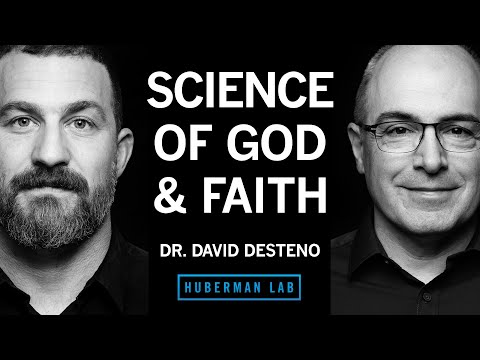
Science & Health Benefits of Belief in God & Religion | Dr. David DeSteno
Andrew Huberman (host), Dr. David DeSteno (guest), Narrator
In this episode of Huberman Lab, featuring Andrew Huberman and Dr. David DeSteno, Science & Health Benefits of Belief in God & Religion | Dr. David DeSteno explores science Reveals Powerful Health Benefits Of Faith, Ritual, And Prayer Andrew Huberman and psychologist David DeSteno explore whether belief in God and religious practice are compatible with science, concluding that God's existence is scientifically untestable but that the effects of religion on humans are very testable. Longitudinal and lab data show that religious engagement—especially communal practice, formal prayer, and ritual—robustly improves physical health, mental health, honesty, compassion, and social connection. They dissect mechanisms such as breath-regulated prayer, gratitude, motor synchrony, mourning rituals, and surrender to a higher power, emphasizing how these act as sophisticated mind-body technologies. The conversation also tackles Pascal’s wager, Russell’s teapot, intelligent design, fear of death, cults versus enduring religions, AI-era spirituality, and how to rationally “try on” practices without being told what to believe.
Science Reveals Powerful Health Benefits Of Faith, Ritual, And Prayer
Andrew Huberman and psychologist David DeSteno explore whether belief in God and religious practice are compatible with science, concluding that God's existence is scientifically untestable but that the effects of religion on humans are very testable. Longitudinal and lab data show that religious engagement—especially communal practice, formal prayer, and ritual—robustly improves physical health, mental health, honesty, compassion, and social connection. They dissect mechanisms such as breath-regulated prayer, gratitude, motor synchrony, mourning rituals, and surrender to a higher power, emphasizing how these act as sophisticated mind-body technologies. The conversation also tackles Pascal’s wager, Russell’s teapot, intelligent design, fear of death, cults versus enduring religions, AI-era spirituality, and how to rationally “try on” practices without being told what to believe.
Key Takeaways
Science cannot prove or disprove God, but it can rigorously study religion’s effects.
DeSteno emphasizes that God’s existence is not a scientifically useful question because we cannot manipulate God to run experiments or establish causality. ...
Get the full analysis with uListen AI
Regular religious engagement significantly improves health and longevity beyond generic social participation.
Epidemiological work (e. ...
Get the full analysis with uListen AI
Rituals are powerful mind-body “technologies” that reshape behavior, emotion, and social bonds.
Meditation significantly increased compassionate helping in DeSteno’s lab: only ~15% of non-meditators gave up a chair to someone in visible pain versus ~50% of meditators. ...
Get the full analysis with uListen AI
Formalized prayer and breath-linked practices biologically downshift stress and support resilience.
Reciting structured prayers (rosary, sutras, mantras) reliably slows breathing and lengthens exhalation, increasing vagal tone, lowering heart rate, and dampening cortisol. ...
Get the full analysis with uListen AI
Religious practices can dramatically reduce cheating and increase pro-social behavior via emotions like gratitude.
In DeSteno’s cheating experiments, ~85% of people lied to secure an easy task when they could do so privately, despite unanimously calling this lying immoral in theory. ...
Get the full analysis with uListen AI
Mourning rituals across religions embody sophisticated psychological tools for processing grief.
Jewish shiva combines several empirically supported elements: eulogizing to consolidate positive memories of the deceased (a key predictor of healthy grief trajectories), covering mirrors to avoid intensifying sadness (mirror gazing amplifies current emotion), reducing self-focus (no shaving, plain clothing), and enforcing communal presence plus motor synchrony in prayer (at least 10 people, swaying and reciting together). ...
Get the full analysis with uListen AI
Belief in an afterlife and clear stances on death meaningfully shape death anxiety and life priorities.
Data suggest a U-shaped curve: firm believers in a positive afterlife have the least death anxiety; convinced non-believers have moderate anxiety; the most anxious group is those who “don’t know” and worry about being wrong. ...
Get the full analysis with uListen AI
Notable Quotes
“The question of ‘Does God exist?’ is one science can’t answer. I see no empirical evidence that God exists, but without being able to run an experiment, it’s beyond the realm of science.”
— David DeSteno
“Epidemiological data show that people who engage with religion… cut all-cause mortality by 30 percent over 15 to 20 years.”
— David DeSteno
“Rituals are like sophisticated packages of life hacks, where a life hack is a single note on a piano and a ritual is a symphony.”
— David DeSteno
“We did not evolve to be saints. We did not evolve to be sinners. We evolved to be adaptive.”
— David DeSteno
“Sometimes it’s in the doing of the practice that the understanding comes later. If you have to work out all the logic first, it can be an impediment.”
— David DeSteno
Questions Answered in This Episode
The cheating experiments you described were striking; have you tested whether explicit religious reminders (like reading a specific verse about honesty) add any benefit beyond gratitude alone in reducing cheating?
Andrew Huberman and psychologist David DeSteno explore whether belief in God and religious practice are compatible with science, concluding that God's existence is scientifically untestable but that the effects of religion on humans are very testable. ...
Get the full analysis with uListen AI
In your view, where is the ethical line between wisely leveraging ritual’s power (synchrony, breath, narrative) for prosocial ends and ‘manipulating’ people, especially in political or nationalist movements that co-opt religious symbols?
Get the full analysis with uListen AI
You noted that religious community has a larger health effect size than secular clubs; what specific practices within religious gatherings—beyond mere social contact—do you suspect drive that additional benefit?
Get the full analysis with uListen AI
Given your concerns about uncontained psychedelic use, what elements from traditional religious containers (confession, integration, shared narratives, moral framing) do you think modern psychedelic therapy is still missing or underdeveloping?
Get the full analysis with uListen AI
For someone who feels intense death anxiety and sits in the uncertain middle (neither believer nor convinced atheist), what concrete daily practices from different traditions would you recommend they try first to reduce that anxiety without demanding they adopt any particular creed?
Get the full analysis with uListen AI
Transcript Preview
Welcome to the Huberman Lab Podcast, where we discuss science and science-based tools for everyday life. I'm Andrew Huberman, and I'm a professor of neurobiology and ophthalmology at Stanford School of Medicine. My guest today is Dr. David DeSteno. Dr. David DeSteno is a professor of psychology at Northeastern University and an expert on the science of morality, religion, and the health benefits of belief in God and religion. Many people, perhaps most people actually, view science and religion as mutually exclusive. Today, Dr. DeSteno explains why that view is actually incorrect, and he also shares the data showing that religion and prayer have tremendous mental and physical benefits. We discuss the brain mechanisms that often lead people to embrace faith in God and religion, and we attempt to tackle some of the big questions that often come up around science and religion. For instance, can the existence of God actually be proven? Can it be disproven? If not, how should we think about miracles, the origin of life, and the afterlife? So, small questions like that. We also discuss where the line between rituals and suspicions resides and what distinguishes religions from cults. He also shares that despite the fact that more than 100 new religions surface every year, that was surprising to me, very few are able to last. That was not surprising. He also shares amazing data on when and how people lie for personal gain and the simple practices that convert liars into truth-tellers and that make people more empathic overall. To be clear, Dr. DeSteno is not promoting religion. He's a scientist, and his approach is to study in an unbiased way how belief in God and religious practices can benefit individuals and groups. Thanks to him, it's a remarkable conversation that I also believe is important, especially in this time of rapidly evolving AI technology and social media. I learned a ton speaking with him about science, God, and religion, and I'm certain that you will too. Before we begin, I'd like to emphasize that this podcast is separate from my teaching and research roles at Stanford. It is, however, part of my desire and effort to bring zero-cost-to-consumer information about science and science-related tools to the general public. In keeping with that theme, today's episode does include sponsors. And now for my discussion with Dr. David DeSteno. Dr. David DeSteno, welcome.
Thanks for having me, Andrew.
For so many people, the idea of science and religion or science and God are opposite one another and maybe even, um, mutually antagonistic to one another, depending on who you're talking to and how it's framed. Uh, that makes sense, I think, to a lot of people, religious or not, just because on the face of it, science is supposed to be about disproving hypotheses. And religion, in most people's minds, is based on belief and faith in things that are difficult to disprove. Um, not impossible, perhaps, but difficult to disprove. And people go back and forth trying to prove the existence of God, trying to disprove the existence of God. This is going on for, um, many, many thousands of years.
Install uListen to search the full transcript and get AI-powered insights
Get Full TranscriptGet more from every podcast
AI summaries, searchable transcripts, and fact-checking. Free forever.
Add to Chrome