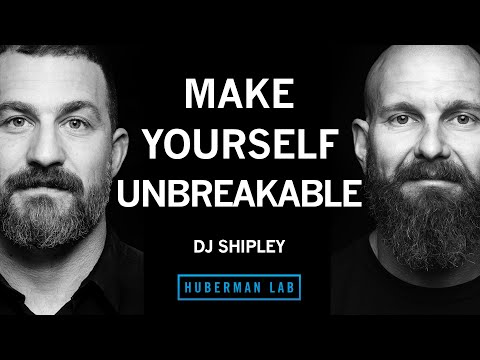
How to Make Yourself Unbreakable | DJ Shipley
DJ Shipley (guest), Andrew Huberman (host), Guest 2 (guest), Narrator
In this episode of Huberman Lab, featuring DJ Shipley and Andrew Huberman, How to Make Yourself Unbreakable | DJ Shipley explores unbreakable Routines, Psychedelic Healing, And Standards For A Life That Works In this episode, retired Tier 1 Navy SEAL DJ Shipley details how extreme structure, physical training, and deliberate transitions between roles keep his mental health stable after years of combat, loss, and severe injury. He walks through his precise morning and evening routines, explaining how “stacking micro wins” and strict control of his environment prevent spirals of stress, rumination, and distraction.
Unbreakable Routines, Psychedelic Healing, And Standards For A Life That Works
In this episode, retired Tier 1 Navy SEAL DJ Shipley details how extreme structure, physical training, and deliberate transitions between roles keep his mental health stable after years of combat, loss, and severe injury. He walks through his precise morning and evening routines, explaining how “stacking micro wins” and strict control of his environment prevent spirals of stress, rumination, and distraction.
Shipley recounts multiple life‑threatening experiences—from near‑overrun firefights in Iraq to a catastrophic electrocution—that left him physically broken and mentally exhausted, and how world‑class coaching and disciplined movement protocols rebuilt his capacity. He emphasizes that physical fitness is not vanity but a moral obligation to family, teammates, and self.
The conversation also explores ibogaine and 5‑MeO‑DMT–based treatment for addiction, PTSD, and suicidality, focusing on the work of Marcus and Amber Capone and Veteran Solutions. Shipley describes how these medicines dismantled his ego, surfaced buried traumas, ended long‑term pharmaceutical dependence, and helped save his marriage.
Throughout, he argues that high standards, deliberate context design (especially around phones and social media), and daily physical effort are accessible tools anyone can use to become more resilient, present, and useful to those around them.
Key Takeaways
Design your evenings so your mornings are automatic and controlled.
Shipley’s 5:00 a. ...
Get the full analysis with uListen AI
Use physical movement every morning as a non‑negotiable anchor for mental health.
He treats his 7–9 a. ...
Get the full analysis with uListen AI
Create deliberate mental ‘dials’ to shift between operator, professional, spouse, and parent.
Shipley refuses to blur work and home. ...
Get the full analysis with uListen AI
Control your information diet as aggressively as your food and training.
He no longer checks social media first thing in the morning because a single negative comment can “be a jacket I wear all day. ...
Get the full analysis with uListen AI
Physical standards and body awareness are critical for longevity and performance.
Years of structured training gave him such fine body awareness that he can describe injury locations with surgical precision and differentiate between ‘hurt’ and ‘injured. ...
Get the full analysis with uListen AI
Psychedelic‑assisted therapy can dismantle ego defenses and unlock deep behavioral change, but it is not recreational.
After years on ~60 pills/day (Cymbalta, Adderall, gabapentin, etc. ...
Get the full analysis with uListen AI
Adopt and test against objective standards to avoid becoming a “big fish in a small pond.”
His GBRS fitness test—broad jump, bodyweight bench press reps, pull‑ups, heavy farmer’s carry, trap bar deadlift, plank, and 800‑meter run—is designed to be taken cold on any day to reveal true readiness. ...
Get the full analysis with uListen AI
Notable Quotes
“I have to be selfish right now in order to be selfless later.”
— DJ Shipley
“If it can be done by a human being, I can do it.”
— DJ Shipley
“There is nothing like hunting a human being who’s hunting you. Nothing.”
— DJ Shipley
“Once you’ve hunted armed men long enough and liked it, you’ll never care for anything else thereafter.”
— DJ Shipley, quoting Hemingway
“Ibogaine is the only thing stronger than the ego I spent my whole life building.”
— DJ Shipley
Questions Answered in This Episode
You’ve said your worst mental health dips happened when injury cut you off from movement. For someone currently immobilized or with very limited mobility, what specific micro-wins and routines would you recommend to prevent that same spiral?
In this episode, retired Tier 1 Navy SEAL DJ Shipley details how extreme structure, physical training, and deliberate transitions between roles keep his mental health stable after years of combat, loss, and severe injury. ...
Get the full analysis with uListen AI
Your ibogaine experiences focused on childhood and family harm, not combat trauma. Why do you think the medicine skipped over your most dramatic war experiences, and did that surprise or frustrate you initially?
Shipley recounts multiple life‑threatening experiences—from near‑overrun firefights in Iraq to a catastrophic electrocution—that left him physically broken and mentally exhausted, and how world‑class coaching and disciplined movement protocols rebuilt his capacity. ...
Get the full analysis with uListen AI
You were very candid about hiding injuries and even a broken femoral neck to avoid missing ops. Looking back, do you think there is a better cultural balance the Teams could strike between mission focus and long-term operator health?
The conversation also explores ibogaine and 5‑MeO‑DMT–based treatment for addiction, PTSD, and suicidality, focusing on the work of Marcus and Amber Capone and Veteran Solutions. ...
Get the full analysis with uListen AI
You and Huberman both stressed the dangers of phones and social media first thing in the morning. If someone can only make one change to their phone behavior tomorrow, what is the single highest-impact rule you would have them adopt?
Throughout, he argues that high standards, deliberate context design (especially around phones and social media), and daily physical effort are accessible tools anyone can use to become more resilient, present, and useful to those around them.
Get the full analysis with uListen AI
For civilians who will never see combat but feel a deep sense of purposelessness or ‘mission withdrawal’ from ordinary life, how can they ethically and safely create the kind of meaningful challenge and camaraderie you describe from the Teams without drifting into self-destructive extremes?
Get the full analysis with uListen AI
Transcript Preview
(sighs) I had a lot of emotional stuff happen to me in that second deployment. You know, my, my idol, Mattie Roberts, I've talked about him a couple of times, I really, really hung onto that dude. Like, he was my true north, like he was the guy, and when he got shot up, (sighs) when you see it happen, you know, but I think that was the c- uh, the closest call for fire mission the entire Iraq War. Like, inside a 15 meters, I mean, cordy mic mic from an AC-130 gunship, I mean it was on top of you, a belt-fed machine gun just chewing us up. Everybody shot up except for me and one other guy and we were all crowded behind this tractor tire just, and you felt like a victim. Like, I felt helpless. You know, I'm getting rounds poured all over me and at a certain point you just go, "I'd rather run back into the front of this thing and get killed with all of them than be the lone survivor."
(Intro music plays) Welcome to the Huberman Lab Podcast, where we discuss science and science-based tools for everyday life. I'm Andrew Huberman, and I'm a professor of neurobiology and ophthalmology at Stanford School of Medicine. My guest today is DJ Shipley. DJ Shipley is a retired Navy SEAL who served for 17 years, much of that time as a Tier 1 operator, meaning part of an elite, highly selective special operation unit within the SEALS. In recent years, DJ has emerged as a top public educator on the topics of how to structure your days to maximize your mindset for sake of physical and mental health, as well as performance in work or school and to best support and build your closest relationships. As you'll soon learn from DJ, there are key points in your day when you can take specific physical steps, including but not limited to physical exercise, to shift your mind away from rumination, distraction and frustration to a state of immense clarity, focus and drive. Through trial and error, DJ has figured out, and he shares with us how that process is done and how you can do it too, right down to the details. What he describes goes way beyond a standard morning routine or evening routine, and most importantly, is accessible to all of us. You also won't hear any cliches or fluff in today's discussion. DJ is very specific about what to do and when and how in order to become the best possible version of yourself. You'll often hear those words out there, how to become the best version of yourself or reach your potential, but what DJ does so beautifully is he explains exactly how to do that, and he shares his story of how he joined and moved through the SEAL teams and the victories, but of course also the immense challenges and losses that he and his teammates experienced. We also discuss addiction, PTSD and depression, and new paths for overcoming those, in particular a new medical treatment, ibogaine followed by DMT, and how that's being used to help veterans overcome addiction, PTSD and suicidality. I've paid close attention to that work over the last five years because the brain imaging aspect is being done by my colleague, Dr. Nolan Williams at Stanford. I should mention that the ibogaine/DMT process we discuss is not a recreational one. Rather, it's being done as part of clinical trials and dedicated research studies. DJ explains that process firsthand and at the same time I should mention that ibogaine and DMT are still illegal in the United States. They are not FDA approved, so no one should explore their use outside of these clinical trials. However, the FDA is looking seriously at these compounds and approval for them seems quite likely in the next 12 months or so. Today's discussion is one that anybody, male, female, young or old, can benefit from. DJ has immense knowledge, he has immense experience, and he has an incredible ability to take what he's learned and turn it into actionable steps so you can improve your mental health, physical health and performance and become the best possible version of yourself. Before we begin, I'd like to emphasize that this podcast is separate from my teaching and research roles at Stanford. It is, however, part of my desire and effort to bring zero-cost-to-consumer information about science and science-related tools to the general public. In keeping with that theme, today's episode does include sponsors. And now for my discussion with DJ Shipley. DJ Shipley, welcome.
Install uListen to search the full transcript and get AI-powered insights
Get Full TranscriptGet more from every podcast
AI summaries, searchable transcripts, and fact-checking. Free forever.
Add to Chrome