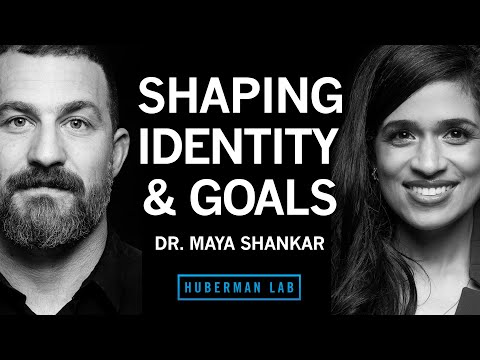
How to Shape Your Identity & Goals | Dr. Maya Shankar
Andrew Huberman (host), Maya Shankar (guest)
In this episode of Huberman Lab, featuring Andrew Huberman and Maya Shankar, How to Shape Your Identity & Goals | Dr. Maya Shankar explores rewriting Who You Are: Science-Backed Tools For Identity And Change Andrew Huberman and cognitive scientist Dr. Maya Shankar explore how identities form, how they break, and how to rebuild them using science-based tools. Drawing on Maya’s own story of losing a concert violin career at 15 and pivoting into cognitive science and public policy, they unpack concepts like identity foreclosure, identity paralysis, essentialism, and growth mindset. They discuss how awe, curiosity, and human connection can serve as reliable ‘through lines’ across careers and life changes, and how to redefine identity around the “why” rather than the “what” of what we do. The conversation then shifts into highly practical frameworks for goal-setting, motivation, empathy, behavior change, and dealing with uncertainty, offering listeners a toolkit for reshaping both their self-narrative and their daily habits.
Rewriting Who You Are: Science-Backed Tools For Identity And Change
Andrew Huberman and cognitive scientist Dr. Maya Shankar explore how identities form, how they break, and how to rebuild them using science-based tools. Drawing on Maya’s own story of losing a concert violin career at 15 and pivoting into cognitive science and public policy, they unpack concepts like identity foreclosure, identity paralysis, essentialism, and growth mindset. They discuss how awe, curiosity, and human connection can serve as reliable ‘through lines’ across careers and life changes, and how to redefine identity around the “why” rather than the “what” of what we do. The conversation then shifts into highly practical frameworks for goal-setting, motivation, empathy, behavior change, and dealing with uncertainty, offering listeners a toolkit for reshaping both their self-narrative and their daily habits.
Key Takeaways
Anchor your identity to the ‘why’, not the ‘what’.
Maya distinguishes between defining yourself by what you do (e. ...
Get the full analysis with uListen AI
Beware identity foreclosure and essentialism; keep identity malleable.
Identity foreclosure occurs when families, cultures, or peer groups impose narrow scripts (‘you’re the math kid’, ‘you’ll be a doctor’), which can limit what you believe you’re capable of. ...
Get the full analysis with uListen AI
Curiosity and awe are powerful engines for life pivots and resilience.
Both Maya and Andrew describe awe-filled moments (Maya with Beethoven’s violin concerto, Andrew with New York City and neuroscience) that later became career-defining. ...
Get the full analysis with uListen AI
Use science-based goal framing: approach, agency, slack, and fresh starts.
Maya outlines several evidence-backed goal techniques: (1) Frame goals in approach terms (‘eat more vegetables’) rather than avoidance (‘avoid junk food’) to make progress easier to track and more motivating. ...
Get the full analysis with uListen AI
Solve the ‘middle problem’ by shortening goal horizons and bundling temptations.
Motivation is typically high at the start and end of a goal but dips in the middle. ...
Get the full analysis with uListen AI
Your future self is more changeable than you think; audit how change is changing you.
Humans fall prey to the ‘end-of-history illusion’: we fully recognize how much we’ve changed in the past but assume who we are now is who we’ll always be. ...
Get the full analysis with uListen AI
Empathy is multi-dimensional; cultivate cognitive empathy to avoid burnout and improve conflict.
Maya, drawing on Jamil Zaki’s work, explains three distinct empathies: emotional (feeling what others feel), cognitive (understanding what they feel and why), and empathic concern/compassion (wanting to help). ...
Get the full analysis with uListen AI
Notable Quotes
“When you define yourself by the what, then as soon as the what goes away you’re like, ‘Oh my gosh, who the hell am I?’”
— Maya Shankar
“I have learned in my adult life to anchor my identity to why I do the things I do rather than what I do, and I found this to be a much more durable, reliable relationship.”
— Maya Shankar
“Our desire as humans to have identities is not going anywhere, and we shouldn’t want it to. Identities bring us so much meaning and purpose. But we can be more particular about what we anchor our identities to.”
— Maya Shankar
“We tend to think we have a very veridical understanding of who we are, but that understanding is based on the random set of data points we’ve happened to collect over our lifetime.”
— Maya Shankar
“The greatest gift cognitive science has given me is empathy. The more you learn about how minds work, the more you can bridge these empathy gaps.”
— Maya Shankar
Questions Answered in This Episode
You described redefining your identity from ‘I am a violinist’ to ‘I am someone driven by emotional connection.’ For someone currently in identity paralysis after a career loss or breakup, what concrete journaling prompts or daily practices would you prescribe for the first 30 days to start finding their own ‘through line’?
Andrew Huberman and cognitive scientist Dr. ...
Get the full analysis with uListen AI
The end-of-history illusion means we’re bad at imagining our future, changed selves. How would you integrate that insight into major life decisions like marriage, having children, or taking a demanding job—are there specific experiments or time-limited trials you’d recommend before fully committing?
Get the full analysis with uListen AI
In high-pressure, elite environments (Juilliard, Stanford, top firms), comparison is almost unavoidable. What are the most effective evidence-based strategies you’ve seen for reducing destructive self-comparison while still using talented peers as positive fuel for growth?
Get the full analysis with uListen AI
Your story about Daryl Davis shows how curiosity and agency can change even extremist beliefs. Do you think his methods could realistically scale to online environments and polarized politics, and if so, how would you redesign social media or public discourse to embody those principles?
Get the full analysis with uListen AI
You mentioned that emotional empathy can drive burnout, while cognitive empathy and compassion can be protective. For clinicians, teachers, or caregivers already exhausted, what would a ‘training program’ to rebalance toward cognitive empathy look like week by week, and how could they measure whether it’s actually reducing their burnout?
Get the full analysis with uListen AI
Transcript Preview
Welcome to the Huberman Lab Podcast, where we discuss science and science-based tools for everyday life. I'm Andrew Huberman, and I'm a professor of neurobiology and ophthalmology at Stanford School of Medicine. Today my guest is Dr. Maya Shankar. Dr. Maya Shankar is a cognitive scientist who did her undergraduate training at Yale University, her PhD thesis at Oxford as a Rhodes Scholar, and a postdoctoral fellowship also in cognitive science at Stanford University. Dr. Shankar also served as a senior advisor to the White House, and she founded and served as the chair of the White House Behavioral Science Team. Dr. Shankar is also the host of her own podcast entitled A Slight Change of Plans. And indeed, Dr. Shankar herself is no stranger to having to make major changes to one's life plans. As you'll learn today, prior to all of those incredible accomplishments that Dr. Shankar has achieved, she was a student at the Juilliard Conservatory of Music, preparing her life to become a professional concert violinist. But, as you'll also soon learn, she then experienced a career-devastating injury, forcing herself to have to reframe everything about her life plans and her own identity. And that's really what we talk about today. We talk about identity, not just Dr. Shankar's prior and current identities, but of course your identity. We pose a number of questions geared toward getting you to ask, "Who am I really?" "Do my goals align with who I am and what I want?" Dr. Shankar shares with us the research on identity, goals, motivation, and plans, as well as many practical tools to answer those key questions that guide us down either the correct or incorrect trajectories in life. She shares with us, for instance, how to assess on-paper goals of the sort that you would see on a CV, so which school, which job, which salary, which spouse, et cetera, et cetera, and how to relate those to the deeper feelings that relate to one's ability to continually pursue a given goal knowing that it's the right goal for us. We also talk about the science of feelings, what they can and cannot tell us, and when they should or should not serve as a compass for guiding our everyday and longer-term decisions. By the end of today's episode, you will realize that Dr. Shankar is essentially handing you a science-supported roadmap for how to determine and assess your identity and goals and how one influences the other, that is, how your identity influences your goals and how your goals influences your identity in becoming the person that you want to be. Before we begin, I'd like to emphasize that this podcast is separate from my teaching and research roles at Stanford. It is, however, part of my desire and effort to bring zero-cost-to-consumer information about science and science-related tools to the general public. In keeping with that theme, I'd like to thank the sponsors of today's podcast. Our first sponsor is Maui Nui Venison. Maui Nui Venison is the most nutrient-dense and delicious red meat available. I've spoken before on this podcast, in solo episodes and with guests, about the need to get approximately one gram of high-quality protein per pound of body weight each day for optimal nutrition. Now, there are many different ways that one can do that, but a key thing is to make sure that you're not doing that by ingesting excessive calories. Maui Nui Venison has the highest density of quality protein per calorie, and it achieves that in delicious things like ground meats, venison steaks, jerky, and bone broth. I particularly like the ground venison. I make those into venison burgers probably five times a week or more. I also like the jerky for its convenience, especially when I'm traveling or I'm especially busy with work and know that I'm getting an extremely nutrient-dense, high-quality source of protein. If you'd like to try Maui Nui Venison, you can go to maui nui venison dot com slash huberman and get 20% off your first order. Again, that's maui nui venison dot com slash huberman to get 20% off. Today's episode is also brought to us by Eight Sleep. Eight Sleep makes smart mattress covers with cooling, heating, and sleep-tracking capacity. Sleep is the foundation of mental health, physical health, and performance. When we're sleeping well and enough, everything in life goes much better, and when we aren't sleeping well or long enough, things in life get worse. We know that from data. We all know that from our own experience. One of the essential things to getting a great night's sleep is that the temperature of your sleeping environment needs to be such that your core body temperature drops by about one to three degrees in order to fall and stay deeply asleep and then increase by one to three degrees in order to wake up feeling refreshed in the morning. With Eight Sleep smart mattress covers, you can program the temperature of your sleeping environment so that it's ideally matched to your temperature needs. I started sleeping on an Eight Sleep mattress cover a few years ago, and it has completely transformed the quality of the sleep that I get, so much so that I actually loathe traveling because I don't have my Eight Sleep mattress cover when I travel. If you'd like to try Eight Sleep, you can go to eight sleep dot com slash huberman, and you'll save up to $150 off their Pod 3 cover. Eight Sleep currently ships in the USA, Canada, UK, select countries in the EU, and Australia. Again, that's eight sleep dot com slash huberman. And now for my discussion with Dr. Maya Shankar. Welcome. I'm so happy you're here.
Install uListen to search the full transcript and get AI-powered insights
Get Full TranscriptGet more from every podcast
AI summaries, searchable transcripts, and fact-checking. Free forever.
Add to Chrome