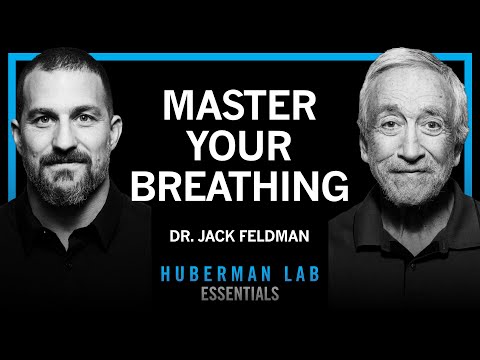
Essentials: Breathing for Mental & Physical Health & Performance | Dr. Jack Feldman
Andrew Huberman (host), Jack Feldman (guest)
In this episode of Huberman Lab, featuring Andrew Huberman and Jack Feldman, Essentials: Breathing for Mental & Physical Health & Performance | Dr. Jack Feldman explores how Breathing Shapes Brain Health, Emotion, Fear, and Longevity Potential Andrew Huberman and respiratory neuroscientist Dr. Jack Feldman explore how breathing is generated in the brainstem and how it supports both basic survival and higher brain functions. They discuss the mechanics of breathing, evolutionary advantages of the diaphragm, and the critical role of physiological sighs in maintaining lung health and possibly survival during overdose or near-death states.
How Breathing Shapes Brain Health, Emotion, Fear, and Longevity Potential
Andrew Huberman and respiratory neuroscientist Dr. Jack Feldman explore how breathing is generated in the brainstem and how it supports both basic survival and higher brain functions. They discuss the mechanics of breathing, evolutionary advantages of the diaphragm, and the critical role of physiological sighs in maintaining lung health and possibly survival during overdose or near-death states.
Feldman details how specific brainstem circuits, vagus nerve signaling, CO₂ levels, and nasal airflow link breathing patterns to emotional state, anxiety, and cognitive function. He shares rodent data showing that daily slow-breathing practice dramatically reduces fear responses, supporting the idea that breath work can rewire emotional circuits rather than being just placebo.
They also examine how breathing interacts with broader neural networks, potentially disrupting maladaptive circuits seen in depression, and why simple protocols like box breathing can be powerful tools for daily regulation. Finally, Feldman outlines mechanistic research on magnesium threonate as a cognitive-support supplement that may slow age-related decline by enhancing synaptic plasticity.
Key Takeaways
Breathing is driven by a small brainstem oscillator that can be consciously overridden.
Every breath begins with activity in the preBötzinger complex, a cluster of a few thousand neurons in the brainstem that generates inspiratory rhythm and activates the diaphragm and intercostal muscles. ...
Get the full analysis with uListen AI
The diaphragm is a key evolutionary innovation enabling large, oxygen-hungry brains.
Mammals are unique in having a diaphragm, which can expand a lung surface area roughly a third the size of a tennis court by moving only about two-thirds of an inch. ...
Get the full analysis with uListen AI
Physiological sighs are automatic maintenance breaths that keep lungs functional and may be lifesaving.
Humans sigh about every five minutes: a deep breath that reopens collapsed alveoli, preserving lung surface area for gas exchange. ...
Get the full analysis with uListen AI
Slow, deliberate breathing can measurably reduce fear and likely anxiety by reshaping neural circuits.
Feldman’s lab developed a rodent protocol that slowed awake mice’s breathing tenfold for 30 minutes a day over four weeks. ...
Get the full analysis with uListen AI
Multiple pathways link breathing to emotion and cognition, making breath work a multi-lever tool.
Rhythmic nasal airflow modulates the olfactory bulb, which projects widely across the brain; lung stretch signals travel via the vagus nerve, a major target in device-based depression therapies; and changes in CO₂ alter blood pH, strongly influencing ventilation and anxiety levels. ...
Get the full analysis with uListen AI
Breath practices may disrupt maladaptive loops in conditions like depression, similar in principle to brain stimulation.
Feldman proposes that depressive and other maladaptive states can be seen as over-strengthened recurrent circuits (deep “ruts” in neural activity). ...
Get the full analysis with uListen AI
Magnesium threonate may enhance plasticity and slow cognitive decline by increasing brain magnesium.
Feldman describes work by Guosong Liu showing that elevated magnesium in tissue culture reduces background neural noise and increases long-term potentiation (LTP). ...
Get the full analysis with uListen AI
Notable Quotes
“Every breath begins with neurons in this region beginning to be active, and those neurons then connect ultimately to these motor neurons going to the diaphragm.”
— Dr. Jack Feldman
“I would say a key step in the ability to develop a large brain that has a continuous demand for oxygen is the diaphragm. Without a diaphragm, you're an amphibian.”
— Dr. Jack Feldman
“It turns out, we sigh about every five minutes... and you can't stop it.”
— Dr. Jack Feldman
“My mice don't believe in the placebo effect.”
— Dr. Jack Feldman
“What breathing is doing is sort of filling in the rut bit by bit to the point that you can climb out of that rut.”
— Dr. Jack Feldman
Questions Answered in This Episode
In your mouse slow-breathing protocol, what specific respiratory rate and pattern did you use, and do you see a human-equivalent dose (minutes per day × weeks) that you would hypothesize as a threshold for fear and anxiety reduction?
Andrew Huberman and respiratory neuroscientist Dr. ...
Get the full analysis with uListen AI
You mentioned several candidate pathways (olfactory bulb, vagus, CO₂, motor cortex) by which breathing alters brain state—if you had to prioritize one for future human intervention (e.g., devices or targeted training), which would you bet on and why?
Feldman details how specific brainstem circuits, vagus nerve signaling, CO₂ levels, and nasal airflow link breathing patterns to emotional state, anxiety, and cognitive function. ...
Get the full analysis with uListen AI
Given your agnostic stance on diaphragmatic versus non-diaphragmatic breathing, are there any contexts—such as COPD, asthma, or vocal training—where the specific recruitment of the diaphragm might clearly matter clinically or functionally?
They also examine how breathing interacts with broader neural networks, potentially disrupting maladaptive circuits seen in depression, and why simple protocols like box breathing can be powerful tools for daily regulation. ...
Get the full analysis with uListen AI
In patients who die from combined alcohol and barbiturate overdose, do you think there is a feasible way to pharmacologically or electrically preserve or restore the gasp/sigh-generating circuits you described, effectively extending the window for rescue?
Get the full analysis with uListen AI
Magnesium threonate appears promising for mild cognitive impairment; based on the mechanisms you outlined (noise reduction and increased LTP), how cautious should we be about using it in younger, cognitively healthy individuals—could chronically elevating plasticity have downsides, such as destabilizing existing networks or exacerbating certain psychiatric conditions?
Get the full analysis with uListen AI
Transcript Preview
(peaceful music) Welcome to Huberman Lab Essentials, where we revisit past episodes for the most potent and actionable science-based tools for mental health, physical health, and performance. I'm Andrew Huberman, and I'm a professor of neurobiology and ophthalmology at Stanford School of Medicine. And now for my conversation with Dr. Jack Feldman. Thanks for joining me today.
Pleasure to be here, Andrew.
You're my go-to source for all things respiration and how the brain and breathing interact. You're the person I call. Why don't we start off by just talking about what's involved in generating breath?
So on the mechanical side, which is obvious to everyone, we, um, want to have air flow in, inhale, and we need to have air flow out. And the reason we need to do this is because for body metabolism, we need oxygen, and when oxygen's utilized through the meta- aerobic metabolic process, we produce carbon dioxide. And so we have to get rid of the carbon dioxide that we produce, in particular because the carbon dioxide affects the acid-base balance of the blood, the pH. And all living cells are very sensitive to what the pH value is, so your body is very interested in regulating that pH. So how do we generate this air flow? We have to expand the lungs, and as the lungs expand, basically it's like a balloon that you would pull apart. The pressure inside that balloon drops, and air will flow into the balloon. That lowers the pressure in the air sacs, called alveoli, and air will flow in because pressure outside the body is higher than pressure inside the body when you're doing this expansion, when you're inhaling. What produces that? Well, the principal muscle is the d- the diaphragm, which is sitting inside the body just below the lung, and when you want to inhale, you basically contract the diaphragm and it pulls it down. And as it pulls it down, it's exerting pressure forces on the lung. The lung wants to expand. At the same time, the ribcage is going to rotate up and out, and therefore expanding the, the cavity, the thoracic cavity. At the end of inspiration, under normal conditions when you're at rest, you just relax and it's like pulling on a spring. You pull down a spring and you let go and it relaxes. Where does that activity originate? The region in the brainstem, that's once again this region sort of above the spinal cord, which was critical for generating this rhythm. It's called the preBotzinger complex. This small site, which contains, in humans, a few thousand neurons, it's located on either side and works in tandem, and every breath begins with neurons in this region beginning to be active, and those neurons then connect ultimately to these motor neurons going to the diaphragm and to the external intercostals, causing them to be active and causing this inspiratory effort. When the neurons in the preBotzinger complex finish their burst of activity, then inspiration stops and then you begin to exhale because of this passive, uh, recall of the lung and ribcage.
Install uListen to search the full transcript and get AI-powered insights
Get Full TranscriptGet more from every podcast
AI summaries, searchable transcripts, and fact-checking. Free forever.
Add to Chrome