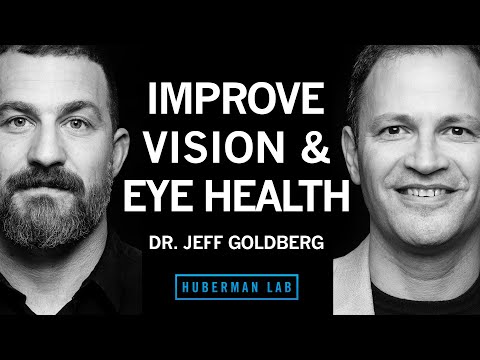
How to Improve Your Eye Health & Offset Vision Loss | Dr. Jeffrey Goldberg
Andrew Huberman (host), Jeffrey Goldberg (guest), Narrator
In this episode of Huberman Lab, featuring Andrew Huberman and Jeffrey Goldberg, How to Improve Your Eye Health & Offset Vision Loss | Dr. Jeffrey Goldberg explores lifelong Vision: Goldberg’s Science-Backed Blueprint To Protect Your Eyes Andrew Huberman and Stanford ophthalmology chair Dr. Jeffrey Goldberg cover eye health across the lifespan—from newborn screening to aging-related vision loss. They explain how vision actually develops, what truly matters for kids’ screen time and outdoor light, and when and how often adults should get comprehensive eye exams. The conversation details the science and real-world use of glasses, contacts, LASIK, eye exercises, and dry-eye treatments, as well as risk factors and leading-edge therapies for glaucoma, macular degeneration, diabetic retinopathy, and inherited retinal disease. Throughout, Goldberg emphasizes practical protocols: when to worry, what to do now, and which emerging tools may soon change how we prevent and treat blindness.
Lifelong Vision: Goldberg’s Science-Backed Blueprint To Protect Your Eyes
Andrew Huberman and Stanford ophthalmology chair Dr. Jeffrey Goldberg cover eye health across the lifespan—from newborn screening to aging-related vision loss. They explain how vision actually develops, what truly matters for kids’ screen time and outdoor light, and when and how often adults should get comprehensive eye exams. The conversation details the science and real-world use of glasses, contacts, LASIK, eye exercises, and dry-eye treatments, as well as risk factors and leading-edge therapies for glaucoma, macular degeneration, diabetic retinopathy, and inherited retinal disease. Throughout, Goldberg emphasizes practical protocols: when to worry, what to do now, and which emerging tools may soon change how we prevent and treat blindness.
Key Takeaways
Start eye care early: newborn red-reflex checks and childhood amblyopia screening are critical.
Every newborn should have a basic eye exam in the nursery, primarily to confirm a normal red reflex (the same red-eye effect in flash photos). ...
Get the full analysis with uListen AI
Outdoor light time in childhood likely protects against myopia more than just “less screen time.”
Older thinking blamed near work (reading, screens) alone for myopia, but newer cohort studies and randomized trials suggest time outdoors in full-spectrum daylight is a stronger protective factor. ...
Get the full analysis with uListen AI
Adults should not rely on “I think I see fine” and should get periodic comprehensive eye exams.
Silent diseases like glaucoma can progress for years without symptoms, especially because they initially damage peripheral vision and elevated eye pressure cannot be felt. ...
Get the full analysis with uListen AI
Use the glasses or readers that give you the clearest, most comfortable vision—don’t fear “weakening” your eyes.
For presbyopia and distance prescriptions, Goldberg emphasizes that wearing appropriate correction does not meaningfully accelerate dependence. ...
Get the full analysis with uListen AI
Contacts can give superior optics but demand excellent hygiene and realistic expectations as you age.
Contact lenses often provide sharper, higher-quality correction than glasses because they sit directly on the cornea and can smooth higher-order aberrations. ...
Get the full analysis with uListen AI
Dry eye is multi-factorial and common; treat both quantity and quality of tears and eyelid health.
Tears are not just saltwater—they have an aqueous layer from the lacrimal gland and an oil layer from meibomian glands in the eyelids that prevents evaporation. ...
Get the full analysis with uListen AI
The leading causes of irreversible blindness—glaucoma, macular degeneration, and diabetic retinopathy—are partly preventable and increasingly treatable.
Glaucoma: age and eye pressure are key risks; lowering pressure with drops, laser (SLT), or surgery slows progression even in normal-pressure glaucoma. ...
Get the full analysis with uListen AI
Notable Quotes
“We use sort of, we used to use very sort of, you know, gross numbers like fully correctable if you can intervene before age three… but even kids into their young teens have a shot at correcting that eye–brain connection.”
— Dr. Jeffrey Goldberg
“It looks like it's pretty clear now that it has maybe more to do with outdoor lighting time than just near work.”
— Dr. Jeffrey Goldberg
“You're probably helping the lens, but you're definitely not helping your retina and brain by feeding it blurry information all of that time.”
— Dr. Jeffrey Goldberg
“The number one cause of low vision is actually refractive error… The next most common cause is cataract… Then you start hitting the eye diseases that lead to currently irreversible causes of vision loss.”
— Dr. Jeffrey Goldberg
“We have this longstanding saying in ophthalmology that the eye is a window to the brain… we can detect the degeneration of the retina and optic nerve associated with Alzheimer's disease.”
— Dr. Jeffrey Goldberg
Questions Answered in This Episode
For parents trying to reduce their child’s myopia risk, how would you practically prioritize interventions: limiting continuous near work, ensuring a specific minimum of outdoor light per day, or exploring newer red/violet light devices?
Andrew Huberman and Stanford ophthalmology chair Dr. ...
Get the full analysis with uListen AI
You mentioned that even successful amblyopia treatment often fails to fully restore stereoscopic depth perception; are there any experimental protocols or technologies that specifically target stereo recovery in older children or adults?
Get the full analysis with uListen AI
Given how promising high-dose vitamin B3 looks for glaucoma, what dose ranges and formulations (nicotinamide vs. nicotinic acid) are being tested in current phase 3 trials, and how do you monitor for systemic side effects in those patients?
Get the full analysis with uListen AI
For someone already diagnosed with early dry macular degeneration who does not smoke, how would you prioritize AREDS2 supplementation, strict diet optimization, blue-light-filter lenses, and experimental red-light therapy in a realistic treatment plan?
Get the full analysis with uListen AI
As retinal biomarkers for Alzheimer’s and MS become more specific, do you foresee routine eye imaging being used to screen asymptomatic people for brain disease—and what ethical safeguards should be in place before that becomes common practice?
Get the full analysis with uListen AI
Transcript Preview
(music plays) Welcome to the Huberman Lab Podcast, where we discuss science and science-based tools for everyday life. I'm Andrew Huberman, and I'm a professor of neurobiology and ophthalmology at Stanford School of Medicine. Today my guest is Dr. Jeffrey Goldberg. Dr. Jeffrey Goldberg is the chair of the Department of Ophthalmology at Stanford University School of Medicine. He is a clinician, an MD or medical doctor who sees patients every week, as well as a PhD, meaning a laboratory scientist who directs his own laboratory focused on understanding the mechanisms and cures for diseases of the eye and vision such as glaucoma, retinitis pigmentosa, and macular degeneration. Indeed, Dr. Goldberg is one of the world leaders in developing methods to cure blindness. He is also intensely knowledgeable about all things related to vision. So during today's discussion, we indeed cover most all of visual and eye health. You will learn, for instance, about the benefits as well as drawbacks of wearing corrective lenses such as contact lenses or eyeglasses for reading. You will learn about the benefits and detriments of sunlight, meaning how it can help your vision, in fact, how it can help reverse or prevent myopia, nearsightedness, as well as the things to be cautious about with respect to sunlight in terms of development of cataracts, which are occlusions that prevent vision. We also discuss many tools for maintaining and improving vision across the lifespan, ranging from behavioral tools, so specific vision tasks and exercises for the eye that you can do that are known to improve or maintain your vision, as well as specific surgical procedures such as LASIK surgery. We get into all the details of, for instance, how often to do these various eye exercises, how long the benefits are maintained, as well as age-related considerations for things like LASIK eye surgery. We even get into how to best clean your contact lenses, whether or not to use disposable contact lenses or other forms of contact lenses. We also discuss things like dry eye and the best remedies for dry eye, and we talk about the scientific and clinical data around nutritional approaches and supplementation-based approaches for maintaining and improving vision. So whether or not you suffer from floaters or dry eye, or you're considering changing your eye prescription, or you have concerns about whether or not relying on corrective lenses is impairing your vision and you want to enhance your vision, or if you're somebody who has perfect vision, today's episode is going to include science and protocols that will be highly relevant to you. I should also add that if you are somebody who suffers from or who has family members who suffer from diseases of the eye that can impact vision such as glaucoma, retinitis pigmentosa, and macular degeneration, we also delve deep into the discussion about the most advanced technologies for preventing and offsetting vision loss due to those diseases as well. Thanks to Dr. Goldberg's incredible knowledge, his clarity of communication, and his generosity with that knowledge, by the end of today's episode, you will be armed with all of the modern information you need in order to best maintain and improve your eye and vision health. Before we begin, I'd like to emphasize that this podcast is separate from my teaching and research roles at Stanford. It is, however, part of my desire and effort to bring zero cost to consumer information about science and science-related tools to the general public. In keeping with that theme, I'd like to thank the sponsors of today's podcast. Our first sponsor is Maui Nui Venison. Maui Nui Venison is the most nutrient-dense and delicious red meat available. I've talked before on this podcast about the key importance of striving to get one gram of protein per pound of body weight. Now when one strives to do that, it's also important to maximize the quality protein to calorie ratio. In other words, you don't want to consume a lot of extra calories in order to get your quality protein. Maui Nui Venison, in having an extremely high-quality protein and nutrient to calorie ratio, allows you to do that very easily, and in addition to that, Maui Nui Venison is delicious. I particularly like their bone broth, which has an unmatched 25 grams of protein per 100 calories. I also love their ground venison and their venison steaks. All of them are absolutely delicious. If you'd like to try Maui Nui Venison, go to mauinuivenison.com/huberman and get 20% off your first order. Again, that's mauinuivenison.com/huberman to get 20% off. Today's episode is also brought to us by LMNT. LMNT is an electrolyte drink that has everything you need, that is the electrolytes, sodium, magnesium, and potassium, but nothing you don't, which means no sugar. It's critical that we get electrolytes because every cell of our body, but in particular, our nerve cells, our neurons rely on electrolytes in order to function properly. With LMNT, it's very easy to ingest the correct ratios of electrolytes. They come in these little packets. They're really delicious. You mix them up with anywhere from 8 to 16 to 32 ounces of fluid. I like mine pretty concentrated so I'll drink a 16-ounce glass of water with LMNT in it when I first wake up. I'll also consume another one of those maybe 32 ounces with one packet when I exercise and maybe another one if I happen to sweat a lot during exercise or if I was in the sauna and sweating a lot if it's a very hot day, et cetera. If you'd like to try LMNT, go to DrinkLMNT, that's lmnt.com/huberman to claim a free LMNT sample pack with your purchase. Again, that's Drink LMNT, lmnt.com/huberman. Today's episode is also brought to us by Eight Sleep. Eight Sleep makes smart mattress covers with cooling, heating, and sleep tracking capacity. Now there's absolutely no question that sleep is the foundation of mental health, physical health, and performance. When we're sleeping well and we're sleeping long enough, everything in our daily life goes that much better. Now a key component to getting a great night's sleep is the temperature of your sleeping environment, and that's because in order to fall and stay deeply asleep, your core body temperature actually has to drop by about one to three degrees. Conversely, in order to wake up feeling refreshed, your core body temperature has to increase by about one to three degrees. With Eight Sleep mattress covers, you can cool or heat your mattress at the beginning, middle, and end of your night in order to optimize your night's sleep. I started sleeping on an Eight Sleep mattress cover about two years ago, and it has dramatically improved the sleep that I get each and every night. If you'd like to try Eight Sleep, you can go to eightsleep.com/huberman and save up to $150 off their Pod 3 cover. Eight Sleep currently ships in the USA, Canada, UK, select countries in the EU, and Australia. Again, that's eightsleep.com/huberman. And now for my discussion with Dr. Jeffrey Goldberg.Dr. Jeffrey Goldberg, welcome.
Install uListen to search the full transcript and get AI-powered insights
Get Full TranscriptGet more from every podcast
AI summaries, searchable transcripts, and fact-checking. Free forever.
Add to Chrome