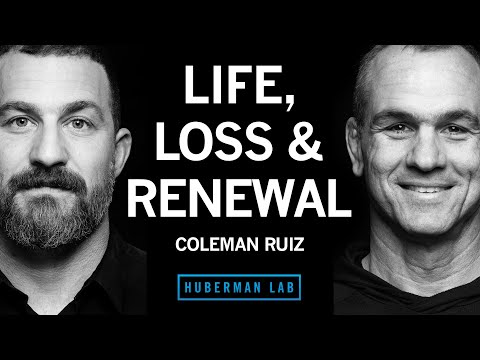
Overcoming Physical & Emotional Challenges | Coleman Ruiz
Andrew Huberman (host), Coleman Ruiz (guest), Narrator, Narrator, Narrator
In this episode of Huberman Lab, featuring Andrew Huberman and Coleman Ruiz, Overcoming Physical & Emotional Challenges | Coleman Ruiz explores navy SEAL’s Journey: From Invincible Warrior To Vulnerable, Whole Man Former Tier 1 Navy SEAL operator Coleman Ruiz traces his life from a modest New Orleans upbringing through elite military service, intense combat, and deep personal loss, to a hard-earned psychological reckoning. He describes how early aggression and chaos were transformed through wrestling, structure, and the Naval Academy into an extreme work ethic and a narrow, high‑RPM focus that served him well in war but later broke him in civilian life. After years of repeated combat losses, a psychedelic-assisted experience, and a severe depressive crash that brought him to the brink of suicide, he was forced to confront long-ignored trauma. Through therapy, lifestyle changes, and accepting help from others, he rebuilt himself, broadened his emotional range, and found a different, more sustainable way to live, work, and be a husband and father.
Navy SEAL’s Journey: From Invincible Warrior To Vulnerable, Whole Man
Former Tier 1 Navy SEAL operator Coleman Ruiz traces his life from a modest New Orleans upbringing through elite military service, intense combat, and deep personal loss, to a hard-earned psychological reckoning. He describes how early aggression and chaos were transformed through wrestling, structure, and the Naval Academy into an extreme work ethic and a narrow, high‑RPM focus that served him well in war but later broke him in civilian life. After years of repeated combat losses, a psychedelic-assisted experience, and a severe depressive crash that brought him to the brink of suicide, he was forced to confront long-ignored trauma. Through therapy, lifestyle changes, and accepting help from others, he rebuilt himself, broadened his emotional range, and found a different, more sustainable way to live, work, and be a husband and father.
Key Takeaways
Channel Aggression Into Structure, Not Suppression
Ruiz’s early adolescence was marked by fights, suspensions, and what he and Huberman call the “wildness” of dispersal—brain- and hormone-driven exploratory chaos. ...
Get the full analysis with uListen AI
Elite Performance Often Runs On Fear And Narrow Focus
From prep school to the Naval Academy to SEAL Team 3 and a Tier 1 special mission unit, Ruiz operated on a 24‑hour horizon, constantly trying to “earn his place” and never feeling good enough. ...
Get the full analysis with uListen AI
Unprocessed Combat Loss Accumulates As Invisible Trauma
Ruiz personally knew 40 comrades who were killed between 2003 and 2011, attended memorials roughly every 90 days, and even notified families himself. ...
Get the full analysis with uListen AI
Psychedelics Can Open Doors, But They Are Not A Shortcut
After leaving the military, Ruiz undertook an intensive, physician-supervised ibogaine and 5-MeO-DMT protocol and felt an immediate, profound sense of connection to warrior cultures across time. ...
Get the full analysis with uListen AI
Depression Can Feel Physically Catastrophic—and Requires Help
Ruiz describes his depressive episode as feeling like someone filleted his chest open and scorched him from the inside with a torch. ...
Get the full analysis with uListen AI
Talk Therapy And Targeted Medication Can Rebuild A Life
Contrary to his earlier contempt for PTSD and therapy, Ruiz entered weekly psychotherapy, offloaded years of unspoken experiences, and used a short, low‑dose course of Wellbutrin to gain a safety buffer while his nervous system settled. ...
Get the full analysis with uListen AI
True Strength Is Range: From Warrior To Vulnerable Human
Ruiz argues that mature “manhood” is not pure aggression or control, but range: the capacity to be fiercely protective when needed and also kind, calm, emotionally open, and non‑controlling in everyday life. ...
Get the full analysis with uListen AI
Notable Quotes
“I was entirely convinced that I couldn’t be killed. I was convinced our training was so good that that shit wouldn’t happen to us.”
— Coleman Ruiz
“If Doug can be killed, all fucking bets are off.”
— Coleman Ruiz
“It took 10,000 times the energy of anything I’ve ever done just to put my feet on the ground in the morning.”
— Coleman Ruiz
“You have foggy goggles. You’re clearly not on stable ground. You have to outsource your decisions now.”
— Andrew Huberman (paraphrased by Ruiz)
“Don’t mistake my kindness for weakness. There is a category for everything.”
— Coleman Ruiz
Questions Answered in This Episode
You described the trio of predictors for getting through BUD/S—varsity sports, divorced parents, or school suspension. If psychologists studied this formally, what deeper traits or mechanisms do you think they’d actually be measuring?
Former Tier 1 Navy SEAL operator Coleman Ruiz traces his life from a modest New Orleans upbringing through elite military service, intense combat, and deep personal loss, to a hard-earned psychological reckoning. ...
Get the full analysis with uListen AI
When you realized that no BUD/S instructor had truly experienced what you faced in real combat, how did that change the way you approached training and mentoring younger operators later on?
Get the full analysis with uListen AI
Your ibogaine and 5-MeO-DMT experiences felt profoundly meaningful at first but preceded a severe crash. In hindsight, what specific preparation, integration, or therapeutic container do you think might have turned that opening into a safer, more sustained benefit?
Get the full analysis with uListen AI
You’ve said that the hardest part wasn’t combat, but sitting with a therapist and telling the truth. For men who still equate vulnerability with weakness, what concrete first steps can they take that don’t feel like a total identity betrayal?
Get the full analysis with uListen AI
Now that you’re running a large civilian organization, how do you decide when to bring your “Tier 1” intensity to bear and when to prioritize your newer skills—like listening, range, and non‑control—especially under pressure or during crises?
Get the full analysis with uListen AI
Transcript Preview
(uptempo music) Welcome to the Huberman Lab Podcast, where we discuss science and science-based tools for everyday life. I'm Andrew Huberman, and I'm a professor of neurobiology and ophthalmology at Stanford School of Medicine. My guest today is Coleman Ruiz. Coleman Ruiz is a former Tier 1 Navy SEAL special operator. I think it's fair to assume that most of you have never heard of Coleman Ruiz before, and in fact, it was part of his former life job description to be largely covert, such that only his family and friends really knew what he did for a living. He is, however, now living as a civilian, and the reason I invited Coleman on this podcast was essentially to tell us his life story, which, of course, includes his time in the SEAL teams, but includes so much more that I'm certain is of value to everyone. Today, Coleman shares with you his remarkable journey from childhood through his teenage years into the military and some of the things that happened during his time in the military, which then informed his post-military civilian life and what it is to be a father, a husband, and somebody who has experienced tremendous loss at various stages of his life, as well as tremendous triumph. Indeed, if ever there was a life that could be framed within the context of the so-called hero's journey, it is the life of Coleman Ruiz. Coleman Ruiz's life is one that embodies focus and pursuit, family and friends and love, all the things that we think of in terms of having a rich life, but also one that includes many unforeseen tragedies, many unforeseen challenges, both internal and external. Coleman also shares with a rare and extraordinary degree of vulnerability the extent to which challenges in life, both external and internal, have helped shape him as a human being. What follows is a discussion that everyone, male, female, young, or old, and regardless of position in life, is sure to derive tremendous benefit from. Before we begin, I'd like to emphasize that this podcast is separate from my teaching and research roles at Stanford. It is, however, part of my desire and effort to bring zero-cost-to-consumer information about science and science-related tools to the general public. In keeping with that theme, I'd like to thank the sponsors of today's podcast. Our first sponsor is BetterHelp. BetterHelp offers professional therapy with a licensed therapist carried out entirely online. I've been doing therapy for over 30 years. Initially, I started therapy because, well, I was required to in order to stay in school, but eventually, I just decided to keep doing it because I found it to be very beneficial. There are essentially three things that great therapy provides. First of all, it provides a rapport with somebody that you can trust and talk about all issues with. Second of all, they can provide support in the form of emotional support or directed guidance. And third, expert therapy can provide useful insights that you wouldn't have otherwise had access to. In fact, I consider doing regular therapy as important as working out one's body in the gym or through cardiovascular exercise. And with BetterHelp, scheduling and doing therapy becomes extremely convenient. They can match you to a therapist that can provide those three things, excellent rapport, support, and insight, and they can do so on a schedule that matches yours. If you'd like to try BetterHelp, go to betterhelp.com/huberman to get 10% off your first month. Again, that's betterhelp.com/huberman. Today's episode is also brought to us by Maui Nui Venison. Maui Nui Venison is the most nutrient-dense and delicious red meat available. I've spoken before on this podcast and with several expert guests on this podcast about the fact that most of us should be seeking to get about one gram of quality protein per pound of body weight every day. Not only does that protein provide critical building blocks for things like muscle repair and synthesis, but also for overall metabolism and health. Eating enough quality protein each day is also a terrific way to stave off hunger. One of the key things, however, is to make sure that you're getting enough quality protein without ingesting excess calories. Maui Nui Venison has an extremely high-quality protein per calorie ratio such that getting one gram of protein per pound of body weight is both easy and doesn't cause you to ingest an excess of calories. Also, Maui Nui Venison is absolutely delicious. They have venison steaks, they have ground venison, and they have venison bone broth. I personally like all of those. In fact, I probably eat a Maui Nui venison burger pretty much every day, and occasionally I'll swap that for a Maui Nui steak. And if you're really on the go, they have Maui Nui venison jerky, which has 10 grams of protein per stick at just 55 calories. If you'd like to try Maui Nui venison, you can go to mauinuivenison.com/huberman to get 20% off your first order. Again, that's mauinuivenison.com/huberman. Today's episode is also brought to us by Eight Sleep. Eight Sleep makes smart mattress covers with cooling, heating, and sleep tracking capacity. Now, I've spoken many times before on this podcast about the critical need to get sleep, both enough sleep and enough quality sleep. When we do that, everything, our mental health, our physical health, performance in any sports or school, et cetera, all get better. And when we're not sleeping well or enough, all those things suffer. One of the key things to getting a great night's sleep is that your body temperature actually has to drop by about one to three degrees in order to fall and stay deeply asleep. And in order to wake up feeling refreshed, your body temperature actually has to increase by about one to three degrees. One of the best ways to ensure that happens is to control the temperature of your sleeping environment. And with Eight Sleep, it makes it very easy to do that. You program in the temperature that you want at the beginning, middle, and end of the night. You can even divide the temperature for two different people if you have two different people sleeping in the bed. And it tracks your sleep. It tells you how much slow wave sleep and rapid eye movement sleep you're getting. It really helps you dial in the correct parameters to get the best possible night's sleep for you. I've been sleeping on an Eight Sleep mattress cover for well over three years now, and it has completely transformed my sleep for the better. If you'd like to try Eight Sleep, you can go to eightsleep.com/huberman and save $150 off their Pod 3 cover. Eight Sleep currently ships in the USA, Canada, UK, select countries in the EU, and Australia. Again, that's eightsleep.com/huberman. And now for my conversation with Coleman Ruiz.Andrew Huberman: Coleman Ruiz, welcome.
Install uListen to search the full transcript and get AI-powered insights
Get Full TranscriptGet more from every podcast
AI summaries, searchable transcripts, and fact-checking. Free forever.
Add to Chrome