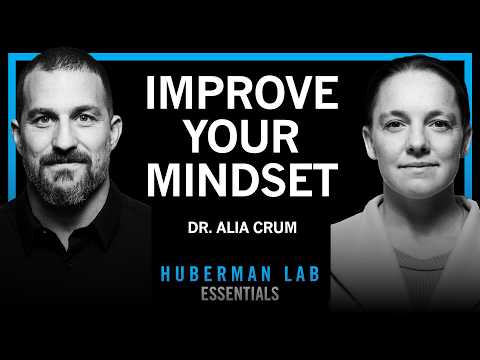
Essentials: Science of Mindsets for Health & Performance | Dr. Alia Crum
Andrew Huberman (host), Dr. Alia Crum (guest)
In this episode of Huberman Lab, featuring Andrew Huberman and Dr. Alia Crum, Essentials: Science of Mindsets for Health & Performance | Dr. Alia Crum explores harnessing Mindsets: Turning Stress, Food, and Exercise Into Superpowers Dr. Alia Crum explains mindsets as core beliefs about domains like stress, food, exercise, and health that shape expectations, motivation, behavior, and even physiology.
Harnessing Mindsets: Turning Stress, Food, and Exercise Into Superpowers
Dr. Alia Crum explains mindsets as core beliefs about domains like stress, food, exercise, and health that shape expectations, motivation, behavior, and even physiology.
She shares landmark studies showing that beliefs about what we eat, how we move, and how we experience stress can alter hormones like ghrelin, cortisol, and DHEA, as well as blood pressure, weight, and performance under pressure.
Crum emphasizes that stress, exercise, and diet are not purely biological—they are bio-psycho-social phenomena in which what you do and what you think about what you do jointly determine outcomes.
She offers a practical three-step protocol for leveraging stress (acknowledge, welcome, utilize) and urges people to treat their own lives like experiments, consciously choosing more empowering mindsets.
Key Takeaways
Mindsets are core assumptions that simplify reality but directly shape outcomes.
Crum defines mindsets as core beliefs about a domain (e. ...
Get the full analysis with uListen AI
What you believe about food can change your hunger hormones and satiety.
In the milkshake study, participants drank the same 300-calorie shake on two occasions but were told it was either a 620-calorie “indulgent” shake or a low-calorie “sensible” shake. ...
Get the full analysis with uListen AI
Reframing everyday activity as exercise can improve objective health markers without changing behavior.
In the hotel housekeepers study, women who were already highly active at work but did not see their work as exercise were informed—accurately—that their daily tasks met or exceeded Surgeon General exercise guidelines and carried associated health benefits. ...
Get the full analysis with uListen AI
Stress is not inherently bad; your global mindset about stress powerfully shapes health and performance.
Crum distinguishes between viewing stress as inherently damaging versus as something that can be enhancing. ...
Get the full analysis with uListen AI
Negative expectations (nocebo) can create real negative symptoms; belief effects cut both ways.
Just as placebo effects produce real physiological benefits from positive expectations, nocebo effects arise when negative beliefs lead to negative outcomes. ...
Get the full analysis with uListen AI
Stress can be leveraged using a three-step mindset protocol: acknowledge, welcome, utilize.
Crum suggests first acknowledging that you are stressed (bringing it into awareness rather than suppressing it). ...
Get the full analysis with uListen AI
Mindsets operate as a portal between conscious beliefs and subconscious physiology—and can be deliberately reprogrammed.
Brain systems controlling hormones like cortisol, DHEA, testosterone, and epinephrine are largely subconscious, but mindsets give the conscious mind an indirect lever over these systems. ...
Get the full analysis with uListen AI
Notable Quotes
“Mindsets are core beliefs or assumptions that we have about a domain or category of things that orient us to a particular set of expectations, explanations, and goals.”
— Dr. Alia Crum
“The total effect of anything is a combined product of what you're doing and what you think about what you're doing.”
— Dr. Alia Crum
“When people thought they were consuming the high-fat, high-calorie indulgent milkshake, their ghrelin levels dropped at a threefold rate stronger than when they thought they were consuming the sensible shake.”
— Dr. Alia Crum
“Stress is a neutral, yet-to-be-determined effect of experiencing or anticipating adversity in your goal‑related efforts.”
— Dr. Alia Crum
“Treat yourself like a scientist. Look at your life, look at your mindsets, see what's serving you, see what isn't.”
— Dr. Alia Crum
Questions Answered in This Episode
In the milkshake study, have you since tested whether labeling truly high-calorie or low-calorie foods as more or less indulgent changes longer-term eating behavior and weight, not just acute ghrelin responses?
Dr. ...
Get the full analysis with uListen AI
For the hotel housekeepers, how did you rule out subtle behavior changes (like walking slightly more briskly or taking stairs more often) as contributors to the observed blood pressure and weight improvements after the mindset intervention?
She shares landmark studies showing that beliefs about what we eat, how we move, and how we experience stress can alter hormones like ghrelin, cortisol, and DHEA, as well as blood pressure, weight, and performance under pressure.
Get the full analysis with uListen AI
When cultivating a ‘stress-is-enhancing’ mindset in people facing objectively severe, chronic stressors (e.g., poverty, serious illness), how do you avoid crossing into invalidating or minimizing their hardship?
Crum emphasizes that stress, exercise, and diet are not purely biological—they are bio-psycho-social phenomena in which what you do and what you think about what you do jointly determine outcomes.
Get the full analysis with uListen AI
Do you see ethical limits to deliberately shaping patients’ mindsets (for placebo or nocebo reduction) in clinical settings—for example, in how bluntly side-effect risks should be communicated?
She offers a practical three-step protocol for leveraging stress (acknowledge, welcome, utilize) and urges people to treat their own lives like experiments, consciously choosing more empowering mindsets.
Get the full analysis with uListen AI
If someone currently holds very negative beliefs about their diet, exercise, or stress levels, what is the first concrete experiment you would have them run this week to test a more empowering mindset in their own life?
Get the full analysis with uListen AI
Transcript Preview
Welcome to Huberman Lab Essentials, where we revisit past episodes for the most potent and actionable science-based tools for mental health, physical health, and performance. I'm Andrew Huberman, and I'm a professor of neurobiology and ophthalmology at Stanford School of Medicine. And now, my conversation with Dr. Alia Crum. Well, great to have you here.
(laughs) Great to be here.
Yeah. Just to start off, you know, you've talked a lot and worked a lot on the science of mindsets. Could you define for us what is a mindset and what sort of purpose does it serve?
We define mindsets as core beliefs or assumptions that we have about a domain or category of things that orient us to a particular set of expectations, explanations, and goals. I can, uh, distill it down for you. So mindsets are an assumption that you make about a domain. So take stress, for example, the nature of stress. What's your sort of core belief about that? Do you view stress as enhancing, good for you, or do you view it as debilitating and bad for you? Those mindsets, those core beliefs orient our thinking. They change what we expect will happen to us when we're stressed, how we explain the occurrences that happen or unfold when we're stressed, and also change our motivation for what we engage in when we're stressed. Sort of distilling down those core assumptions that really shape and orient our thinking and action.
Mm-hmm. I've heard you say before that mindsets simplify life in some way by constraining the number of things that we have to consider. Um, and it sounds to me like we can have mindsets about many things as, as you said. Uh, many people are familiar with our colleague Carol Dweck's, um, notion of growth mindset, that if we're not proficient at something that, uh, we should think about not being proficient yet, that we are on some path to proficiency. But what are some examples of mindsets, um, and how early do these get laid down, or do we learn them from our parents? So w-
Yeah, sure. So I think it's important with, with Carol Dweck's work, a lot of people kind of get focused on growth motivation and all these things. But her work really originated from thinking about what she called as implicit theories or core beliefs about the nature of intelligence or ability, right? So do you believe that your baseline levels of intelligence are fixed, static, set throughout the rest of your life? Or do you believe that they can grow and change? And the reality is, as it always is, complex and it's a bit of both and it's all these things. But as humans, we need these simplifying systems to help us understand a complex reality. But they're not inconse- inconsequential, right? They, they matter in shaping our motivation. And as she has shown, if you have the mindset that intelligence is malleable, you're motivated to work harder to grow your intelligence. If you have the mindset that it's fixed, why work harder at math if you don't think you're good at it? What our work has aimed to do is to expand the range of mindsets that we are, uh, studying, focused on, and also understand and expand the range of effects that they have. Uh, so I mentioned, you know, mindsets about stress. We've also looked at mindsets about food and healthy eating. So do you have the mindset that foods that are good for you, healthy foods are disgusting and depriving? Or do you have the mindset that healthy foods are indulgent and delicious? Generally, people, at least in our culture, in, in the West, have this view that stress is debilitating, healthy foods are disgusting and depriving. And those mindsets, whether or not they're true or false, right or wrong, they have an impact. And they have an impact not just through the motivational mechanisms that Dweck and others have studied, but as our lab has started to reveal, they also shape physiological mechanisms by changing what our bodies prioritize and prepare to do. We've looked at mindsets about exercise. Do you feel like you're getting enough or do you feel like you're getting an insufficient amount to get the health benefits you're seeking? Uh, mindsets about illness. Do you view cancer as an unmitigated catastrophe or do you view cancer as manageable? We've looked at mindsets about symptoms and side effects. Do you view side effects as, you know, a sign that the treatment is, is harmful or do you view side effects as a sign that the treatment is working? Again, these are sort of core beliefs or assumptions you have about these domains or categories. Uh, but they matter because they're shaping, they're synthesizing and simplifying the way we're thinking, but they're also shaping what we're paying attention to, what we're motivated to do, and potentially even how our bodies respond.
Install uListen to search the full transcript and get AI-powered insights
Get Full TranscriptGet more from every podcast
AI summaries, searchable transcripts, and fact-checking. Free forever.
Add to Chrome