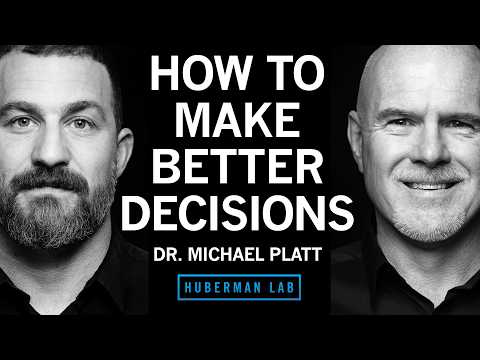
How to Make Better Decisions | Dr. Michael Platt
Andrew Huberman (host), Michael Platt (guest), Narrator
In this episode of Huberman Lab, featuring Andrew Huberman and Michael Platt, How to Make Better Decisions | Dr. Michael Platt explores hormones, Hierarchies, and Attention: The Hidden Drivers of Decisions Neuroscientist Dr. Michael Platt explains how our decision-making systems are fundamentally primate systems, tuned by evolution for social hierarchies, resource foraging, and survival rather than modern markets and smartphones. He describes how attention, valuation, hormones (testosterone, oxytocin), and social status signals are computed in the brain—with monkeys and humans using nearly identical circuitry.
Hormones, Hierarchies, and Attention: The Hidden Drivers of Decisions
Neuroscientist Dr. Michael Platt explains how our decision-making systems are fundamentally primate systems, tuned by evolution for social hierarchies, resource foraging, and survival rather than modern markets and smartphones. He describes how attention, valuation, hormones (testosterone, oxytocin), and social status signals are computed in the brain—with monkeys and humans using nearly identical circuitry.
The conversation covers how we allocate attention in rich digital environments, why focus feels so hard now, how foraging rules determine our web and social media behavior, and how subtle visual or social cues (faces, celebrities, proximity, fonts, endorsements) unconsciously bias what we value and choose. Platt’s work shows that we literally pay for social information—status, sex, and celebrity—in both monkeys and humans.
He also explains how oxytocin flattens primate hierarchies and increases prosocial behavior, how synchrony between brains and bodies is the “glue” of teams and relationships, and how our brains keep ledgers of social debts like grooming or texting. Throughout, he connects lab findings to real-world issues: social media addiction, meme coins, brand loyalty (Apple vs Samsung), political tribalism, loneliness, fertility decline, and financial bubbles.
Overall, the episode reveals that much of what we think are rational, individual choices are in fact driven by ancient circuits for attention, social evaluation, and hormones operating below conscious awareness—but that we can shape these circuits through environment design, deliberate attention practices, and better understanding of our primate wiring.
Key Takeaways
Your attention system is a foraging system, optimized to leave quickly in rich environments.
Platt explains that attention follows the same principles as animal foraging (the Marginal Value Theorem). ...
Get the full analysis with uListen AI
Where you put your eyes shapes the size and style of your mental focus.
Humans are highly visual, and the spatial properties of what we look at (tight vs. ...
Get the full analysis with uListen AI
Phones and unseen options silently tax working memory and self-control.
Even when your phone is face down or in your bag, your brain keeps it in the option set; it's 'under the hood' in your foraging calculations. ...
Get the full analysis with uListen AI
Our valuation of objects and brands is hijacked by social cues: status and sex.
In Platt’s famous "monkey porn" studies, male macaques gave up juice to view female perineums and dominant male faces, but had to be overpaid to view subordinate males—quantifying the value of status and sexual cues. ...
Get the full analysis with uListen AI
Your brain keeps an invisible social ledger of who owes whom what.
Using wireless recordings in freely interacting monkeys, Platt’s lab showed that the brain tracks precise grooming “accounts” between individuals—how much each has given and received over minutes, days, even weeks—across prefrontal and temporal cortices. ...
Get the full analysis with uListen AI
Oxytocin relaxes threat vigilance, flattens hierarchies, and increases prosociality—but in sex- and context-specific ways.
Delivered intranasally via nebulizer in monkeys, oxytocin reduced general vigilance and threat monitoring, made dominant males more chilled and subordinates bolder, and flattened steep rhesus hierarchies. ...
Get the full analysis with uListen AI
Synchrony across brains and bodies is the hidden “glue” of strong teams and relationships.
Platt describes work showing that when two people with good rapport interact, their brain activity patterns begin to align; their heart rates and breathing synchronize, their movements and gaze patterns converge. ...
Get the full analysis with uListen AI
Notable Quotes
“There’s a little monkey in all of us.”
— Dr. Michael Platt
“Your brain is basically a 30‑million‑year‑old Swiss Army knife.”
— Dr. Michael Platt
“You are doing exactly what you’re designed to do when you cycle between your phone, your laptop, and your TV. The environment is just too rich.”
— Dr. Michael Platt
“We discovered the mental account for social relationships in the brain—literally a ledger for who owes whom what.”
— Dr. Michael Platt
“It’s all about Apple. Apple customers choose Apple because they want to be part of something bigger. Samsung customers choose Samsung because they don’t want Apple.”
— Dr. Michael Platt
Questions Answered in This Episode
In your monkey stock market experiments, did any individuals consistently resist social contagion and bubbles, and if so, what distinguished their neural patterns or behavior from the others?
Neuroscientist Dr. ...
Get the full analysis with uListen AI
How would you design a practical, 10–15 minute daily “attention warm‑up” protocol that leverages gaze, foraging tasks, and environment control to reliably prepare someone for deep work?
The conversation covers how we allocate attention in rich digital environments, why focus feels so hard now, how foraging rules determine our web and social media behavior, and how subtle visual or social cues (faces, celebrities, proximity, fonts, endorsements) unconsciously bias what we value and choose. ...
Get the full analysis with uListen AI
Given your findings that oxytocin can both increase prosociality and sharpen in‑group versus out‑group responses, how concerned are you about using it (or oxytocin‑like interventions) in polarized political or corporate environments?
He also explains how oxytocin flattens primate hierarchies and increases prosocial behavior, how synchrony between brains and bodies is the “glue” of teams and relationships, and how our brains keep ledgers of social debts like grooming or texting. ...
Get the full analysis with uListen AI
In the real world, how can organizations ethically apply your celebrity/sex/status valuation findings without sliding into pure manipulation of consumers’ unconscious biases?
Overall, the episode reveals that much of what we think are rational, individual choices are in fact driven by ancient circuits for attention, social evaluation, and hormones operating below conscious awareness—but that we can shape these circuits through environment design, deliberate attention practices, and better understanding of our primate wiring.
Get the full analysis with uListen AI
Your Apple vs. Samsung work suggests that some people literally have larger social brain regions; do you think we should be screening leaders (political, corporate, military) for these neural and synchrony traits, and what ethical guardrails would that require?
Get the full analysis with uListen AI
Transcript Preview
Welcome to the Huberman Lab podcast, where we discuss science, and science-based tools for everyday life. I'm Andrew Huberman, and I'm a professor of neurobiology and ophthalmology at Stanford School of Medicine. My guest today is Dr. Michael Platt. Dr. Michael Platt is a professor of neuroscience and psychology at the University of Pennsylvania. His laboratory focuses on decision-making, more specifically, how we make decisions, and the impact of power dynamics, such as hierarchies in a given organization or group, as well as hormones on decision-making. We also discuss valuation, that is how we place value on things, on people, and what you'll find is that there are many factors that impact whether or not we think something is good, very good, bad, or very bad that operate below our conscious awareness. In fact, today's discussion will teach you how you make decisions, how to make better decisions in the context of everything from picking out a watch or a pair of shoes, all the way up to something as important as picking a life mate. Indeed, hormones, hierarchies, and specific things that are operating within you and adjacent to, nearby the things that you're evaluating, whether or not those things are people or objects, are powerfully shaping the neural circuits that lead you to make specific decisions. So today you're going to learn how all of that works, and as I mentioned, how to make better decisions. Dr. Platt also explains how we are evaluating the hormone levels of other people, both same sex and opposite sex, and the implications that has for relationships of all kinds. It's an incredibly interesting and unique conversation, certainly unique among the conversations I've had with any of my neuroscience colleagues over the decades, and I know that the information you're going to learn today is going to be both fascinating to you, it certainly was to me, and that it will impact the way that you think about all decisions at every level in everyday life. Before we begin, I'd like to emphasize that this podcast is separate from my teaching and research roles at Stanford. It is however part of my desire and effort to bring zero-cost-to-consumer information about science and science-related tools to the general public. In keeping with that theme, this episode does include sponsors. And now for my discussion with Dr. Michael Platt. Dr. Michael Platt, welcome.
Thanks. It's awesome to be here.
I've been following your work since I was a graduate student, and it's really interesting. You're an anthropologist by training, turned neuroscientist, turned practical applications of neuroscience and related fields to everybody as it relates to business, decision-making, social interactions, hormones. You've worked on a lot of different things. The first question I have is, let's all agree we're old world primates.
Yes.
Right? Most people don't even think of us as old world primates, but we are all old world primates, and we share many similarities in terms of the neural circuits that we have in our skulls with some of the other old world primates like macaque monkeys-
Install uListen to search the full transcript and get AI-powered insights
Get Full TranscriptGet more from every podcast
AI summaries, searchable transcripts, and fact-checking. Free forever.
Add to Chrome