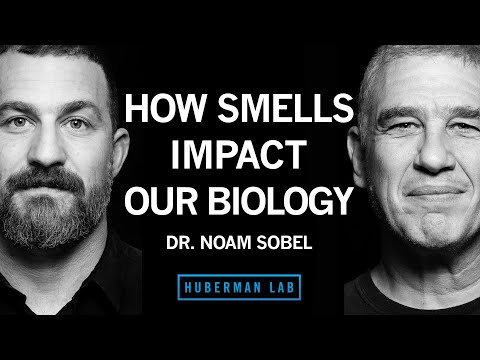
How Smells Influence Our Hormones, Health & Behavior | Dr. Noam Sobel
Andrew Huberman (host), Noam Sobel (guest), Narrator
In this episode of Huberman Lab, featuring Andrew Huberman and Noam Sobel, How Smells Influence Our Hormones, Health & Behavior | Dr. Noam Sobel explores invisible Scents: How Human Smell Quietly Controls Hormones, Safety, Desire Andrew Huberman interviews neurobiologist Dr. Noam Sobel about how human smell and chemosensation profoundly shape hormones, emotions, social behavior, and health—mostly outside our conscious awareness.
Invisible Scents: How Human Smell Quietly Controls Hormones, Safety, Desire
Andrew Huberman interviews neurobiologist Dr. Noam Sobel about how human smell and chemosensation profoundly shape hormones, emotions, social behavior, and health—mostly outside our conscious awareness.
They detail the biology of the olfactory system, debunk myths about humans having a “weak” sense of smell, and describe striking chemosensory effects: from tears that lower male testosterone and aggression, to baby odors that differentially modulate maternal and paternal aggression.
Sobel explains subconscious smell-based social signaling in handshakes, friendships, romantic attraction, and possible miscarriage risk, and describes the nasal cycle as a powerful, overlooked window into autonomic nervous system balance and disorders like ADHD.
The conversation concludes with ongoing efforts to “digitize” smell—developing algorithms and hardware that can predict and recreate odors, paving the way for olfactory communication, diagnostics, and new medical tools.
Key Takeaways
Humans Have Far Better Smell Than Commonly Believed
Humans can detect some odorants at extraordinarily low concentrations (e. ...
Get the full analysis with uListen AI
The Nasal Cycle Is a Live, Non-invasive Window Into Your Nervous System
Airflow naturally alternates between nostrils roughly every 2. ...
Get the full analysis with uListen AI
Social Chemosignals Quietly Shape Attraction, Friendship, and Aggression
Humans constantly self‑sniff and sniff others, usually without realizing it. ...
Get the full analysis with uListen AI
Tears and Baby Odors Directly Modulate Hormones and Aggression
Emotional tears from women are odorless but significantly lower free testosterone in men (~14% drop within ~20–30 minutes) and dampen activity in brain regions including the hypothalamus. ...
Get the full analysis with uListen AI
Chemosensation May Contribute to Pregnancy Loss and Reproductive Decisions
In many mammals, the Bruce effect shows that a pregnant female exposed to the odor of a non-fathering male will abort the pregnancy, mediated by the vomeronasal system. ...
Get the full analysis with uListen AI
Loss of Smell Is Clinically Important—and Trainable
The olfactory nerve passes through the fragile cribriform plate, making it vulnerable to shearing during head trauma (often from back-of-head impacts), which can produce permanent smell loss if fibers are fully severed. ...
Get the full analysis with uListen AI
Smell Can Be Predicted and Recreated Algorithmically—Enabling Digital Olfaction
Sobel’s lab developed an algorithmic framework that predicts how similar any two odor mixtures will smell and can design completely different mixtures (no shared molecules) that smell indistinguishable—olfactory “metamers. ...
Get the full analysis with uListen AI
Notable Quotes
“Humans have an utterly remarkable sense of smell. We are not a bad mammal at olfaction.”
— Dr. Noam Sobel
“You are walking around with a marker on balance in your autonomic nervous system, and we do nothing with it.”
— Dr. Noam Sobel (about the nasal cycle)
“Babies are conducting chemical warfare… reducing aggression in their fathers and increasing aggression in their mothers, and both of those things are good for them.”
— Dr. Noam Sobel
“Emotional tears are like a chemical blanket you put over yourself to protect against aggression.”
— Dr. Noam Sobel
“In the two most basic behaviors we have, we follow our nose, not our eyes.”
— Dr. Noam Sobel
Questions Answered in This Episode
In your nasal halter data for ADHD, do you see specific patterns in the timing or amplitude of the nasal cycle (e.g., more frequent switches, flatter cycles) that could guide targeted breathing or behavioral interventions beyond pharmacology?
Andrew Huberman interviews neurobiologist Dr. ...
Get the full analysis with uListen AI
For couples experiencing unexplained recurrent pregnancy loss, what exactly does your ongoing interventional study involve in terms of smell-blocking, and are there any preliminary signals that certain timing (e.g., peri-implantation vs later) is especially critical?
They detail the biology of the olfactory system, debunk myths about humans having a “weak” sense of smell, and describe striking chemosensory effects: from tears that lower male testosterone and aggression, to baby odors that differentially modulate maternal and paternal aggression.
Get the full analysis with uListen AI
Hexadecanal clearly has opposite effects on male and female aggression; do you think chronic exposure in modern environments (e.g., from household products or industrial sources) could be subtly biasing social behavior in ways we haven’t recognized?
Sobel explains subconscious smell-based social signaling in handshakes, friendships, romantic attraction, and possible miscarriage risk, and describes the nasal cycle as a powerful, overlooked window into autonomic nervous system balance and disorders like ADHD.
Get the full analysis with uListen AI
Given the strong hormonal and behavioral effects of odorless tears and baby-head odors, do you envision ethical concerns or potential misuse if synthetic versions of these chemosignals were commercialized (e.g., to calm crowds or influence negotiations)?
The conversation concludes with ongoing efforts to “digitize” smell—developing algorithms and hardware that can predict and recreate odors, paving the way for olfactory communication, diagnostics, and new medical tools.
Get the full analysis with uListen AI
Your digital olfaction work produced olfactory metamers and even a metamer of Chanel No. 5; what are the main technical and conceptual barriers to scaling this into a consumer-level 'smell display,' and how would you prioritize applications—entertainment, telepresence, or medical diagnostics—if resources were limited?
Get the full analysis with uListen AI
Transcript Preview
Welcome to the Huberman Lab Podcast, where we discuss science and science-based tools for everyday life. I'm Andrew Huberman, and I'm a professor of neurobiology and ophthalmology at Stanford School of Medicine. Today my guest is Dr. Noam Sobel. Dr. Noam Sobel is a professor of neurobiology in the Department of Brain Sciences at the Weizmann Institute of Science. His laboratory studies olfaction and chemosensation. Olfaction is, of course, our sense of smell. Chemosensation is our ability to respond to chemicals in our environment. Today you are going to learn some absolutely incredible facts about how you interact with the world and other people around you. For instance, you will learn that humans can smell things around them as well as dogs can. In fact, humans are incredibly good at sensing the chemical world around them. You will also learn, for instance, that every time you meet somebody, you are taking chemicals from that person, either from the chemical cloud that surrounds them or directly from the surface of their body, and you are actually applying it to your own body, and you are processing information about that person's chemicals to determine many things about them, including how stressed they are, their hormone levels, things that operate at a subconscious level on your brain and nervous system, and that impact your emotions, your decision-making, and who you choose to relate to or not to relate to. You will also learn that tears, yes, the tears of others, are impacting your hormone levels in powerful ways. You will also learn that every so often, actually on a regular schedule, there is an alternation of ease through which you can breathe through one nostril or the other, and that alternation reflects an underlying dynamic of your nervous system and has a lot to do with how alert or sleepy you happen to be. The list of things that Dr. Noam Sobel's laboratory has discovered that relate to everyday life and that are going to make you say, "Wow, I can't believe that happens," but then go out into the real world and actually observe that that happens in ways that are incredibly interesting just goes on and on. In fact, his laboratory discovered that we are always sensing our own odors. That's right. Even though you might not notice your own smell, you are always sensing your own odor cloud, and throughout the day you periodically smell yourself deliberately, even though you might not realize it, in order to change your cognition and behavior. I first learned of Dr. Sobel's laboratory through a rather odd observance. That observance took place when I was a graduate student many years ago at UC Berkeley. At the time, Noam Sobel was a professor at UC Berkeley. As I mentioned before, he has since moved to the Weizmann. Well, I was walking through the Berkeley campus and I saw people on their hands and knees, but with their head very close to the ground, and their eyes were covered, their hands were covered, their mouths were covered, and only their nose was exposed. And what I was observing was an experiment being conducted by the Sobel Laboratory in which humans were following a scent trail. That scent trail was actually buried some depth underneath the earth, and yet they could follow that scent trail with a high degree of fidelity. It was from that experiment and other experiments done in Dr. Sobel's laboratory at Berkeley and at the Weizmann involving neuroimaging and a number of other tools and techniques that revealed the incredible power of human olfaction and humans' ability to follow scent trails if they need to. And that, of course, led to many other important discoveries, some of which I alluded to a few moments ago, but you are going to learn about many, many other important discoveries in the realm of olfaction and chemosensation that have been carried out by Dr. Sobel's laboratory through the course of today's episode. And by the end of today's episode, I assure you that you will never look at or smell the world around you the same way again. Before we begin, I'd like to emphasize that this podcast is separate from my teaching and research roles at Stanford. It is, however, part of my desire and effort to bring zero-cost-to-consumer information about science and science-related tools to the general public. In keeping with that theme, I'd like to thank the sponsors of today's podcast. Our first sponsor is ROKA. ROKA makes eyeglasses and sunglasses that are of the absolute highest quality. I've spent a lifetime working on the biology of the visual system, and I can tell you that your visual system has to contend with an enormous number of challenges in order for you to be able to see clearly. ROKA eyeglasses and sunglasses were designed with the biology of the visual system in mind, so no matter whether or not you're wearing them for sport, whether or not you're wearing them for work or for socializing, you can always see with crystal clarity. Their glasses are extremely lightweight, so most of the time you don't even realize that you're wearing them. I wear ROKA Readers at night and sometimes when I drive at night, and I wear ROKA sunglasses throughout the day, except, of course, I do not wear them for my morning sunlight viewing. If you'd like to try ROKA eyeglasses or sunglasses, go to ROKA, that's R-O-K-A, .com and enter the code Huberman to save 20% off your first order. Again, that's R-O-K-A .com and enter the code Huberman at checkout. Today's episode is also brought to us by Thesis. Thesis makes custom nootropics, and nootropics is a word that I do not like because it means smart drugs. As a neurobiologist, I can tell you that there is no neural circuit in your brain for being smart. There are neural circuits for focus, there are neural circuits for memory, there are neural circuits for creativity, and there are neural circuits for task switching. Thesis understands that there's a diversity of neural circuits that support different brain body states and therefore have designed nootropics that are customized to achieve specific brain body states. If you go to the Thesis website and take a brief quiz, they will design a nootropic starter kit. Some of those nootropics that they'll send you are designed to enhance your focus, others for clarity, others for creativity, and so on. To get your own personalized nootropic starter kit, you can go to takethesis.com/huberman and take a three-minute quiz, and Thesis will send you four different formulas to try in your first month. That's takethesis.com/huberman and use the code Huberman at checkout to get 10% off your first order.Today's episode is also brought to us by Helix Sleep. Helix Sleep makes customized mattresses and pillows that allow you to get the best possible night's sleep. So if you go to the Helix website, you can take a very brief quiz, it only takes about two minutes, and answer questions such as, do you tend to sleep on your back or your side or your stomach? Do you tend to run hot or cold throughout the night? Maybe you don't know the answers to those questions. But they'll match you to a mattress that's ideal for your sleep needs. For me, that was the Dusk, D-U-S-K, mattress, which is not too firm and not too soft, and I've been sleeping on it for more than two years and it's the best sleep that I've ever had. If you'd like to try a Helix mattress, go to helixsleep.com/huberman. Take that two-minute quiz and they'll match you to a customized mattress and you'll get up to $350 off any mattress order and two free pillows. Again, if you're interested, you can go to helixsleep.com/huberman for up to $350 off and two free pillows. And now for my discussion with Dr. Noam Sobel. Dr. Sobel-
Install uListen to search the full transcript and get AI-powered insights
Get Full TranscriptGet more from every podcast
AI summaries, searchable transcripts, and fact-checking. Free forever.
Add to Chrome