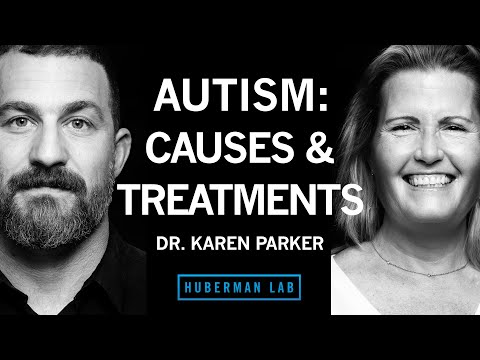
The Causes & Treatments for Autism | Dr. Karen Parker
Andrew Huberman (host), Dr. Karen Parker (guest)
In this episode of Huberman Lab, featuring Andrew Huberman and Dr. Karen Parker, The Causes & Treatments for Autism | Dr. Karen Parker explores vasopressin, Not Oxytocin, Emerges As Key To Autism Treatment Andrew Huberman and social neuroscientist Dr. Karen Parker discuss current science on autism’s causes, biology, and potential treatments, focusing on social behavior circuitry. They review why autism incidence is truly rising, how genetics and environment interact, and why diagnostic and treatment efforts are hampered by heterogeneity and late diagnosis.
Vasopressin, Not Oxytocin, Emerges As Key To Autism Treatment
Andrew Huberman and social neuroscientist Dr. Karen Parker discuss current science on autism’s causes, biology, and potential treatments, focusing on social behavior circuitry. They review why autism incidence is truly rising, how genetics and environment interact, and why diagnostic and treatment efforts are hampered by heterogeneity and late diagnosis.
Parker outlines the limitations of mouse models and describes developing a naturalistic non‑human primate model of social impairment that more closely mirrors human autism traits. This led her lab to identify low vasopressin in cerebrospinal fluid (CSF)—not oxytocin—as a robust biological signature of social deficits in both monkeys and humans.
Follow‑up human work shows that infants who later develop autism already have low CSF vasopressin, suggesting an early, possibly causal deficit. In a first‑in‑human randomized controlled trial, intranasal vasopressin improved core social symptoms in children with autism, positioning vasopressin pathways as a promising therapeutic target.
They also cover why large oxytocin and pharmaceutical vasopressin‑antagonist trials failed, how microbiome–brain signaling via the vagus nerve may modulate oxytocin/vasopressin, and why early, biology‑informed, stratified trials and better access to diagnosis are urgently needed.
Key Takeaways
Autism incidence is genuinely increasing, and early diagnosis is crucial but logistically constrained.
Current US prevalence is about 1 in 36 children, up from 1 in 44 just a few years ago, with a 3–4:1 male bias. ...
Get the full analysis with uListen AI
Autism is not one condition but many overlapping ‘autisms,’ complicating diagnosis and treatment.
Autism is defined behaviorally by two core domains—pervasive social interaction challenges and restricted, repetitive behaviors—but presentations vary dramatically. ...
Get the full analysis with uListen AI
Oxytocin is not broadly deficient in autism; its therapeutic benefit may be limited to specific subgroups and ages.
Large CSF and blood studies show oxytocin levels do not systematically differ between autistic and non‑autistic groups. ...
Get the full analysis with uListen AI
Vasopressin in CSF, not oxytocin, tracks social functioning and autism diagnosis across species.
Using a naturalistic rhesus macaque model of low vs. ...
Get the full analysis with uListen AI
Infants who later develop autism already show low CSF vasopressin, suggesting an early biological deficit.
In collaboration with John Constantino, Parker analyzed banked neonatal CSF samples from medically evaluated but largely healthy infants. ...
Get the full analysis with uListen AI
Intranasal vasopressin improved core social symptoms in a controlled pediatric autism trial, with acceptable safety.
In a double‑blind, randomized, placebo‑controlled four‑week trial (6–12‑year‑olds), intranasal vasopressin twice daily led to statistically significant social gains versus placebo on the Social Responsiveness Scale (parent ratings), clinician assessments, and lab‑based emotion recognition tasks. ...
Get the full analysis with uListen AI
Blocking vasopressin appears counterproductive for autism, underscoring the importance of mechanism-aligned drug design.
A major pharma company (Roche) tested a V1a vasopressin receptor antagonist (balovaptan) for autism, based partly on rodent data where vasopressin can promote aggression in asocial species like hamsters. ...
Get the full analysis with uListen AI
Notable Quotes
“If you've met one kid with autism, you've met one kid with autism.”
— Dr. Karen Parker
“We are at the infancy of thinking about whether autism is truly a brain-based disorder, or for some people a gut–brain disorder, or something else entirely.”
— Dr. Karen Parker
“Vasopressin was like flipping a light switch. These males ran around the cage, picked up all the babies, put them in a nest, and huddled over them.”
— Dr. Karen Parker
“Infants who went on to have an autism diagnosis later in life already had low vasopressin levels in their spinal fluid.”
— Dr. Karen Parker
“To me, it actually seems unethical not to move forward, in a scientifically sound way, with a medication that could reduce suffering and help people with autism reach their full potential.”
— Dr. Karen Parker
Questions Answered in This Episode
Given that low CSF vasopressin appears present in infancy, how early do you think vasopressin-based interventions could ethically and safely be started, and what would an ideal early-life trial design look like?
Andrew Huberman and social neuroscientist Dr. ...
Get the full analysis with uListen AI
In your vasopressin trial, did baseline CSF or blood vasopressin levels predict which children responded best, and do you envision a future where such a lab test guides who should receive vasopressin therapy?
Parker outlines the limitations of mouse models and describes developing a naturalistic non‑human primate model of social impairment that more closely mirrors human autism traits. ...
Get the full analysis with uListen AI
How do you reconcile rodent data in which vasopressin can promote aggression with your primate and human findings that vasopressin is pro-social, and what does that say about choosing model species for psychiatric drug development?
Follow‑up human work shows that infants who later develop autism already have low CSF vasopressin, suggesting an early, possibly causal deficit. ...
Get the full analysis with uListen AI
For autistic individuals or parents who are wary of psychoactive drugs, what do you see as the most realistic non-pharmacologic ways to influence oxytocin/vasopressin systems (e.g., microbiome interventions, vagus nerve stimulation, behavioral therapies)?
They also cover why large oxytocin and pharmaceutical vasopressin‑antagonist trials failed, how microbiome–brain signaling via the vagus nerve may modulate oxytocin/vasopressin, and why early, biology‑informed, stratified trials and better access to diagnosis are urgently needed.
Get the full analysis with uListen AI
If autism is likely a collection of ‘autisms,’ what concrete steps should research funders and regulators take to stop lumping everyone into the same trials and start supporting biologically stratified, mechanism-driven studies like yours?
Get the full analysis with uListen AI
Transcript Preview
Welcome to the Huberman Lab Podcast, where we discuss science and science-based tools for everyday life. I'm Andrew Huberman, and I'm a professor of neurobiology and ophthalmology at Stanford School of Medicine. My guest today is Dr. Karen Parker. Dr. Karen Parker directs the Social Neurosciences Research Program at the Stanford University School of Medicine. The goal of her laboratory's research is to understand the biological basis of social functioning at every stage of the lifespan. So this includes the bonds that form between infant and parent or parents, as well as the bonds that occur between children as they grow up, which, of course, form the template for social functioning when we become adults. Dr. Parker's research is heavily focused on autism and indeed on all forms of autism spectrum disorders. Today, we discuss autism, we talk about the prominent theories and current understanding of the biological basis for autism, as well as what still remains mysterious and unresolved about the causes of autism. You may have heard that the incidents or perhaps just the diagnosis of autism has dramatically increased in the last 10 to 15 years, and today, we discuss why it is in fact that the incidents, not just the diagnoses but the incidents of autism has so dramatically increased. And perhaps most excitingly, Dr. Parker shares with us brand new research findings from her laboratory that point to a new understanding of what causes autism as well as a novel treatment for autism. Before we begin, I'd like to emphasize that this podcast is separate from my teaching and research roles at Stanford. It is, however, part of my desire and effort to bring zero-cost-to-consumer information about science and science-related tools to the general public. In keeping with that theme, I'd like to thank the sponsors of today's podcast. Our first sponsor is Eight Sleep. Eight Sleep makes smart mattress covers with cooling, heating, and sleep tracking capacity. I've spoken many times before on this podcast about the fact that sleep is the foundation of mental health, physical health, and performance. Now, a key component of getting a great night's sleep is that in order to fall and stay deeply asleep, your body temperature actually has to drop by about one to three degrees, and in order to wake up feeling refreshed and energized, your body temperature actually has to increase by about one to three degrees. One of the best ways to make sure that those temperature changes occur at the appropriate times, at the beginning and throughout and at the end of your night when you wake up, is to control the temperature of your sleeping environment, and that's what Eight Sleep allows you to do. It allows you to program the temperature of your mattress and sleeping environment such that you fall and stay deeply asleep easily and wake up each morning feeling incredibly refreshed and energized. I've been sleeping on an Eight Sleep mattress cover for almost three years now, and it has dramatically improved the quality of my sleep, so much so that when I travel and I'm at a hotel or an Airbnb and I don't have access to my Eight Sleep, I very much look forward to getting home because my sleep is always better when I sleep on my Eight Sleep mattress cover. If you'd like to try Eight Sleep, you can go to eightsleep.com/huberman to get $150 off their Pod 3 mattress cover. Eight Sleep currently ships in the USA, Canada, UK, select countries in the EU, and Australia. Again, that's eightsleep.com/huberman. Today's episode is also brought to us by LMNT. LMNT is an electrolyte drink that has everything you need and nothing you don't. That means zero sugar and the appropriate ratios of the electrolytes sodium, magnesium, and potassium. And that correct ratio of electrolytes is extremely important because every cell in your body, but especially your nerve cells, your neurons, relies on electrolytes in order to function properly. So when you're well-hydrated and you have the appropriate amount of electrolytes in your system, your mental functioning and your physical functioning is improved. I drink one packet of LMNT dissolved in about 16 to 32 ounces of water when I wake up in the morning, as well as while I exercise, and if I've sweat a lot during that exercise, I often will drink a third LMNT packet dissolved in about 32 ounces of water after I exercise. LMNT comes in a variety of different flavors, all of which I find really tasty. I like the citrus, I like the watermelon, I like the raspberry. Frankly, I can't pick just one. It also comes in chocolate and chocolate mint, which I find taste best if they are put into water dissolved and then heated up. I tend to do that in the winter months because, of course, you don't just need hydration on hot days and in the summer and spring months but also in the winter when the temperatures are cold and the environment tends to be dry. If you'd like to try LMNT, you can go to Drink LMNT, spelled L-M-N-T, .com/huberman to try a free sample pack. Again, that's drinklmnt.com/huberman. Today's episode is also brought to us by AeroPress. AeroPress is similar to a French press for making coffee but is in fact a much better way to make coffee. I first learned about AeroPress well over 10 years ago, and I've been using one ever since. AeroPress was developed by Alan Adler, who was an engineer at Stanford, and I knew of Alan because he had also built the so-called Aerobie Frisbee, which I believe at one time, perhaps still now, held the Guinness Book of World Records for furthest thrown object, and I used to see Alan, believe it or not, at parks around Palo Alto, testing out different Aerobie Frisbees, so he was sort of famous in our community for developing these different feats of engineering that turned into commercial products. Now, I love coffee. I'm somebody that drinks coffee nearly every day, usually about 90 to 120 minutes after I wake up in the morning, although not always. Sometimes if I'm going to exercise, I'll drink coffee first thing in the morning, but I love, love, love coffee, and what I've personally found is that by using the AeroPress, I can make the best possible tasting cup of coffee. I don't know what exactly it is in the AeroPress that allows the same beans to be prepared into a cup of coffee that tastes that much better as compared to any other form of brewing that coffee, even the traditional French press. The AeroPress is extremely easy to use, and it's extremely compact. In fact, I take it with me whenever I travel, and I use it on the road in hotels, even on planes. I'll just ask for some hot water, and I'll brew my coffee or tea right there on the plane. If you'd like to try AeroPress, you can go to aeropress.com/huberman. That's A-E-R-O-P-R-E-S-S .com/huberman to get 20% off any AeroPress coffee maker. AeroPress ships anywhere in the USA, Canada, and over 60 other countries around the world. Again, that's aeropress.com/huberman to get 20% off. And now for my discussion with Dr. Karen Parker. Dr. Karen Parker, welcome.
Install uListen to search the full transcript and get AI-powered insights
Get Full TranscriptGet more from every podcast
AI summaries, searchable transcripts, and fact-checking. Free forever.
Add to Chrome