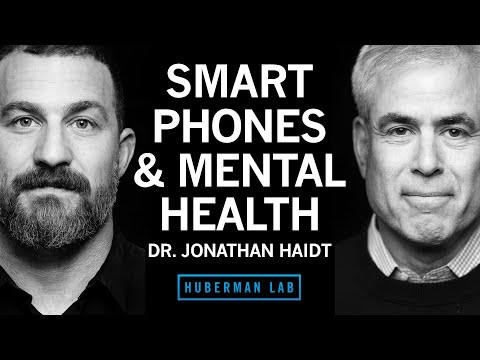
How Smartphones & Social Media Impact Mental Health & the Realistic Solutions | Dr. Jonathan Haidt
Andrew Huberman (host), Jonathan Haidt (guest), Narrator, Narrator, Narrator
In this episode of Huberman Lab, featuring Andrew Huberman and Jonathan Haidt, How Smartphones & Social Media Impact Mental Health & the Realistic Solutions | Dr. Jonathan Haidt explores rewiring Childhood: Smartphones, Social Media, And Saving Kids’ Minds Andrew Huberman and social psychologist Jonathan Haidt argue that 2010–2015 marked a ‘great rewiring’ of childhood, as smartphones and social media replaced play, in‑person friendship, and boredom with a phone‑based, always‑on digital existence. During the same period, anxiety, depression, and self‑harm in adolescents—especially girls—rose sharply across many developed countries, in patterns that closely track the adoption of smartphones, front-facing cameras, and social apps like Instagram, TikTok, and Snapchat.
Rewiring Childhood: Smartphones, Social Media, And Saving Kids’ Minds
Andrew Huberman and social psychologist Jonathan Haidt argue that 2010–2015 marked a ‘great rewiring’ of childhood, as smartphones and social media replaced play, in‑person friendship, and boredom with a phone‑based, always‑on digital existence. During the same period, anxiety, depression, and self‑harm in adolescents—especially girls—rose sharply across many developed countries, in patterns that closely track the adoption of smartphones, front-facing cameras, and social apps like Instagram, TikTok, and Snapchat.
Haidt explains how developmental ‘sensitive periods,’ particularly around puberty, interact with fast, algorithmically amplified social feedback and high‑potency digital stimuli (porn, violent games, short‑form video) to rewire dopamine and social circuits in maladaptive ways. Boys tend to be drawn into digital war, systems, and porn; girls into highly relational platforms that supercharge comparison, conflict, and reputation management.
They emphasize that the primary problem is not the internet per se, but the combination of constant access, social media business models, and the removal of free, unsupervised play in the real world. Haidt proposes four concrete norms—no smartphone before high school, no social media before 16, phone‑free schools, and more independence and free play—that he believes can realistically reverse current trends within a few years if adopted collectively by parents, schools, and policymakers.
Key Takeaways
2010–2015 Marked a Structural Shift in Childhood—and in Youth Mental Health
Large, multi-decade datasets from the U. ...
Get the full analysis with uListen AI
Time, Not Just Content, Is the Core Problem: Childhood Became Phone-Based
Contemporary U. ...
Get the full analysis with uListen AI
Boys and Girls Are ‘Trapped’ Differently—But Both Lose Crucial Development
Drawing on Simon Baron-Cohen’s empathizing/systemizing framework, Haidt notes that girls, on average, are more attuned to social relationships and status; boys, more to systems, war, and (especially) sex. ...
Get the full analysis with uListen AI
Pornography Rewires Adolescent Dopamine Systems Away from Real Relationships
Huberman explains that fast, high peaks in dopamine—whether from drugs like methamphetamine or endless on-demand porn—train the brain to expect quick, effortless reinforcement and progressively reduce sensitivity to more natural, slower forms of reward. ...
Get the full analysis with uListen AI
Sensitive Periods Around Puberty Make Digital Exposures Especially Consequential
Haidt and Huberman connect classic sensitive periods (e. ...
Get the full analysis with uListen AI
Loss of Free, Unsupervised Play Undermines Social Skills and Resilience
Act I of Haidt’s ‘three-act tragedy’ is declining community trust; Act II is the 1990s–2000s panic over kidnapping and abuse, which led parents to keep kids indoors and constantly supervised. ...
Get the full analysis with uListen AI
Four Concrete Norms Offer a Realistic Path Out of the Trap
Haidt proposes four collective norms: (1) No smartphone before high school—kids can have basic/flip phones or controlled devices but not full internet-in-pocket; (2) No social media before age 16—raise legal minimum age and enforce age verification, because the social-trap dynamics make ‘just be the only family who says no’ untenable; (3) Phone-free schools—phones locked away all day (not just ‘in pockets’) to restore attention and in-person interaction; and (4) Far more independence, free play, and real-world responsibility—through neighborhood adventures, team sports, summer camps, music ensembles, and religious or community groups. ...
Get the full analysis with uListen AI
Notable Quotes
“It’s as though our kids are being raised in Harrah’s Casino.”
— Jonathan Haidt
“Our kids used to have a play‑based childhood. Since 2010 or 2012, our kids have a phone‑based childhood.”
— Jonathan Haidt
“If you intervene in the developmental process and say, ‘Hey kid, you want the endpoint without the journey? Here you go,’ you’re cutting off development.”
— Jonathan Haidt
“When dopamine arrives quickly without effort, such as with amphetamine, crack cocaine, or pornography, the whole reinforcement loop becomes wired to these short timescales.”
— Andrew Huberman
“There is no way to make social media safe for children… even if the content were perfect, you’re still making them brand managers of their own lives.”
— Jonathan Haidt
Questions Answered in This Episode
For adolescents who have already gone through puberty with heavy social media and porn exposure, what specific, neuroscience-informed interventions (beyond simple abstinence) could help ‘re-train’ their dopamine and social circuits toward healthier reward sources?
Andrew Huberman and social psychologist Jonathan Haidt argue that 2010–2015 marked a ‘great rewiring’ of childhood, as smartphones and social media replaced play, in‑person friendship, and boredom with a phone‑based, always‑on digital existence. ...
Get the full analysis with uListen AI
You argue there’s effectively ‘no way’ to make social media safe for minors; if platforms were willing to radically alter their business models, what concrete design changes (e.g., no likes, no follower counts, no algorithmic feeds) would be required before you’d reconsider that stance?
Haidt explains how developmental ‘sensitive periods,’ particularly around puberty, interact with fast, algorithmically amplified social feedback and high‑potency digital stimuli (porn, violent games, short‑form video) to rewire dopamine and social circuits in maladaptive ways. ...
Get the full analysis with uListen AI
Given that boys and girls are drawn into different digital ‘traps’ (war/games/porn vs. relational social media), should schools and parents tailor their interventions differently by sex, or is there a risk that doing so would reinforce stereotypes and miss important individual variation?
They emphasize that the primary problem is not the internet per se, but the combination of constant access, social media business models, and the removal of free, unsupervised play in the real world. ...
Get the full analysis with uListen AI
You compare today’s social media environment to a casino owning our children’s attention; what would a realistic regulatory framework look like if we treated attention and dopamine manipulation with the same seriousness as gambling or tobacco control?
Get the full analysis with uListen AI
If you could redesign middle school and high school from the ground up to align with what we now know about sensitive periods, plasticity, and social development, what would the daily schedule, physical environment, and use of technology actually look like?
Get the full analysis with uListen AI
Transcript Preview
(instrumental music) Welcome to the Huberman Lab Podcast, where we discuss science and science-based tools for everyday life. I'm Andrew Huberman, and I'm a professor of neurobiology and ophthalmology at Stanford School of Medicine. My guest today is Dr. Jonathan Haidt. Dr. Jonathan Haidt is a social psychologist and professor at New York University. He is also the author of several important best-selling books, including The Coddling of the American Mind, and more recently, The Anxious Generation: How the Great Rewiring of Childhood Is Causing an Epidemic of Mental Illness. And today, we talk mainly about The Anxious Generation. However, it is not a purely pessimistic conversation. Indeed, Dr. Haidt offers several clear solutions to the mental health crisis that now exists and that we have all created through the use of smartphones, in particular in kids entering and transitioning through puberty. During today's episode, we discuss so-called critical or sensitive periods for social development, for the development of an understanding about competition and violence, about sex, and how boys and girls are impacted differently by smartphone use, and the specific solutions that do exist, and that Dr. Haidt has created, that can place boys and girls, as well as young adults, back on the trajectory of mental health. So today's discussion is really one that brings together an understanding of neurobiology, psychology, social psychology, and technology in ways that are designed to serve the most critical members of our species, meaning our youth. And for those that have already gone through youth, today's discussion is also relevant to you, because as many of you know and perhaps have experienced, most everybody nowadays is challenged in some way by smartphones, both for their utility and the ways in which they can diminish our social and family interactions, academic performance, and more. So thanks to Dr. Haidt, today's discussion really is a solution-based one, and it's one that is sure to educate, inform, and inspire specific, positive action. Before we begin, I'd like to emphasize that this podcast is separate from my teaching and research roles at Stanford. It is, however, part of my desire and effort to bring zero-cost-to-consumer information about science and science-related tools to the general public. In keeping with that theme, I'd like to thank the sponsors of today's podcast. Our first sponsor is Helix Sleep. Helix Sleep makes mattresses and pillows that are customized to your unique sleep needs. Now, I've spoken many times before on this and other podcasts about the fact that sleep is the foundation for mental health, physical health, and performance. Now, one of the key things to getting a great night's sleep is to make sure that you sleep on a mattress designed specifically for your sleep needs. And that's what Helix Sleep mattresses are designed to accomplish. If you go to the Helix website and take a brief two-minute quiz, it asks you questions such as, "Do you sleep on your back, your side, or your stomach? Do you tend to run hot or cold during the night?" Maybe you know, maybe you don't know the answers to those questions. In any case, they'll match you to the ideal mattress for your unique sleep needs. For me, that turned out to be the Dusk Helix mattress. I started sleeping on a Dusk mattress about three and a half years ago, and it's been far and away the best sleep that I've ever had. So if you'd like to try a Helix mattress designed for your unique sleep needs, you can go to helixsleep.com/huberman, take that brief two-minute sleep quiz, and Helix will match you to a mattress that's ideal for your unique sleep needs. Right now, Helix is offering 20% off mattresses and two free pillows. Again, that's helixsleep.com/huberman to get 20% off and two free pillows. Today's episode is also brought to us by AeroPress. AeroPress is like a French press, but a French press that always brews the perfect cup of coffee, meaning no bitterness and excellent taste. AeroPress achieves this because it uses a very short contact time between the hot water and the coffee. And that short contact time also means that you can brew an excellent cup of coffee very quickly. The whole thing only takes about three minutes. I started using an AeroPress over 10 years ago. I first learned about it from a guy named Alan Adler, who's a former Stanford engineer and inventor. I'm a big fan of Adler's inventions, and when I heard he developed a coffee maker, the AeroPress, I tried it, and I found that indeed it makes the best possible tasting cup of coffee. And I'm not alone in my love of the AeroPress. With over 55,000 five-star reviews, AeroPress is the best-reviewed coffee press in the world. I'm also excited to share that AeroPress has just released a brand-new AeroPress that brews and packs into its own travel tumbler. This new AeroPress, called the AeroPress Go Plus, makes brewing coffee when traveling incredibly easy. The design is really clever. The entire AeroPress unit packs really nicely into a custom AeroPress travel thermos that's small enough that it can fit into your carry-on or any form of luggage. And with it, you can make an excellent cup of coffee anywhere. All you need is some ground coffee and hot water. Indeed, I've even used it on the plane, in hotels, of course. Basically, I take it with me anywhere I need a great-tasting cup of coffee. And with Father's Day coming up, it makes for a great Father's Day gift. If you'd like to try AeroPress, you can go to aeropress.com/huberman to get 20% off. AeroPress currently ships in the USA, Canada, and to over 60 countries around the world. Again, that's aeropress.com/huberman. Today's episode is also brought to us by Joovv. Joovv makes medical-grade red light therapy devices. Now, if there's one thing I've consistently emphasized on this podcast, it's the incredible impact that light can have on our biology. Now, in addition to sunlight, red light and near-infrared light have been shown to have positive effects on improving numerous aspects of cellular and organ health, including faster muscle recovery, improved skin health and wound healing, even improvements in acne, reducing pain and inflammation, improving mitochondrial function, and even improving vision itself. What sets Joovv lights apart and why they're my preferred red light therapy devices is that they use clinically proven wavelengths, meaning it uses specific wavelengths of red light and near-infrared light in combination to trigger the optimal cellular adaptations. Personally, I use the Joovv handheld light both at home and when I travel. It's only about the size of a sandwich, so it's super portable and convenient to use. I also have a Joovv whole body panel, and I use that about three or four times per week. If you'd like to try Joovv, you can go to Joovv, spelled J-O-O-V-V, .com/huberman. Joovv is offering an exclusive discount to all Huberman Lab listeners with up to $400 off select Joovv products. Again, that's Joovv, J-O-O-V-V, .com/huberman to get $400 off select Joovv products. And now for my discussion with Dr. Jonathan Haidt. Dr. Jonathan Haidt-Welcome.
Install uListen to search the full transcript and get AI-powered insights
Get Full TranscriptGet more from every podcast
AI summaries, searchable transcripts, and fact-checking. Free forever.
Add to Chrome