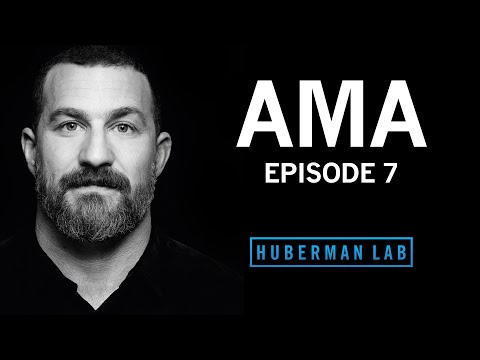
AMA #7: Cold Exposure, Maximizing REM Sleep & My Next Scientific Studies
Andrew Huberman (host)
In this episode of Huberman Lab, featuring Andrew Huberman, AMA #7: Cold Exposure, Maximizing REM Sleep & My Next Scientific Studies explores cold Exposure, Immunity, and Illness: Huberman’s Nuanced Science-Backed Guidelines Andrew Huberman uses this AMA to answer whether deliberate cold exposure can cause you to get sick, and whether you should use cold when you already have a cold or flu.
Cold Exposure, Immunity, and Illness: Huberman’s Nuanced Science-Backed Guidelines
Andrew Huberman uses this AMA to answer whether deliberate cold exposure can cause you to get sick, and whether you should use cold when you already have a cold or flu.
He explains that short, controlled cold exposure itself is unlikely to cause infection, but cold, dry air and prolonged post-cold shivering in such environments can weaken mucosal defenses and increase susceptibility.
Huberman reviews human studies showing that repeated cold exposure and hyperventilation-style breathing can modestly increase certain immune markers, but can also suppress aspects of the immune response and symptoms via elevated adrenaline and noradrenaline.
He concludes with practical rules of thumb: use cold exposure only when you’re feeling well, avoid all stressful physiological challenges when truly sick, warm up promptly afterward, and favor nasal breathing to support respiratory defenses.
Key Takeaways
Short, controlled cold exposure is unlikely to directly cause colds if you rewarm promptly.
Huberman emphasizes that 1–10 minutes of deliberate cold exposure in clean water, followed by effective rewarming (clothing, sauna, hot shower, sun), is not in itself a direct cause of upper respiratory infections. ...
Get the full analysis with uListen AI
Cold, dry air can thin mucosal linings and increase infection susceptibility.
Laboratory studies manipulating humidity and temperature show that cold, dry environments reduce the robustness of mucus in the nose and throat, making it easier for viruses and bacteria to enter and establish infection. ...
Get the full analysis with uListen AI
Avoid stressful cold, heat, or exercise when you are truly sick.
If you have clear illness-related malaise (from a cold, flu, or bacterial infection), Huberman recommends avoiding deliberate cold exposure, strenuous exercise, and very hot, stressful sauna use. ...
Get the full analysis with uListen AI
Repeated cold exposure can modestly boost immune markers, but effects are not huge.
In a study of people exposed to 14°C (57. ...
Get the full analysis with uListen AI
Adrenaline and noradrenaline can both enhance and suppress immune responses depending on context.
Deliberate cold exposure and cyclic hyperventilation increase epinephrine and norepinephrine, which can acutely stimulate immune activity and cell deployment. ...
Get the full analysis with uListen AI
Wim Hof–style breathing can blunt illness symptoms by modulating immune pathways.
In a PNAS study where subjects received endotoxin injections, those performing cyclic hyperventilation (Wim Hof/Tummo-style breathing) had significantly fewer symptoms like fever, nausea, and vomiting. ...
Get the full analysis with uListen AI
Favor nasal breathing to support immune defenses in the upper airway.
Huberman strongly recommends nasal breathing whenever possible (except in high-intensity exercise or when talking). ...
Get the full analysis with uListen AI
Notable Quotes
“If you warm up after a relatively brief one to ten-minute deliberate cold exposure, I can't see how the deliberate cold exposure itself would enhance your susceptibility to getting sick.”
— Andrew Huberman
“Cold, dry air does seem to increase our susceptibility to viral and bacterial infections.”
— Andrew Huberman
“If you're sick, stay out of deliberate cold exposure.”
— Andrew Huberman
“Deliberate cold exposure and deliberate hyperventilation will increase norepinephrine and epinephrine, and their increase is pro-immune… However, if they are elevated chronically, that can cause reductions in the number and efficiency of immune cells.”
— Andrew Huberman
“One of the additional reasons [to nasal breathe] is a main site of entry for infections is through the mouth, so keep that mouth shut unless you need to talk.”
— Andrew Huberman
Questions Answered in This Episode
In the cold-adaptation study you mentioned, how would you design a follow-up trial to directly test whether repeated cold exposure actually reduces rates or severity of common colds and flu over a winter season?
Andrew Huberman uses this AMA to answer whether deliberate cold exposure can cause you to get sick, and whether you should use cold when you already have a cold or flu.
Get the full analysis with uListen AI
Given the dual role of adrenaline in both boosting and suppressing immune responses, what specific weekly frequency and time-of-day schedule for cold plunges would you recommend to maximize benefits while minimizing potential chronic stress on the immune system?
He explains that short, controlled cold exposure itself is unlikely to cause infection, but cold, dry air and prolonged post-cold shivering in such environments can weaken mucosal defenses and increase susceptibility.
Get the full analysis with uListen AI
In the PNAS endotoxin study, do you see any potential downside to regularly blunting fever and sickness symptoms with hyperventilation or cold, in terms of possibly prolonging infections or masking when people should be resting?
Huberman reviews human studies showing that repeated cold exposure and hyperventilation-style breathing can modestly increase certain immune markers, but can also suppress aspects of the immune response and symptoms via elevated adrenaline and noradrenaline.
Get the full analysis with uListen AI
For someone who lives in a cold, dry climate and trains outdoors daily, what concrete steps—beyond nasal breathing—would you prioritize to protect their mucosal barriers and reduce infection risk during winter?
He concludes with practical rules of thumb: use cold exposure only when you’re feeling well, avoid all stressful physiological challenges when truly sick, warm up promptly afterward, and favor nasal breathing to support respiratory defenses.
Get the full analysis with uListen AI
How would your recommendations change, if at all, for individuals with autoimmune conditions who want to use cold exposure or Wim Hof–style breathing, given the immune-modulating effects you described?
Get the full analysis with uListen AI
Transcript Preview
(instrumental music) Welcome to the Huberman Lab Podcast, where we discuss science, and science-based tools for everyday life. I'm Andrew Huberman, and I'm a professor of neurobiology and ophthalmology at Stanford School of Medicine. Today is an Ask Me Anything episode, or AMA. This is part of our premium subscriber channel. Our premium subscriber channel was started in order to provide support for this standard Huberman Lab Podcast, which comes out every Monday and is available at zero cost to everybody, on all standard feeds, YouTube, Apple, Spotify, and elsewhere. We also started the premium channel as a way to generate support for exciting research being done at Stanford and elsewhere, research on human beings that leads to important discoveries that assist mental health, physical health, and performance. I'm also pleased to inform you that for every dollar the Huberman Lab Premium Channel generates for research studies, the Tiny Foundation has agreed to match that amount, so now we are able to double the total amount of funding given to studies of mental health, physical health, and human performance. If you'd like to subscribe to the Huberman Lab Podcast Premium Channel, please go to hubermanlab.com/premium. It is $10 a month to subscribe, or you can pay $100 all at once to get an entire 12-month subscription for a year. We also have a lifetime subscription model that is a one-time payment, and again, you can find that option at hubermanlab.com/premium. For those of you that are already subscribers to the premium channel, please go to hubermanlab.com/premium and download the premium subscription feed. And for those of you that are not Huberman Lab Podcast premium subscribers, you can still hear the first 20 minutes of today's episode, and determine whether or not becoming a premium subscriber is for you. Without further ado, let's get to answering your questions. The first question asks, "Is it possible to get a cold or to get sick from deliberate cold exposure?" And I suppose a related question is, should you even do deliberate cold exposure if you have a sniffle, a cold, or a flu? I get that question all the time as well. So I'll answer both of those questions, and I will also touch on some of the immune-enhancing effects of deliberate cold exposure. But just to make sure that we answer the specific question asked here right off the bat, is it possible to get a cold or to get sick from deliberate cold exposure? Well, assuming that you're not doing the deliberate cold exposure for more than say, five or six minutes at one stretch, probably not directly from the deliberate cold exposure. I mention that because most people are doing anywhere from about a minute to three minutes, sometimes five or six minutes, and maybe for those of you that are really pushing it, 10 minutes of deliberate cold exposure. And most often, after doing that deliberate cold exposure, people are either getting clothed or they're getting into a sauna or they're taking a hot shower, and then getting clothed and heading off into their day or off to sleep, depending on what time of day or night you happen to do your deliberate cold exposure. We can safely say that if you warm up after a relatively brief, meaning one minute to, let's extend it out to 10 minutes, 10-minute deliberate cold exposure, although I really want to caution people to not do 10-minute deliberate cold exposure right off the bat. If you are somebody who's not accustomed to it, don't jump right up to that, uh, long exposure to cold water. Start with shorter exposures. But if you're doing that one to 10-minute deliberate cold exposure and then you're getting warm afterwards and heading about your day, I can't see how the deliberate cold exposure itself would enhance your susceptibility to getting sick. That said, we know from an enormous number of studies that have looked at cold virus transmission and other forms of viral and bacterial transmission, that the environment that you happen to be in does impact your susceptibility to colds and other types of viruses and to bacterial infections in the following way. There have been controlled studies in which people go into laboratories, whose laboratories have rooms in which they can very tightly control the humidity, so essentially the water content in the air, as well as the temperature in the room. And if you look at the total mass of those data, we can say a couple of specific things in kind of bullet point fashion. First off, cold, dry air does seem to increase our susceptibility to viral and bacterial infections, because whether or not you're a mouth breather or a nose breather, and by the way, I suggest everyone be a nose breather unless you're exercising hard enough that you have to breathe through your mouth, or you're talking or something of that sort. But if you're a nose breather or a mouth breather or both, viruses and bacteria enter through your nose and mouth. Sometimes through your eyes, but your nose and mouth are going to be the main sites of entry and your main barriers to viral and bacterial infections. In fact, one of the ways you are constantly fighting off bacterial and viral infections that you're exposed to all the time is by way of those viruses and bacteria getting trapped in the mucus lining of your nose or your mouth, most notably in the back of your throat. So if you spend time in cold, dry environments, there is a tendency for that mucosal lining to be thinner. There is a tendency for that mucosal lining to not be as robust in general. When I say robust, what I mean is that if you're mouth breathing, for instance, in a cold, dry environment, I'm thinking, um, from the time I spent in Cambridge, Massachusetts in winter at the T station, you know, if you're ... I'm just imagining myself 'cause it was so darn cold back there, you know, breathing (breathes deeply) through your mouth or having gone for a run and your mouth isn't covered, or even if you're deliberately nasal breathing, you are drying out your nasal passages and making them more susceptible to infections. Does that necessarily mean that every time you go out in cold, dry air that you're going to get an infection? No, of course it doesn't. But to relate this back to the question we had before, there are a lot of data pointing to the fact that more humid, warm environments are going to make your mucosal lining and the general upper respiratory area more, I don't want to say immune, 'cause I don't want to conflate that word with the other meaning of immune. It's going to make it more robust against-... bacterial and viral infections. Okay? So if you get into a cold shower or a cold plunge or a cold ocean or a cold lake, and then you get out and you're out there, you know, shivering and shaking, trying to boost your metabolism, or whatever it is that you're doing it for, and it's cold, dry air, and especially if you're mouth breathing in that cold, dry air, yes, I could see how that might lead to a higher probability of getting a cold or other type of infection. But there's nothing specific about the deliberate cold exposure itself that can induce a cold or other type of infection, assuming that the water is clean, right? We're not talking about bacterial infections of cuts on the skin, et cetera. We're talking about colds and other forms of being sick, namely upper respiratory infections. Okay? Now, with that said, I often get asked whether or not for people who already have a little sniffle, they're feeling a little run down, or perhaps a lot run down, should they do deliberate cold exposure? Well, it's a little tricky to give a one-size-fits-all answer, but I think we can safely say that if you are feeling malaise, if you're feeling like you have to rest, you're tired, you're not feeling good because of a cold or because of a flu or because of a bacterial infection, okay? Now, I'm not saying just feeling not good, I'm saying feeling not good due to a cold or other form of virus or bacterial infection, then I would say stay out of deliberate cold exposure. Don't use it. Now, why would I say that given the data I'll talk about in a few minutes showing that regular deliberate cold exposure, if done correctly, can in fact increase immune system markers and perhaps even make you much more robust to combating different types of infection through the release of adrenaline? We'll talk about what all that looks like in a moment in terms of protocols and some of the science. But to just be very clear and very direct, if you're sick, stay out of deliberate cold exposure. There I would instead recommend warmer hot baths, warmer hot showers, the sauna, et cetera. But I also would caution that if you are getting into saunas that are too hot, you know, saunas that are so hot that it's stressful for you, and again, a lot of people use deliberate heat exposure because of the stress it induces, they're doing, um, some heat induced, for instance, heat shock proteins and different ways of increasing heart rate, that's a different sort of thing. That's hard, it's stressful, in order to generate an adaptation. I don't recommend doing that. In fact, I don't recommend doing deliberate cold exposure exercise or deliberate heat exposure if you're feeling really not well. Now, if you're feeling just a little bit not well, you're feeling a little bit run down, little bit of sniffle, little bit of malaise, well then it's kind of an edge case where we could say, "All right, you know what? Just take a hot shower and go to sleep." That's probably the best advice, right? That good old-fashioned advice. But if you are determined to do your deliberate cold exposure anyway, then I would say definitely get warm or take a hot shower afterwards, hot bath or a hot sauna, but not too hot that it's stressful, of course. And keep in mind that one of the variables that's been measured quite a lot in laboratory studies of deliberate cold exposure is the increase in immune system markers. So I'll provide a few links to some of these studies. Um, although nowadays there are many, many of them. But it's very clear that deliberate cold exposure can increase the release and the production of different immune molecules and immune cells. One slightly older study, but nonetheless a good study that has relevance here, is entitled Immune System of Cold-Exposed and Cold-Adapted Humans. Uh, keep in mind that this study is a little bit extreme, uh, and there are reasons for that. Uh, I guess to make a long story short, oftentimes in order to, quote-unquote, "see an effect" in a study, scientists will use conditions that are pretty extreme compared to control group. Oftentimes you'll see a dose response too, but that's a little bit trickier to do with, uh, human studies of deliberate cold exposure. It can be done but not too common. But here, they used a pretty what I would call extreme stimulus. It was exposing people to 14 degrees Celsius water, so that's 57.2 degrees Fahrenheit, which isn't that cold. It's g- it's like cool, I would say very cool water, but not what you might consider cold depending on how well you tolerate cold. And that will vary, of course. But they had people exposed to that for an hour, which is a pretty long time. You know, most people, as I mentioned, are using colder temperatures of deliberate cold exposure, so even, you know, high 30s, low 40s, maybe upper 40s, for anywhere from one to 10 minutes depending on how conditioned they are. Uh, and again, don't just jump into 10 minutes of deliberate cold exposure. Please, um, at, you know, 35 degrees or 40 degrees or even 45 degrees if you aren't familiar with deliberate cold exposure. You have to ease into these sorts of things over time, and if you're interested in protocols for deliberate cold exposure, we have a zero-cost newsletter at hubermanlab.com. Go to the menu, go newsletter, and you can find that. We've done several episodes on deliberate cold exposure. In any event, this study, Immune System of Cold-Exposed and Cold-Adapted Humans, as I mentioned, had people in 14 degrees Celsius water for one hour, and basically what they found is that one exposure to cold did not change immune system function in any kind of significant way. However, what they found was if people did deliberate cold exposure repeatedly over a period of about six weeks, and by repeatedly I mean three times per week, what they found were trends. And again, trends are not statistically significant, but trends towards increases in plasma concentrations of things like IL-6, interleukin-6, or total numbers of T lymphocytes and T helper cells and T suppressor cells and activated T and B lymphocytes. These are all immune cells and immune molecules that roughly correspond to an increase in immune system function. If you'd like to learn more about the immune system, I did an episode on immune system function. Again, you can find that at hubermanlab.com, and it spells out the basic cell types of what's called the innate and the adaptive immune system. This study, which we will link to in the show note captions, is but one study of several other studies showing that deliberate cold exposure can increase immune system markers, especially when deliberate cold exposure is done repeatedly over time, so in this case three times a week over a period of six weeks. But again, I want to highlight these aren't highly significant effects. These are trends in the direction of increased numbers of immune cells and immune markers. Now, what's impossible to know is how those trends translate to actual resistance to specific concentrations of, say, cold virus or flu virus or any other virus or bacteria. That would be great, but that's a very difficult study to do, especially in the context of deliberate cold exposure as well. Now-... we can all be scientists about this and say, "What is it about deliberate cold exposure that would increase immune system function?" And there, we can confidently say the molecules epinephrine and norepinephrine, which are released in both brain and body in response to cold water exposure, as well as things like deliberate hyperventilation, the release of norepinephrine and epinephrine into the brain and body is known to have a number of different effects related to the immune system. It can be pro-immune, at least in the short term. And in the long term, meaning if noradrenaline and adrenaline, again those are just different names for norepinephrine and epinephrine, I'm sorry those are the same thing, but that's why I use them interchangeably so that you don't get confused if you see noradrenaline or norepinephrine, it's the same thing. You hear epinephrine or adrenaline, same thing. Deliberate cold exposure or deliberate hyperventilation will increase those molecules, norepinephrine and epinephrine. And their increase is pro-immune. It can trigger the activation of immune cells and immune molecules that can make you more resistant to certain forms of infection. However, if norepinephrine and epinephrine are elevated chronically, and especially if they are elevated late in the day, repeatedly over many, many days, that can cause reductions in the number and efficiency of immune cells in combating infections. So getting cold in this context of whether or not you can get sick from it should really be considered more as what happens when you spike your adrenaline and norepinephrine. And there's one other study that we can look to, which is now really a famous study published in Proceedings of the National Academy of Sciences, looking at so-called Wim Hof breathing. Um, but really that just translates to cyclic hyperventilation. So this is inhaling through the nose, exhaling through the mouth repeatedly, 25 times or so. (breathes deeply) If you do that, you notice you feel quite warm. Has to do with some things related to vasodilation, has some things to do with release of norepinephrine and epinephrine. We know that pattern of deliberate hyperventilation, much like deliberate cold exposure, deploys or releases noradrenaline and adrenaline into your brain and body. And we know from this study entitled Voluntary Activation of the Sympathetic Nervous System and Attenuation of the Innate Immune Response in Humans showed really nicely, I think, that if people are injected with E. coli, right, a bacteria, it's actually end- they did this through endotoxin injections, people got really sick, they'd get, you know, feel like they had the flu, they'd vomit, diarrhea, get a fever, et cetera. However, if they did the sorts of breathing that I talked about just a moment ago, prior to that, they were able to ward off a lot of the symptoms associated with the endotoxin infection. And you would say, "Okay, wow, their immune system just fired up and they were able to fight it off." But it's trickier than that, actually. What happened was the release of epinephrine and norepinephrine from cyclic hyperventilation, which is really what (breathes deeply) really is, cyclic hyperventilation, also called Wim Hof breathing, also called Tummo breathing, et cetera, that actually had a suppressive action on certain arms of the immune system in a way that allowed people to avoid symptomatology such as fever, nausea, et cetera. And we would imagine the same thing would occur with deliberate cold exposure done prior to bacterial infection or viral exposure. So if you're sensing that I'm saying two things at once, I am. I'm saying deliberate cold exposure and cyclic hyperventilation can both cause deployment of molecules such as epinephrine and norepinephrine that lead to enhanced immune system function if done repeatedly. I'm also saying that increasing norepinephrine and epinephrine too much can suppress your immune system. In this study, the PNAS study that I mentioned a moment ago, that suppression of the immune response was actually one of the reasons people avoided symptomatology, but they were still injected with endotoxin, so they just weren't fighting off the endotoxin with fever. Remember, fever is an adaptation to fight infection. It's designed essentially to heat up the infection and kill it. So, what are we to take away from this? Here are what I think are the key takeaways. One, if you are feeling good to great, do your deliberate cold exposure, and perhaps don't worry so much about using your body's natural metabolism and thermogenic abilities to heat back up afterwards. But I don't suggest anyone ever allow themselves to stay really cold after deliberate cold exposure for more than 10, 15 minutes or maybe half an hour. Right? Get bundled back up or put on clothes. If it's a nice hot sunny day, get out in the sun and warm up. Again, temperatures and conditions will vary for different people, different locations, et cetera. If you are not feeling great, you're feeling a little run down and you really want to do your deliberate cold exposure, do it, but then warm up really well afterwards, maybe even drink some, you know, hot tea or other fluid afterwards as well. And if you are not feeling good, you're feeling malaise, you're feeling run down, despite what you read about deliberate cold exposure or cyclic hyperventilation allowing for the deployment of immune molecules or increasing the number of immune cells that you're making, avoid anything that's stressful or challenging, whether or not it's a cold challenge, a heat challenge, or an exercise challenge when you're feeling run down, because under those conditions what you really want to do is slow your circulation down, probably find you take little walks or something, provided you're not doubled over in bed and you know, vomiting and things like that. You know, a little bit of movement probably good to circulate your blood. But in general, the advice that you get to rest when you're sick and not push yourself, that's really good advice, because you want all of your body's resources to be devoted to getting over that infection. And if you're interested in sickness and sickness behavior and the sorts of behaviors that can combat infection, check out the episode I did on the immune system. We'll link to it in the show note captions, because it talks about how when we have a viral or bacterial infection, a whole set of brain circuits get activated that kind of encourage us to be more in the fetal position, to move less, to be eyes down, to kind of, you know, slump down. That's not a coincidence. That's because of the activation of these so-called sickness circuits that are really designed to help you heal yourself. So I both apologize and, what do the kids say? Sorry not sorry. Don't apologize for...... the somewhat nuanced answer here. Because a lot of information out there says, "Oh, you know, cold boosts your immune system," and yeah, that's true under certain conditions. It can also deplete your immune system and limit your ability to fight off infections under other conditions. (smacks lips) And perhaps the last thing to say about this (smacks lips) is that I am a big believer in using nasal breathing whenever you don't have to breathe through your mouth. So if you're exercising hard, by all means, breathe through your mouth. If you're doing martial arts and it requires that you breathe through your mouth, go ahead and do that. But if you're doing, say, zone two cardio, low-level cardio, or you're just walking along, it's very clear based on a growing amount of data that being a nasal breather is better than being a mouth breather, and there are a number of different reasons for that. We've talked about it on the podcast and elsewhere. But one of the additional reasons is a main side of entry for infections is through the mouth, so keep that mouth shut unless you need to talk. Thank you for joining for the beginning of this Ask Me Anything episode. To hear the full episode and to hear future episodes of these Ask Me Anything sessions, plus to receive transcripts of them and transcripts of the Huberman Lab Podcast Standard channel and Premium tools not released anywhere else, please go to hubermanlab.com/premium. Just to remind you why we launched the Huberman Lab Podcast Premium channel, it's really twofold. First of all, it's to raise support for the standard Huberman Lab Podcast channel, which, of course, will still be continued to be released every Monday in full length. We are not going to change the format or anything about the standard Huberman Lab Podcast, and to fund research. In particular, research done on human beings, so not animal models, but on human beings, which I think we all agree is a species that we are most interested in. And we are going to specifically fund research that is aimed toward developing further protocols for mental health, physical health, and performance, and those protocols will be distributed through all channels, not just the Premium channel, but through all channels, Huberman Lab Podcast and other media channels. So the idea here is to give you information to your burning questions in depth and allow you the opportunity to support the kind of research that provides those kinds of answers in the first place. Now, an especially exciting feature of the Premium channel is that the Tiny Foundation has generously offered to do a dollar-for-dollar match on all funds raised for research through the Premium channel. So this is a terrific way that they're going to amplify whatever funds come in through the Premium channel to further support research for science and science-related tools for mental health, physical health, and performance. If you'd like to sign up for the Huberman Lab Premium channel, again, there's a cost of $10 per month, or you can pay $100 up front for the entire year. That will give you access to all the AMAs. You can ask questions and get answers to your questions, and you'll, of course, get answers to all the questions that other people ask as well. There will also be some premium content, such as transcripts of the AMAs and various transcripts and protocols of Huberman Lab Podcast episodes not found elsewhere. And again, you'll be supporting research for mental health, physical health, and performance. You can sign up for the Premium channel by going to hubermanlab.com/premium. Again, that's hubermanlab.com/premium. And as always, (upbeat music) thank you for your interest in science.
Install uListen to search the full transcript and get AI-powered insights
Get Full TranscriptGet more from every podcast
AI summaries, searchable transcripts, and fact-checking. Free forever.
Add to Chrome