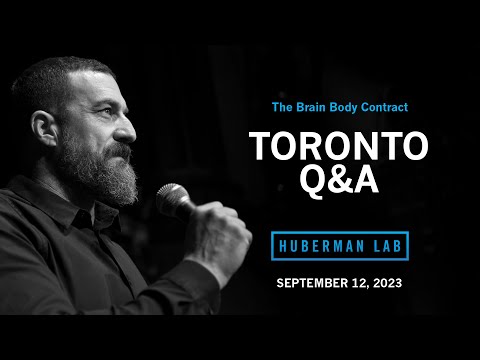
LIVE EVENT Q&A: Dr. Andrew Huberman Question & Answer in Toronto, ON
Andrew Huberman (host), Narrator, Narrator, Narrator, Narrator, Narrator, Narrator, Narrator
In this episode of Huberman Lab, featuring Andrew Huberman and Narrator, LIVE EVENT Q&A: Dr. Andrew Huberman Question & Answer in Toronto, ON explores huberman Explores Unconscious Mind, Resilience, Seasons, Psychedelics, and Daily Practice In this live Toronto Q&A, Dr. Andrew Huberman answers audience questions on topics ranging from the unconscious mind and emotional resilience to seasonal depression, neuroplasticity, and movement for sedentary workers.
Huberman Explores Unconscious Mind, Resilience, Seasons, Psychedelics, and Daily Practice
In this live Toronto Q&A, Dr. Andrew Huberman answers audience questions on topics ranging from the unconscious mind and emotional resilience to seasonal depression, neuroplasticity, and movement for sedentary workers.
He explains why he created a ‘mental fitness’ series with psychiatrist Dr. Paul Conti, emphasizing practical, zero-cost tools for accessing the unconscious and improving relationships.
Huberman highlights how preparation, self-care, light exposure, and deliberate perceptual practices shape our stress responses, mood, and capacity for inspiration and plasticity.
He also touches on the promise and limits of psychedelics, the physiological basis of seasonal affective symptoms, and simple physical strategies to counter long hours at a desk.
Key Takeaways
Structured, zero-cost tools can bring ‘mental fitness’ work to everyone.
Huberman’s series with psychiatrist Dr. ...
Get the full analysis with uListen AI
Emotional resilience in triggering situations is built outside those moments.
Huberman argues that we overemphasize in-the-moment hacks and under-appreciate daily practices that raise our threshold for stress. ...
Get the full analysis with uListen AI
Inspiration requires both rich inputs and periods of wordless, undistracted experience.
Citing Joe Strummer’s ‘no input, no output,’ Huberman suggests that great ideas arise when diverse experiences are allowed to ‘geyser up’ from the unconscious. ...
Get the full analysis with uListen AI
Seasonal mood issues can be mitigated by manipulating morning light exposure.
Seasonal depression is tied to how the melatonin signal lengthens across days as light shortens, not just absolute day length. ...
Get the full analysis with uListen AI
Neuroplasticity always runs through neuromodulators—regardless of method.
Whether change is driven by focused learning, talk therapy, breathing practices, or psychedelics, the common pathway involves neuromodulators like serotonin, dopamine, acetylcholine, and epinephrine. ...
Get the full analysis with uListen AI
Simple lower-leg movements can significantly improve metabolism during long sitting.
For people at desks from 8–5, Huberman highlights research on the ‘soleus push-up’: repeatedly lifting the heel while pressing the forefoot down. ...
Get the full analysis with uListen AI
Deliberately shifting visual focus changes your perception of time and cognitive mode.
Huberman’s one-minute morning ‘space-time bridging’ practice cycles through internal focus (eyes closed), near-field, far-field, and global perspective (imagining yourself on the planet). ...
Get the full analysis with uListen AI
Notable Quotes
“Traumas, if understood, can be transmuted into deep sources of knowledge that other people can benefit from.”
— Andrew Huberman
“The unconscious mind is the supercomputer of the mind.”
— Andrew Huberman (paraphrasing Paul Conti)
“Ultimately our best ideas come from disparate experiences when we're not seeking a particular kind of input to get ideas.”
— Andrew Huberman
“The location of the earth around the sun and the tilt of the earth is translated into a physiological signal that's working unconsciously to tell your brain and body what time of year it is.”
— Andrew Huberman
“Whether or not it's through talk therapy, Kundalini breathing, high-dose psilocybin, MDMA, or the combination, it's opening windows for plasticity.”
— Andrew Huberman
Questions Answered in This Episode
In the Conti series, how could someone practically assess and rebalance their own aggressive, pleasure, and generative drives in an ongoing way, rather than just once?
In this live Toronto Q&A, Dr. ...
Get the full analysis with uListen AI
You emphasize that resilience is built outside of crises; what would a concrete 7-day protocol look like for someone who currently ‘snaps’ easily and sleeps poorly?
He explains why he created a ‘mental fitness’ series with psychiatrist Dr. ...
Get the full analysis with uListen AI
Your seasonal depression advice focuses on light intensity and timing—how should people in very northern regions combine this with temperature, activity, and social interventions for maximal effect?
Huberman highlights how preparation, self-care, light exposure, and deliberate perceptual practices shape our stress responses, mood, and capacity for inspiration and plasticity.
Get the full analysis with uListen AI
You draw parallels between music training in children and psychedelic-induced connectivity in adults; what specific music-education structures (age, ensemble vs. solo, practice dosage) appear most powerful for shaping life-long plasticity?
He also touches on the promise and limits of psychedelics, the physiological basis of seasonal affective symptoms, and simple physical strategies to counter long hours at a desk.
Get the full analysis with uListen AI
In your ‘space-time bridging’ practice, how might someone empirically test whether their task-switching or time perception is actually improving over weeks or months of doing it?
Get the full analysis with uListen AI
Transcript Preview
(peaceful music) Welcome to the Huberman Lab podcast, where we discuss science and science-based tools for everyday life. Recently, the Huberman Lab hosted a live event at the Meridian Theatre in Toronto, Ontario. The event consisted of a lecture entitled The Brain-Body Contract, followed by a question-and-answer session. We wanted to make sure that the question-and-answer session was available to everybody regardless of who could attend in person. I also want to make sure to thank the sponsors of th- that event, which were AG1 and Eight Sleep. Eight Sleep makes smart mattress covers with cooling, heating, and sleep tracking capacity. One of the key things to getting a great night's sleep is to make sure that the temperature of your sleeping environment is correct, and that's because in order to fall and stay deeply asleep, your body temperature actually has to drop by about one to three degrees. And in order to wake up feeling refreshed and energized, your body temperature actually has to increase by about one to three degrees. With Eight Sleep, you can program the temperature of your sleeping environment in the beginning, middle, and end of your night. It has a number of other features, like tracking the amount of rapid eye movement and slow-wave sleep that you get, things that are essential to really dialing in the perfect night's sleep for you. I've been sleeping on an Eight Sleep mattress cover for well over two years now, and it has greatly improved my sleep. I fall asleep far more quickly, I wake up far less often in the middle of the night, and I wake up feeling far more refreshed than I ever did prior to using an Eight Sleep mattress cover. If you'd like to try Eight Sleep, you can go to EightSleep.com/Huberman to save $150 off their Pod 3 cover. Eight Sleep currently ships to the USA, Canada, UK, select countries in the EU, and Australia. Again, that's EightSleep.com/Huberman. AG1 is an all-in-one vitamin/mineral/probiotic drink. I've been taking AG1 since 2012, so I'm delighted that they sponsored the live event. The reason I started taking AG1 and the reason I still drink AG1 once or twice a day is that it provides all of my foundational nutritional needs. That is, it provides insurance that I get the proper amounts of those vitamins, minerals, probiotics, and fiber to ensure optimal mental health, physical health, and performance. If you'd like to try AG1, you can go to DrinkAG1.com/Huberman to claim a special offer. They're giving away five free travel packs plus a year's supply of vitamin D3 K2. Again, that's DrinkAG1.com/Huberman to claim that special offer. And now without further ado, the question-and-answer session from our live event at the Meridian Theatre in Toronto, Ontario. (upbeat music) Okay. Um, what motivated me to do the guest series with Paul Conti? Okay, so first of all, for those of you that don't know, Paul Conti is a psychiatrist. He's a Stanford and Harvard-trained psychiatrist. Um, and I wanted to do this series with Paul for several reasons, um, and we, we initiated that series. Uh, first of all, um, he's incredibly talented as a clinician, and yet, um, despite having written an excellent book about trauma, I felt that, uh, two things were true for sure. One is that most people won't get the opportunity to work with Paul, sadly. His, he's time-limited. And second, that, um, his expertise is incredibly vast, not just restricted to trauma. Traumas, if understood, can be transmuted into, you know, deep sources of knowledge that other people can benefit from. And indeed, um, what I found in Paul as I got to know him is that he has just profound insight into the unconscious mind, and people had long asked me, you know, arou- in and around the podcast, "What about the subconscious? What about the unconscious?" And I was of the mind that the supercomputer of the human brain is the forebrain, the thinking, planning, context-setting piece right behind our forehead. It's there to s- You know, it's the reason that we're not the house cats. Th- the house cats are the house cats, and it's the reason... We're the curators of the planet. But Paul said, "Oh, no, no, no, no, no. No, no, no, no, no. The unconscious mind is the supercomputer of the mind." I'm like, "Well, that sounds great, but how do we understand the unconscious mind?" And he has a really biological and psychological and psychiatric understanding of the unconscious, and in that series, he talks about these so-called cupboards that we can look into in order to better understand our own conscious- unconscious mind in order to allow our unconscious mind to teach us things about ourselves that are useful. And there are three main places where our unconscious teaches us useful things that allow us to be more conscious of the way that our brain is working in useful ways. Um, the first is in these liminal states between waking and sleep. It really does seem to be the case that when, surprise, surprise, we're completely still, and we're emerging from or we're dropping into states of reduced autonomic arousal, but our level of thought, if you will, is still active enough that we are aware, maybe even lucid dreams, and also in dreams, our unconscious mind uses, as I think Jung and Freud pretty well-understood, symbols to teach us things, but everything's flipped in there. Gender's flipped. Like, like, the per- like, just 'cause you're, you're having a conflict with somebody in your life who's a, a man doesn't mean that that person shows up as a man. They could show up as an animal. So species are flipped. The symbols become mish-mashed, but Paul made it very clear that all this can be parsed if you do a certain kind of introspective work, and I thought that would mean a lot of talk therapy that people would... I mean, how are we gonna get people to learn how to do talk therapy by themselves? We wanna keep things as much co- you know, independent of cost and things like that. And the practices he started talking about were incredibly simple, things like mirror work. The s- some of the psychologists in the room will be familiar with this. I thought, "Mirror work? What is that?" And he said, "Literally, people trying to activate their unconscious, you know, or excuse me, access their unconscious in sleep by..."... a practice of staring into the mirror for some period of time while awake and reflecting on self and aspirations and the idea of the body as a container. All this s- stuff, even for a kid from Northern California, sounded really woo new-agey. But here, it's scripted by Paul into a formal structure that one can use to parse your own mental health and enhance mental health. So that was the reason for, for doing this series and especially the, the episode on relationships, not just romantic relationships, I found, hasn't come out yet, incredibly interesting because he talked about how in his clinical experience, all, virtually all the stuff that people pay attention to in relational stuff is are they a narcissist, are they, uh, obsessive, is this person a musician versus whether or not I'm an accountant, would- are we compatible, that none of that stuff predicts anything as well as the balance of these three drives, the aggressive drive, the pleasure drive, and the so-called generative drive. And I found it to be fascinating and I'm excited for that episode and the other episodes to come out, but basically 'cause Paul's brilliant and he makes the, uh, what I consider pretty obscure and, uh, opaque very clear and concrete in their bunch of worksheets. Again, all available at zero cost and none of them requiring that you do therapy with anybody if tha- if you choose not to. This is all the kind of work one could do on oneself and the last thing I'll say about this is the- and I should have said this first, is that the primary motivation was we did a series with Dr. Andy Galpin on physical fitness, why isn't there a series on mental fitness? Right? Like, what is that? Why do we talk so much about mental health when we're... And it's usually a conversation about mental illness, what people should have tools and practices that are zero cost, I believe, to be able to introspect in a structured way and enhance their mental health, uh, independent of, you know, their level of income and I think Paul was the guy to do it. And we'll do more of that with other people as well because no single episode about any topic or series can, uh, exhaustively cover a- any topic, although Lord knows we, we will try. Okay, next question, "What are the recommended protocols and best practices to enhance emotional resilience and develop effective responses during highly triggering situations?" You're asking the wrong guy.
Install uListen to search the full transcript and get AI-powered insights
Get Full TranscriptGet more from every podcast
AI summaries, searchable transcripts, and fact-checking. Free forever.
Add to Chrome