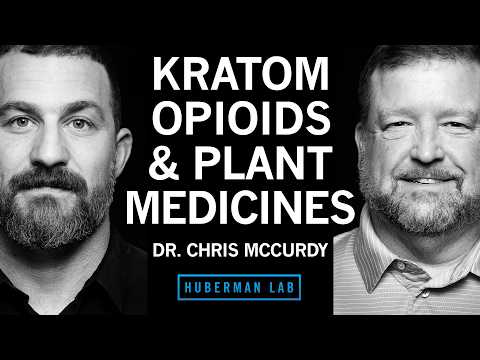
Health Effects & Risks of Kratom, Opioids & Other Natural Occurring Medicines | Dr. Chris McCurdy
Andrew Huberman (host), Dr. Chris McCurdy (guest)
In this episode of Huberman Lab, featuring Andrew Huberman and Dr. Chris McCurdy, Health Effects & Risks of Kratom, Opioids & Other Natural Occurring Medicines | Dr. Chris McCurdy explores kratom’s Double-Edged Sword: Pain Relief, Stimulant, And Hidden Dangers Andrew Huberman and medicinal chemist Dr. Chris McCurdy dissect kratom, a Southeast Asian tree whose leaf has long been used traditionally as a mild stimulant, mood elevator, and pain reliever, but is now sold in highly altered forms across the U.S. and beyond. They distinguish between traditional leaf/tea, crude powders, concentrated extracts, and semi-synthetic isolates that behave like full opioids. McCurdy explains kratom’s complex pharmacology across opioid, serotonin, and adrenergic systems, why dose and product type radically change risk, and how some people successfully use it as an off-ramp from opioids while others become dependent on kratom itself. The conversation broadens into how many modern drugs started as plant products (coca, cacao, willow, tobacco, GLP‑1, etc.), how industrial concentration and marketing distort “natural” medicines, and why clearer regulation and public education are urgently needed.
Kratom’s Double-Edged Sword: Pain Relief, Stimulant, And Hidden Dangers
Andrew Huberman and medicinal chemist Dr. Chris McCurdy dissect kratom, a Southeast Asian tree whose leaf has long been used traditionally as a mild stimulant, mood elevator, and pain reliever, but is now sold in highly altered forms across the U.S. and beyond. They distinguish between traditional leaf/tea, crude powders, concentrated extracts, and semi-synthetic isolates that behave like full opioids. McCurdy explains kratom’s complex pharmacology across opioid, serotonin, and adrenergic systems, why dose and product type radically change risk, and how some people successfully use it as an off-ramp from opioids while others become dependent on kratom itself. The conversation broadens into how many modern drugs started as plant products (coca, cacao, willow, tobacco, GLP‑1, etc.), how industrial concentration and marketing distort “natural” medicines, and why clearer regulation and public education are urgently needed.
Key Takeaways
Not all ‘kratom’ is the same: leaf vs. extract vs. isolate are effectively different drugs.
Traditional kratom use in Southeast Asia involves freshly picked leaves chewed or long-boiled into a weak decoction, with the body extracting alkaloids slowly and inefficiently. ...
Get the full analysis with uListen AI
Serving size and total alkaloid dose are the main immediate safety levers for consumers.
McCurdy’s lab has analyzed many commercial products and found that labeled “servings” can vary wildly; a tiny bottle might contain 2 servings or 15+ servings of kratom extract, with similar packaging. ...
Get the full analysis with uListen AI
Kratom’s pharmacology is complex: it hits opioid, serotonin, and adrenergic systems simultaneously.
The kratom tree (Mitragyna speciosa) contains 20–40 identified alkaloids, not just mitragynine. ...
Get the full analysis with uListen AI
Physical dependence on kratom is real, with a spectrum from ‘caffeine-like’ to ‘opioid-like’ withdrawal.
Regular daily users—especially of leaf or powder—commonly report headache, lethargy, and feeling “off” without their morning kratom, analogous to caffeine dependence. ...
Get the full analysis with uListen AI
Certain kratom-derived isolates, especially 7‑hydroxymitragynine, behave like full opioids and can cause respiratory depression.
In the plant, mitragynine is the major alkaloid; the body metabolizes some of it into 7‑hydroxymitragynine, which is a much more potent μ-opioid agonist. ...
Get the full analysis with uListen AI
Kratom can function as harm reduction for some opioid and possibly alcohol users, but it is not benign.
Survey work (with Johns Hopkins collaborators) suggests many U. ...
Get the full analysis with uListen AI
Youth and developing brains should avoid kratom; adult experimentation should be cautious, minimal, and informed.
McCurdy endorses age limits (18 or 21 minimum) and philosophically would prefer 24–25, aligned with prefrontal cortex maturation and car insurance risk cutoffs. ...
Get the full analysis with uListen AI
Notable Quotes
“Not all kratom is kratom. Leaf powder, an extract shot, and a semi-synthetic isolate are not the same thing.”
— Dr. Chris McCurdy
“I always remind my lab: mitragynine does not equal kratom.”
— Dr. Chris McCurdy
“It absolutely causes a physical dependence. The question is how severe, for whom, and on what product.”
— Dr. Chris McCurdy
“We’re seeing people who used kratom to get off opioids, and now they’re coming into clinics asking for help to get off kratom.”
— Dr. Chris McCurdy
“For every disease that presents itself on this planet, there’s probably a solution in nature. The problem is what humans do with it after they find it.”
— Dr. Chris McCurdy
Questions Answered in This Episode
For patients already on buprenorphine or methadone for opioid use disorder, how would you evaluate whether adding, tapering to, or avoiding kratom might reduce or increase their overall risk and symptom burden?
Andrew Huberman and medicinal chemist Dr. ...
Get the full analysis with uListen AI
Given that 7‑hydroxymitragynine isolates clearly behave like strong opioids in animals, what specific regulatory framework (e.g., scheduling, labeling, prescription-only status) would you recommend for these isolates that still preserves access to traditional leaf products?
Get the full analysis with uListen AI
How would you design a randomized controlled trial to test kratom’s efficacy as an antidepressant or as a treatment for chronic pain compared to standard-of-care SSRIs or opioids, while accounting for its multi-receptor mechanism?
Get the full analysis with uListen AI
Is there a realistic way to standardize and label kratom products (similar to beer/wine/spirits) so that consumers and clinicians can quickly distinguish ‘leaf-equivalent’ products from high-risk concentrates and isolates at the point of sale?
Get the full analysis with uListen AI
From an evolutionary and systems neuroscience perspective, what do you think kratom’s tri-pronged action on opioid, serotonergic, and adrenergic pathways reveals about how human pain, mood, and motivation circuits are co-designed—and does that suggest a new drug design philosophy beyond single-target molecules?
Get the full analysis with uListen AI
Transcript Preview
Welcome to the Huberman Lab podcast, where we discuss science and science-based tools for everyday life. I'm Andrew Huberman, and I'm a professor of neurobiology and ophthalmology at Stanford School of Medicine. My guest today is Dr. Chris McCurdy. Dr. Chris McCurdy is a professor of medicinal chemistry at the University of Florida, where he directs research on natural products and their pharmacologic effects, most recently the plant-derived compound kratom, which is readily sold in the US and around the world and is now used by tens of millions of people daily, and those numbers are increasing fast. Dr. McCurdy's research focuses on understanding how kratom interacts with our nervous system and affects our physiology and behavior. He also studies its potential for addiction. During today's episode, we discuss the complex effects of kratom and its relationship to the opioid system. Dr. McCurdy explains how kratom's active compounds work in the brain, why it shares certain similarities to opioid drugs, and critically, how kratom products available in the US and elsewhere are largely derivatives and isolates of the kratom leaf, which is very different in terms of the effects it produces when compared to the traditional leaf products. And unfortunately, that has confused and in many cases harmed consumers. So today you'll learn about kratom's effects at different doses and when it's sourced in different ways. You'll learn about how it can be a stimulant, how it can increase focus, how it can be a painkiller, how it can increase euphoria, but also its strong potential for addiction. You'll also learn what is known about kratom in terms of its ability to help people transition off traditional opioid drugs. It has been shown to be effective for that. However, we are also going to explain the potential harms of kratom, in particular in young people whose brains are still developing and in people that don't have a prior opioid addiction. Our discussion about kratom also opens up a broader discussion about other plant alkaloids that have medicinal properties, including those found in things like cocoa and 100% chocolate, and we discuss the incredible history of soft drinks like Coca-Cola, Pepsi, 7UP, and Dr Pepper, which believe it or not, were originally developed as pharmacologic tools before becoming the ultra-popular beverages that we're familiar with today. So I realize many people have heard about kratom, but also many of you perhaps have not. What everyone should know, however, is that kratom products are pretty much everywhere now. You can find them in supermarkets, convenience stores, online, and they're sold under the pretense of having very specific effects related to energy, pain management, or mood. But by the end of today's episode, you'll have a thorough understanding of how this plant compound actually works, yes, its potential effects, but also its serious risks. Before we begin, I'd like to emphasize that this podcast is separate from my teaching and research roles at Stanford. It is however part of my desire and effort to bring zero-cost-to-consumer information about science and science-related tools to the general public. In keeping with that theme, today's episode does include sponsors. And now for my discussion with Dr. Chris McCurdy. Dr. Chris McCurdy, welcome.
Install uListen to search the full transcript and get AI-powered insights
Get Full TranscriptGet more from every podcast
AI summaries, searchable transcripts, and fact-checking. Free forever.
Add to Chrome