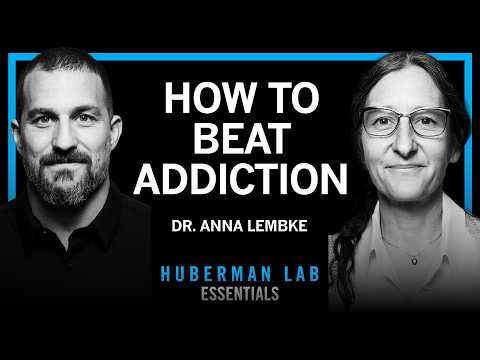
Essentials: Understanding & Treating Addiction | Dr. Anna Lembke
Andrew Huberman (host), Anna Lembke (guest)
In this episode of Huberman Lab, featuring Andrew Huberman and Anna Lembke, Essentials: Understanding & Treating Addiction | Dr. Anna Lembke explores resetting Dopamine: Dr. Anna Lembke’s Blueprint For Treating Addiction Dr. Anna Lembke explains how dopamine underlies reward, movement, pleasure, and pain, and how modern high‑dopamine stimuli (drugs, social media, gambling, etc.) can push the brain into a chronic dopamine‑deficit, addiction-like state. She introduces the “pleasure–pain balance” model: every spike in pleasure is followed by an opposing spike in pain that can, with repetition, reset our baseline toward anhedonia and clinical‑like depression.
Resetting Dopamine: Dr. Anna Lembke’s Blueprint For Treating Addiction
Dr. Anna Lembke explains how dopamine underlies reward, movement, pleasure, and pain, and how modern high‑dopamine stimuli (drugs, social media, gambling, etc.) can push the brain into a chronic dopamine‑deficit, addiction-like state. She introduces the “pleasure–pain balance” model: every spike in pleasure is followed by an opposing spike in pain that can, with repetition, reset our baseline toward anhedonia and clinical‑like depression.
A key intervention she uses clinically is a 30‑day complete abstinence from the addictive substance or behavior to allow dopamine pathways to reset, with the expectation that patients feel significantly worse for about two weeks before improvement begins. She describes why some people are more vulnerable to addiction (impulsivity, high need for friction) and why for severe cases the “balance hinge” may be permanently compromised, making relapse an almost reflexive process.
Lembke also emphasizes the role of triggers (including good times and big wins), anticipatory dopamine, shame, and truth‑telling in both relapse and recovery, highlighting evidence that rigorous honesty helps reconnect prefrontal control circuits to the reward system. She is cautiously skeptical but open-minded about psychedelic‑assisted treatments, and she frames social media as a deliberately engineered “drug” that must be used with strict, intentional boundaries to preserve attention, creativity, and offline human connection.
Key Takeaways
Repeated high‑dopamine behaviors push the brain into a dopamine‑deficit state that mimics depression and drives compulsive use.
Dopamine is always being released at a tonic baseline. ...
Get the full analysis with uListen AI
The pleasure–pain balance means every dopamine spike is followed by an equal and opposite dip that creates craving.
Pleasure and pain are processed in overlapping brain regions and operate like a seesaw that strives for homeostasis. ...
Get the full analysis with uListen AI
A 30‑day complete abstinence from the addictive behavior often allows dopamine pathways to reset, but expect two very hard weeks first.
Clinically, Lembke finds that it typically takes about 30 days of zero contact with the addictive substance or behavior for dopamine systems to re‑equilibrate. ...
Get the full analysis with uListen AI
Temperament traits like impulsivity and a high need for ‘friction’ increase addiction risk in today’s low‑friction, high‑stimulation world.
Some individuals are wired with higher impulsivity—acting on thoughts quickly—and a stronger need for challenge, novelty, and intensity. ...
Get the full analysis with uListen AI
Triggers and even positive life events can precipitate relapse through anticipatory dopamine spikes and loss of hypervigilance.
Triggers—people, places, emotions, even thoughts about the drug—cause a small anticipatory dopamine rise followed by a dip below baseline, which feels like craving and propels action. ...
Get the full analysis with uListen AI
Radical, detailed truth‑telling is a powerful recovery tool that likely strengthens prefrontal control over the reward system.
Lembke observes that people who recover well often adopt a policy of not lying about anything—not even minor excuses (“I hit traffic”)—because addiction thrives on secrecy and habitual dishonesty. ...
Get the full analysis with uListen AI
Social media behaves like a drug and must be used with intentional constraints to protect attention, mood, and real‑world connection.
Social platforms are deliberately engineered to be highly reinforcing: variable rewards, endless scroll, social validation. ...
Get the full analysis with uListen AI
Notable Quotes
“We are always releasing dopamine at a kind of tonic baseline rate, and it's really the deviation from that baseline rather than hits of dopamine in a vacuum that make a difference.”
— Dr. Anna Lembke
“Pleasure and pain are co-located, which means the same parts of the brain that process pleasure also process pain, and they work like a balance.”
— Dr. Anna Lembke
“You will feel worse before you feel better.”
— Dr. Anna Lembke
“For some people, after a month or six months or maybe even six years, their balance is still tipped to the side of pain.”
— Dr. Anna Lembke
“The first message I would wanna get across about social media is that it really is a drug, and it's engineered to be a drug.”
— Dr. Anna Lembke
Questions Answered in This Episode
For someone trying a 30‑day dopamine reset from social media specifically, what concrete daily structure and safeguards would you recommend to get through the first two weeks of heightened anxiety and boredom?
Dr. ...
Get the full analysis with uListen AI
How can a clinician or individual practically distinguish between a temperament that is simply ‘mismatched’ to modern life and a case of major depressive disorder that clearly requires medical treatment?
A key intervention she uses clinically is a 30‑day complete abstinence from the addictive substance or behavior to allow dopamine pathways to reset, with the expectation that patients feel significantly worse for about two weeks before improvement begins. ...
Get the full analysis with uListen AI
In severe addiction cases where the ‘hinge’ of the pleasure–pain balance seems broken, what long‑term strategies (beyond abstinence) have you seen actually improve that resilience, if any?
Lembke also emphasizes the role of triggers (including good times and big wins), anticipatory dopamine, shame, and truth‑telling in both relapse and recovery, highlighting evidence that rigorous honesty helps reconnect prefrontal control circuits to the reward system. ...
Get the full analysis with uListen AI
Given your skepticism, what specific patient characteristics or clinical markers would make you consider psychedelic‑assisted therapy for addiction versus strongly advise against it?
Get the full analysis with uListen AI
If social media is a drug, how should parents apply your pleasure–pain and trigger framework to setting rules for their children’s phone and app use without pushing them toward secret, higher‑risk behavior?
Get the full analysis with uListen AI
Transcript Preview
(soft rock music) Welcome to Huberman Lab Essentials, where we revisit past episodes for the most potent and actionable science-based tools for mental health, physical health, and performance. And now for my discussion with Dr. Anna Lembke. I and many listeners of this podcast are obsessed with dopamine. What is dopamine, and what are maybe some things about dopamine that most people don't know and probably that I don't know either?
So dopamine is a neurotransmitter, and neurotransmitters are those molecules that bridge the gap between two neurons. So they essentially allow one neuron, the presynaptic neuron, to communicate with the postsynaptic neuron. Um, dopamine is intimately, uh, associated with the experience of reward, but also with movement, which I think is really interesting because movement and reward are linked, right? If you think about, you know, um, early humans, it, you had to move in order to go seek out the water or the, the meat or whatever it was. So, um, dopamine is this really, um, powerful, important molecule in the brain that helps us, um, experience pleasure. It's not the only neurotransmitter involved in pleasure, but it's a really, really important one. And if, if you wanna think about something that most people don't know about dopamine, which, which I think is really interesting, is that we, we are always releasing dopamine at a kind of tonic baseline rate, and it's really the deviation from that baseline rather than, like, hits of dopamine in a vacuum that make a difference. So when we experience pleasure, our dopamine release goes above baseline, and likewise, dopamine can go below that tonic baseline and then we experience a kind of pain.
Interesting. So is it fair to say that one's baseline levels of dopamine, how frequently we're, are releasing dopamine in the absence of some, uh, I don't know, drug, or food, or experience, just sitting, being, uh, is that associated with how happy somebody is, their kind of baseline of happiness or level of depression?
There is evidence that shows that people who are depressed may indeed have lower tonic levels of dopamine. So that's a really reasonable thought, and there's, uh, some evidence to suggest that that may be true. The other thing that we know is that if we, um, expose ourselves chronically to substances or behaviors that repeatedly release large a- amounts of dopamine in our brain's reward pathway that we can change our tonic baseline and actually lower it over time as our brain tries to compensate for all of that dopamine, which is more really than we were designed to, to experience.
Interesting. And is, would, is it, um, the case that our baseline levels of dopamine are set by our genetics, by our heredity?
Well, I think, you know, if you think about sort of y- you know, the early stages of development in infancy, certainly that is true. You're kind of, you know, born with probably whatever is your baseline level. But obviously, your experiences can have a huge impact on where your, your dopamine level ultimately settles out.
Install uListen to search the full transcript and get AI-powered insights
Get Full TranscriptGet more from every podcast
AI summaries, searchable transcripts, and fact-checking. Free forever.
Add to Chrome