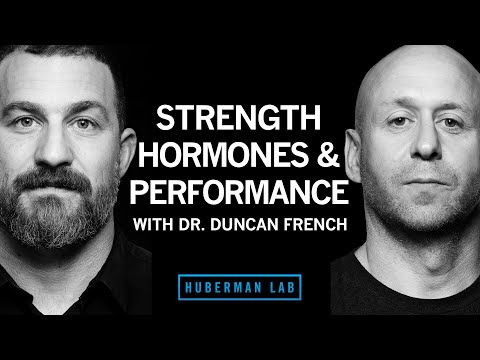
How to Exercise for Strength Gains & Hormone Optimization | Dr. Duncan French
Andrew Huberman (host), Dr. Duncan French (guest)
In this episode of Huberman Lab, featuring Andrew Huberman and Dr. Duncan French, How to Exercise for Strength Gains & Hormone Optimization | Dr. Duncan French explores train Smarter: Use Stress, Heat, and Lifting to Maximize Hormones Andrew Huberman interviews Dr. Duncan French, VP of Performance at the UFC Performance Institute and a PhD in exercise physiology, about how to design training for strength, hypertrophy, and hormone optimization. They explain how resistance training parameters like load, volume, and rest intervals drive acute testosterone and growth hormone responses and long-term adaptations. The conversation also covers stress hormones and arousal, cold and heat exposure, metabolic efficiency and nutrition periodization, and the unique performance demands of mixed martial arts. Throughout, French emphasizes "adaptation-led programming": using science and individual feedback to structure training, recovery, and diet for both elite fighters and everyday exercisers.
Train Smarter: Use Stress, Heat, and Lifting to Maximize Hormones
Andrew Huberman interviews Dr. Duncan French, VP of Performance at the UFC Performance Institute and a PhD in exercise physiology, about how to design training for strength, hypertrophy, and hormone optimization. They explain how resistance training parameters like load, volume, and rest intervals drive acute testosterone and growth hormone responses and long-term adaptations. The conversation also covers stress hormones and arousal, cold and heat exposure, metabolic efficiency and nutrition periodization, and the unique performance demands of mixed martial arts. Throughout, French emphasizes "adaptation-led programming": using science and individual feedback to structure training, recovery, and diet for both elite fighters and everyday exercisers.
Key Takeaways
For maximal hypertrophy and testosterone response, prioritize high-intensity, high-volume compound lifting with short rests.
French’s lab used a classic protocol of 6 sets of 10 reps at ~80% of 1RM on multi-joint lifts like back squats with 2-minute rests. ...
Get the full analysis with uListen AI
There is a narrow window between optimal and excessive training volume; more sets are not always better.
French compared 6×10 vs 10×10 at similar intensities. ...
Get the full analysis with uListen AI
Shorter rest intervals increase metabolic stress and growth, even if you must lower the weight.
Humans are naturally inclined to take more rest and preserve performance on each set, but the physiology of muscle growth favors discomfort: shorter rests keep lactate and other metabolites elevated, amplifying anabolic hormone release and hypertrophic signaling. ...
Get the full analysis with uListen AI
Acute stress and arousal can enhance performance and testosterone, but chronic stress is detrimental.
French’s PhD work showed that before a daunting workout, epinephrine and norepinephrine rise in anticipation, and those with the largest catecholamine surge sustain higher force output across the session. ...
Get the full analysis with uListen AI
Cold exposure can blunt hypertrophy and strength gains if mistimed; use it strategically.
Cold (ice baths, cryotherapy) is a real physiological stressor that triggers sympathetic activation, but at the tissue level it can dampen the mTOR pathway and inflammatory signaling needed for muscle growth and strength adaptations. ...
Get the full analysis with uListen AI
Heat acclimation is trainable and crucial for efficient sweating and safer weight cuts.
The Performance Institute uses graded sauna exposure (around 200°F) starting with about 15 minutes and progressing toward 30–45 minutes continuous, over roughly 14 sessions across 8–10 weeks. ...
Get the full analysis with uListen AI
Nutrition should be periodized based on training demands, emphasizing metabolic efficiency over one fixed “best” diet.
For high-intensity intermittent athletes like MMA fighters, a fully ketogenic diet is generally suboptimal because intense bursts rely heavily on carbohydrate fuel. ...
Get the full analysis with uListen AI
Notable Quotes
“It's an intensity and a volume derivative that is going to be most advantageous for testosterone release.”
— Duncan French
“We're trying to create a very specific stimulus internal to the body, and that is often driven by the metabolic environment at that moment in time.”
— Duncan French
“The greater the arousal, the higher the performance was from a physical exertion perspective.”
— Duncan French
“The best athletes are the ones that consciously and cognitively are aware of it at every moment of the training session.”
— Duncan French
“At the most elite level, you're not necessarily training harder than anybody else... the best athletes are the ones that can do it again and again and again on a daily basis.”
— Duncan French
Questions Answered in This Episode
Given your findings on 6×10 at 80% 1RM, how would you modify that protocol for older lifters or those with joint issues who still want a strong hormonal and hypertrophic response?
Andrew Huberman interviews Dr. ...
Get the full analysis with uListen AI
You mentioned that higher pre-workout epinephrine predicts better performance; what are the most effective, practical ways you’ve seen fighters safely elevate arousal before training or competition without relying on stimulants?
Get the full analysis with uListen AI
When you say cold exposure can blunt mTOR and hypertrophy, how much cold (duration, frequency, and temperature) is enough to cause a meaningful negative effect in a typical training week?
Get the full analysis with uListen AI
For someone training 4–5 days per week with a mix of lifting and conditioning, how would you concretely structure carbohydrate timing across a week to implement the "needs-based eating" and metabolic efficiency approach you described?
Get the full analysis with uListen AI
In MMA, where technical skill, strength, and conditioning all compete for limited time and recovery, what objective markers (lab tests, performance tests, or wearables) do you rely on most to decide when to push a fighter harder versus when to pull back?
Get the full analysis with uListen AI
Transcript Preview
Welcome to the Huberman Lab Podcast, where we discuss science and science-based tools for everyday life. I'm Andrew Huberman, and I'm a professor of neurobiology and ophthalmology at Stanford School of Medicine. Today, I have the pleasure of introducing Dr. Duncan French as my guest on the Huberman Lab Podcast. Dr. French is the vice president of performance at the UFC Performance Institute, and he has over 20 years of experience working with elite professional and Olympic athletes. Prior to joining the UFC, French was the director of performance science at the University of Notre Dame, and he has many, many quality peer-reviewed studies to his name, exploring, for instance, how the particular order of exercise, whether or not one performs endurance exercise prior to resistance training or vice versa, how that impacts performance of various movements and endurance training protocols, as well as the impact on hormones such as testosterone, estrogen, and some of the stress hormones such as cortisol. He's also done fascinating work exploring how neurotransmitters, things like dopamine and epinephrine, also called adrenaline, can impact hormones and how hormones can impact neurotransmitter release. What's particularly unique about Dr. French's work is that he's figured out specific training protocols that can maximize, for instance, testosterone output or reduce stress hormone output in order to maximize the effects of training in the short-term and in the long-term. So today, you're going to learn a lot of protocols. Whether or not you're into resistance training or endurance training, you will learn, for instance, how to regulate the duration of your training and the type of training that you do in order to get the maximum benefit from that training over time. So whether or not you are somebody who just exercises recreationally for your health, whether or not you're an amateur or professional athlete, or whether or not you're just trying to maximize your health through the use of endurance and/or resistance training, today's discussion will have a wealth of takeaways for you. There are only a handful of people working at the intersection of elite performance, mechanistic science, and that can do so in a way that leads to direct, immediately applicable protocols that anybody can benefit from. Dr. French also provides some incredibly important insights about the direction that sport and exercise are taking in the world today, and their applications towards performance and health. Before we begin, I'd like to emphasize that this podcast is separate from my teaching and research roles at Stanford. It is, however, part of my desire and effort to bring zero cost to consumer information about science and science-related tools to the general public. In keeping with that theme, I'd like to thank the sponsors of today's podcast. Our first sponsor is ROKA. ROKA makes eyeglasses and sunglasses that are of the absolute highest quality. I've spent my career working on the visual system, and I can tell you that everything about the way that ROKA eyeglasses and sunglasses were designed was with performance in mind. First of all, they're extremely lightweight, so you actually forget that you're wearing them most of the time. Second of all, even if you get sweaty, if you're running or biking or it's a hot day, you're running around, just happen to be perspiring quite a lot, they don't slip off your face, which is terrific. They also have a great aesthetic, and they have a lot of different styles to choose from. The clarity of the lenses is superb. I don't think there's a match for the clarity of ROKA glasses out there, and if there is, I'm not aware of it. They are absolutely crystal clear, and that's true in any environment. Whether or not you're working in a dim environment or a bright environment, the clarity is unmatched. If you'd like to try ROKA eyeglasses or sunglasses, you can go to roka.com, that's R-O-K-A .com, and enter the code Huberman to save 20% off your first order. Today's episode is also brought to us by Helix Sleep. Helix Sleep makes mattresses and pillows that are uniquely tailored to your sleep needs. All of us have unique sleep needs and we should be sleeping on a mattress that's ideal for us. If you go to the Helix site, they have a quick two-minute quiz, asks you a number of questions about whether or not you sleep on your side, your back, your stomach, do you tend to run hot or cold, et cetera. Maybe you don't have the answers to those questions, which is fine. They'll match you to the mattress that's ideal for your sleep needs. I took that quiz, and about 10 months ago, I started sleeping on the Dusk Helix mattress. That's D-U-S-K. That's the mattress that's ideal for me, and I'm sleeping better than I ever have before. So if you're interested in upgrading your mattress, go to helixsleep.com/huberman, take their two-minute sleep quiz, and they'll match you to a customized mattress, and you'll get up to $200 off all mattress orders and two free pillows. That's helixsleep.com/huberman. Today's episode is also brought to us by Headspace. Headspace is a meditation app that's backed by 25 published studies. By now, I think most people have heard about or experienced the benefits of meditation, improved focus, better sleep, reduced stress, more creativity and insight. There's just so many studies out there that support those claims. The challenge, however, is sticking to a meditation practice, and over the years, I confess there have been times when I've meditated regularly and then I stop meditating, even though it always provides benefits for me the first time I do it and every time I do it. With the Headspace app, it makes it very easy to meditate consistently because they have different types of meditations to select from, and they come in different durations. So sometimes I only have three or four minutes to meditate, they have those sorts of meditations. They also have longer meditations of 20 minutes or more. If you want to try Headspace, you can go to headspace.com/specialoffer, and if you do that, you'll get a free one-month trial with Headspace's full library of meditations that you can use in any situation. This is the best deal offered by Headspace right now. So again, if you're interested, go to headspace.com/specialoffer. And now my conversation with Dr. Duncan French. Duncan French, great to see you again.
Install uListen to search the full transcript and get AI-powered insights
Get Full TranscriptGet more from every podcast
AI summaries, searchable transcripts, and fact-checking. Free forever.
Add to Chrome