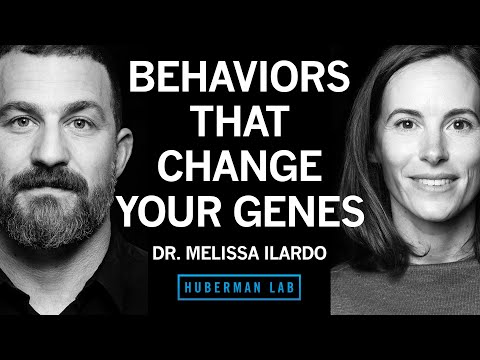
Behaviors That Alter Your Genes to Improve Your Health & Performance | Dr. Melissa Ilardo
Andrew Huberman (host), Dr. Melissa Ilardo (guest)
In this episode of Huberman Lab, featuring Andrew Huberman and Dr. Melissa Ilardo, Behaviors That Alter Your Genes to Improve Your Health & Performance | Dr. Melissa Ilardo explores how Everyday Behaviors Reshape Human Genes, Brains, Bodies, And Lineages Andrew Huberman and geneticist Dr. Melissa Ilardo explore how human genetics, epigenetics, and behavior interact to sculpt our bodies and abilities—sometimes in just one generation, sometimes across many. They focus on real-world “superhuman” populations such as Indonesian Bajau sea nomads and Korean Haenyeo women divers, showing how extreme breath-hold diving in cold water has shaped spleen size, red blood cell dynamics, heart function, and pregnancy adaptations. The discussion ranges from mate choice via body odor and immune genetics to rapid human evolution, cross-breeding with archaic humans, and how trauma, famine, and lifestyle can leave epigenetic marks passed to descendants. They close by examining the promises and ethical risks of human gene editing and how beliefs about our genes can themselves alter our biology and performance.
How Everyday Behaviors Reshape Human Genes, Brains, Bodies, And Lineages
Andrew Huberman and geneticist Dr. Melissa Ilardo explore how human genetics, epigenetics, and behavior interact to sculpt our bodies and abilities—sometimes in just one generation, sometimes across many. They focus on real-world “superhuman” populations such as Indonesian Bajau sea nomads and Korean Haenyeo women divers, showing how extreme breath-hold diving in cold water has shaped spleen size, red blood cell dynamics, heart function, and pregnancy adaptations. The discussion ranges from mate choice via body odor and immune genetics to rapid human evolution, cross-breeding with archaic humans, and how trauma, famine, and lifestyle can leave epigenetic marks passed to descendants. They close by examining the promises and ethical risks of human gene editing and how beliefs about our genes can themselves alter our biology and performance.
Key Takeaways
Behavior Can Rapidly Reshape Gene Expression—And Sometimes Future Generations
While DNA sequence is largely fixed, gene expression is highly dynamic and influenced by environment and behavior on timescales from minutes to generations. ...
Get the full analysis with uListen AI
The Mammalian Dive Reflex Is A Potent, Underappreciated Human System
Immersing the face in cold water while holding the breath triggers a reflex that slows heart rate, constricts peripheral vessels, and causes the spleen to contract, releasing ~10% more oxygen-rich red blood cells into circulation. ...
Get the full analysis with uListen AI
Sea Nomads Have Genetically Enlarged Spleens That Act As Natural Oxygen Tanks
Bajau sea nomads of Indonesia, who dive daily for food, have spleens about 50% larger than neighboring non-diving villagers living in similar environments. ...
Get the full analysis with uListen AI
Female Haenyeo Divers Show Both Trained And Genetic Cardiovascular Adaptations
Korean Haenyeo women on Jeju Island dive into very cold water, often into their 70s and 80s, and historically did so throughout pregnancy. ...
Get the full analysis with uListen AI
Mate Choice Is Quietly Shaped By Immune Genetics And Smell
Both mice and humans tend to prefer mates whose major histocompatibility complex (MHC)—a key immune gene cluster—differs most from their own. ...
Get the full analysis with uListen AI
Human Evolution Is Ongoing, Fast, And Fueled By Mixing
Contrary to the popular notion that humans are “done evolving,” modern humans are evolving wherever traits affect reproductive success or survival: altitude tolerance in Tibetans, lactase persistence in dairying cultures, and extreme lipid metabolism in Greenlandic Inuit are clear examples. ...
Get the full analysis with uListen AI
Beliefs About Your Genetics Can Biologically Change Your Outcomes
Experiments show that merely being told you have a ‘good’ or ‘bad’ genetic profile for exercise adaptation can measurably alter your physiological responses to training, regardless of your actual DNA. ...
Get the full analysis with uListen AI
Notable Quotes
“As long as there are things that are affecting our ability to reproduce, we're gonna continue to evolve.”
— Dr. Melissa Ilardo
“Most mutations are deleterious. We actually don't even see most mutations because they kill the offspring before it even becomes a fetus.”
— Dr. Melissa Ilardo
“The spleen is like a biological scuba tank, increasing the amount of oxygen available to you when you need it the most.”
— Dr. Melissa Ilardo
“People were more drawn to people who had very different immune systems than their own. That smell is a proxy for the immune system of the offspring you haven't even had yet.”
— Andrew Huberman and Dr. Melissa Ilardo (paraphrased exchange)
“Just because you can train a European runner to compete at nearly the same level doesn’t mean there’s not something special about people like Kipchoge.”
— Dr. Melissa Ilardo
Questions Answered in This Episode
In your Bajau work, have you followed children longitudinally to see whether early-life diving frequency changes spleen size or dive reflex strength on top of the genetic baseline?
Andrew Huberman and geneticist Dr. ...
Get the full analysis with uListen AI
With the Haenyeo, do you see any long-term trade-offs—like increased arrhythmias, hearing loss beyond eardrum rupture, or cognitive changes—from decades of extreme cold-water diving and repeated hypoxia?
Get the full analysis with uListen AI
If we could pharmacologically or behaviorally mimic the Bajau thyroid–spleen pathway without gene editing, what concrete applications do you see first—elite sport, high-altitude performance, or clinical treatment of hypoxic patients?
Get the full analysis with uListen AI
Given that mate choice appears to favor immune dissimilarity, do modern practices like heavy perfume, hormonal contraception, or online-only dating risk disrupting this subtle genetic filtering?
Get the full analysis with uListen AI
When embryo sequencing reveals elevated risk for multifactorial traits like autism or depression, what ethical framework would you personally use to help parents interpret that information without slipping into eugenic decision-making?
Get the full analysis with uListen AI
Transcript Preview
Welcome to the Huberman Lab podcast, where we discuss science and science-based tools for everyday life. I'm Andrew Huberman, and I'm a professor of neurobiology and ophthalmology at Stanford School of Medicine. My guest today is Dr. Melissa Elardo, professor of biomedical informatics at the University of Utah. Dr. Elardo is a world-renowned expert in human genetics and epigenetics. She conducts pioneering studies on how our behavior and the environment can modify our gene expression. Today marks the first time on the Huberman Lab podcast that we really explore human genetics, epigenetics, and how behavior shapes gene expression across generations. We talk about the inheritance of physical traits like eye color, and we dive deep into fascinating mechanisms such as the mammalian dive reflex, a physiological reaction to breath holding in cold water that, as Dr. Elardo explains, can dramatically alter the physiology of your spleen to allow significant increases in red blood cell count and oxygen availability to your brain and body. And by the way, the mammalian dive reflex can be activated outside of free diving, and you can even do it at home. We also explore how mate preference and selection in humans relates to the immune system. That is, if you were given a choice of many, many different mates, as most people are, the mate you would select is the mate who has the immune system composition that is most different from yours, and you would know that on the basis of their smell and how attractive their smell is to you compared to the smell of other people. We also talk about how differences in external traits signal important variations in organ function, hormone levels, and even brain physiology. Toward the end of our conversation, we discuss the current state and ethical considerations of gene editing in humans, something that's apt to be an increasingly important topic in the years to come because gene editing in humans is now possible and is happening. As you'll soon learn, Dr. Elardo does incredible real-world experiments that reveal the remarkable interplay between genes and behavior, and she's an absolutely phenomenal teacher who makes complex genetic concepts accessible and practical. The conversation is sure to change the way that you think about mate selection, your parents, their parents, and what you can do to optimize your physiology and health through behavioral practices that influence gene expression. Before we begin, I'd like to emphasize that this podcast is separate from my teaching and research roles at Stanford. It is, however, part of my desire and effort to bring zero-cost-to-consumer information about science and science-related tools to the general public. In keeping with that theme, this episode does include sponsors. And now for my discussion with Dr. Melissa Elardo. Dr. Melissa Elardo, welcome.
Thank you.
Nature versus nurture, super big question that we all wonder about, you know. How much of our capabilities and potential and just general themes of life, everything from how we look to what we're capable of doing or not doing in the moment or where we might be able to improve or not improve, we hear some of it's nature, some of it's nurture. So if we take a step back and we just ask a big question about human genetics, how much of our DNA is modifiable by our environment and what we do, what we choose to do in particular? Because that's most of what we're gonna emphasize today.
Install uListen to search the full transcript and get AI-powered insights
Get Full TranscriptGet more from every podcast
AI summaries, searchable transcripts, and fact-checking. Free forever.
Add to Chrome