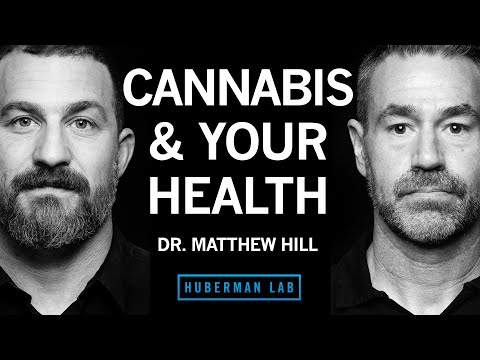
How Cannabis Impacts Health & the Potential Risks | Dr. Matthew Hill
Andrew Huberman (host), Dr. Matthew Hill (guest), Narrator
In this episode of Huberman Lab, featuring Andrew Huberman and Dr. Matthew Hill, How Cannabis Impacts Health & the Potential Risks | Dr. Matthew Hill explores tHC, CBD, and Cannabis Myths: Risks, Benefits, and Unknowns Explained Andrew Huberman and cannabinoid researcher Dr. Matthew Hill conduct a deep, non-debate conversation on what is actually known—and unknown—about cannabis biology, health effects, and risks.
THC, CBD, and Cannabis Myths: Risks, Benefits, and Unknowns Explained
Andrew Huberman and cannabinoid researcher Dr. Matthew Hill conduct a deep, non-debate conversation on what is actually known—and unknown—about cannabis biology, health effects, and risks.
They explain how the endocannabinoid system works, how THC and CBD interact (or don’t) with it, and why route of administration (smoking vs. edibles vs. concentrates) radically changes both effects and risks.
They dissect claims about psychosis, schizophrenia, anxiety, pain, sleep, appetite, hormonal effects, ‘strains’ like indica vs. sativa, and the booming CBD market, emphasizing where data are strong vs. speculative.
Throughout, Hill stresses that harms are real but often mischaracterized, benefits exist but are narrower than marketing claims, and many widely believed ideas (high-THC equals schizophrenia, CBD for everything, indica vs. sativa effects) are not supported by current evidence.
Key Takeaways
THC hijacks a finely tuned homeostatic system rather than just “boosting” it
The brain’s endocannabinoid system (mainly CB1 receptors plus endogenous ligands anandamide and 2-AG) evolved to maintain homeostasis by retrogradely regulating synaptic transmission. ...
Get the full analysis with uListen AI
Route and pattern of use matter as much as THC percentage
With smoked or vaporized cannabis flower, both humans and rodents self-titrate: heavy users given 5% or 25% THC plant still end up around ~100 ng/mL blood THC because they simply take fewer puffs with stronger material. ...
Get the full analysis with uListen AI
Cannabis can strongly modulate appetite and reward, not just “make you hungry”
Endocannabinoids in hypothalamic feeding circuits (e. ...
Get the full analysis with uListen AI
CBD is clinically useful at very high doses for specific epilepsies, but most consumer CBD is likely placebo-level
CBD does not cause a recognizable ‘high’ and does not meaningfully activate CB1. ...
Get the full analysis with uListen AI
Cannabis–psychosis links are real, but causality claims are overstated and likely wrong in many headlines
Cannabis can acutely trigger psychotic episodes and panic in a small subset of users, especially at high doses. ...
Get the full analysis with uListen AI
Most ‘indica vs. sativa’ effects are likely expectancy bias, not chemistry
Botanically, ‘indica’ and ‘sativa’ describe plant morphology, not unique chemical profiles. ...
Get the full analysis with uListen AI
Cannabis has meaningful risks: cardiovascular, lung, cyclic vomiting, and use disorder, especially in vulnerable groups
Smoking cannabis exposes lungs to combustion products and can cause chronic bronchitis and emphysema, though lung cancer links are weaker than with tobacco, likely due to lower lifetime exposure. ...
Get the full analysis with uListen AI
Notable Quotes
“The primary physiological role of endocannabinoids is to maintain homeostasis. That’s what they do. They keep everything in its happy place.”
— Dr. Matthew Hill
“THC is not a sledgehammer version of an endocannabinoid. It’s carpet bombing the whole system indiscriminately instead of being a finely tuned local signal.”
— Dr. Matthew Hill
“If someone has schizophrenia, cannabis is contraindicated. You shouldn’t be using cannabis if you have schizophrenia.”
— Dr. Matthew Hill
“The overwhelming majority of the effects of CBD that people report are all placebo effects… I have yet to see a blinded clinical study showing efficacy at the doses people actually buy in stores.”
— Dr. Matthew Hill
“Cannabis is wildly polarizing. If I don’t say it’s the devil, I’m an advocate. If I don’t say it cures everything, I’m a prohibitionist.”
— Dr. Matthew Hill
Questions Answered in This Episode
Given your model that low tonic anandamide might correlate with higher trait anxiety, do you envision a future where we can screen individuals’ endocannabinoid profiles to predict who might benefit from endocannabinoid-targeted drugs versus who should strictly avoid THC?
Andrew Huberman and cannabinoid researcher Dr. ...
Get the full analysis with uListen AI
You argued that Scandinavian schizophrenia rates don’t track with differences in cannabis use. How would you design a study that could more definitively tease apart cannabis as an accelerant versus a true causal factor in schizophrenia onset?
They explain how the endocannabinoid system works, how THC and CBD interact (or don’t) with it, and why route of administration (smoking vs. ...
Get the full analysis with uListen AI
For chronic pain patients who report real functional gains using nightly THC but also see some cognitive or motivational blunting, how would you help them rationally weigh those tradeoffs against long-term opioid or NSAID use?
They dissect claims about psychosis, schizophrenia, anxiety, pain, sleep, appetite, hormonal effects, ‘strains’ like indica vs. ...
Get the full analysis with uListen AI
You’re quite skeptical of consumer CBD, but given its favorable safety profile, is there a case for formally testing higher (e.g., 300–600 mg) non-pharmaceutical CBD doses for anxiety or sleep in rigorous trials, or do the pharmacokinetic and liver-enzyme issues make that a dead end?
Throughout, Hill stresses that harms are real but often mischaracterized, benefits exist but are narrower than marketing claims, and many widely believed ideas (high-THC equals schizophrenia, CBD for everything, indica vs. ...
Get the full analysis with uListen AI
If most reported ‘indica vs. sativa’ differences are expectancy-driven, should regulators or medical systems push for abandoning those labels entirely in favor of quantified chemovars (THC, CBD, key terpenes), and what practical steps would be required to make that shift without confusing consumers even more?
Get the full analysis with uListen AI
Transcript Preview
(uptempo music) Welcome to the Huberman Lab Podcast, where we discuss science and science-based tools for everyday life. I'm Andrew Huberman, and I'm a professor of neurobiology and ophthalmology at Stanford School of Medicine. My guest today is Dr. Matthew Hill. Dr. Matthew Hill is a professor of cell biology and anatomy at the University of Calgary. His laboratory studies cannabis and its effects on stress, its effects on feeding, and its effects on the behavioral impacts of cannabis exposure at different stages of development. The origin of today's podcast episode is a bit unique, so I'd like to share a little bit of that background with you. Previously, I did a solo episode of the Huberman Lab Podcast about cannabis, the biology of cannabis, some of its medical applications and uses, as well as some of its potential harms. That episode came out several years ago now and remains a very popular episode. It's had millions of views and millions of listens. Several months ago, we posted a clip of that episode to X, formerly known as Twitter, and Dr. Matthew Hill responded to that clip on X with criticism about the specific points made within that clip, most notably my discussion of the data that cannabis use can, in some individuals, cause psychosis. He also took issue with some of the specific points I made in that clip related to potential differences in the biology of the effects of different strains of cannabis, most notably indica versus sativa strains, and a few other points as well. Now, as somebody who's been in the field of science for several decades now, I'm very familiar with the fact that every field, every single field within science, has debates within it, controversies, and sometimes outright battles. And to me, that's part of what makes science interesting. It's an evolving process. It's something for which we should all be very curious to try and understand what we know, what we don't know, and try and get to the real answers. So right off the bat, on X, I invited Dr. Hill onto the podcast, and he accepted the invitation. So today's episode is really a unique one in that, first of all, we cover an enormous amount of biology and clinical data as it relates to cannabis, meaning today's discussion is not a debate. It is really an up-to-date discussion about how cannabis works. So we talk about THC versus CBD. We address the question of whether or not indicas versus sativas have different biological and subjective effects or not. We, of course, talk about the potential correlation, maybe even causation, between cannabis use and psychosis. I think you'll find that discussion very interesting. And we talk about how cannabis relates to hunger, to memory, to anxiety, and to the treatment of anxiety. I'm certain that given the widespread use of cannabis nowadays, that you'll find the discussion to be both an informative and potentially useful one that could help guide decisions as to whether or not you or others should or should not use or avoid cannabis, as well as one that can simply inform about this very interesting compound. And of course, you'll learn a lot of neuroscience and biology along the way. Before we begin, I'd like to emphasize that this podcast is separate from my teaching and research roles at Stanford. It is, however, part of my desire and effort to bring zero-cost-to-consumer information about science and science-related tools to the general public. In keeping with that theme, I'd like to thank the sponsors of today's podcast. Our first sponsor is Eight Sleep. Eight Sleep makes smart mattress covers with cooling, heating, and sleep-tracking capacity. Now, I've spoken many times before on this podcast about the critical need to get sleep, both enough sleep and enough quality sleep. Now, one of the key things to getting a great night's sleep is that your body temperature actually has to drop by about one to three degrees in order for you to fall and stay deeply asleep. And to wake up feeling refreshed, your body temperature actually has to increase by about one to three degrees. One of the best ways to ensure all of that happens is to control the temperature of your sleeping environment. And with Eight Sleep, it's very easy to do that. You program the temperature that you want at the beginning, middle, and the end of the night, and that's the temperature that you're going to sleep at, and it will track your sleep. It tells you how much slow-wave sleep you're getting, how much rapid eye movement sleep you're getting, which is critical, and all of that also helps you dial in the exact parameters you need in order to get the best possible night's sleep for you. I've been sleeping on an Eight Sleep mattress cover for well over three years now, and it has completely transformed my sleep for the better. Eight Sleep recently launched their newest generation pod cover, the Pod 4 Ultra. The Pod 4 Ultra cover has improved cooling and heating capacity, higher fidelity sleep-tracking technology, and the Pod 4 cover has snoring detection that will automatically lift your head a few degrees to improve airflow and stop your snoring. If you'd like to try an Eight Sleep mattress cover, you can go to EightSleep.com/Huberman to save $350 off their Pod 4 Ultra. Eight Sleep currently ships to the USA, Canada, UK, select countries in the EU, and Australia. Again, that's EightSleep.com/Huberman. Today's episode is also brought to us by LMNT. LMNT is an electrolyte drink that has everything you need and nothing you don't. That means the electrolytes sodium, magnesium, and potassium in the correct ratios, but no sugar. Now, I and others on the podcast have talked a lot about the critical importance of hydration for proper brain and bodily function. Research shows that even a slight degree of dehydration can really diminish cognitive and physical performance. It's also important that you get adequate electrolytes in order for your body and brain to function at their best. The electrolytes sodium, magnesium, and potassium are critical for the functioning of all the cells in your body, especially your neurons, or nerve cells. To make sure that I'm getting proper amounts of hydration and electrolytes, I dissolve one packet of LMNT in about 16 to 32 ounces of water when I wake up in the morning, and I drink that basically first thing in the morning. I also drink LMNT dissolved in water during any kind of physical exercise I'm doing, especially on hot days if I'm sweating a lot and losing water and electrolytes. If you'd like to try LMNT, you can go to DrinkLMNT.com/Huberman, spelled Drink L-M-N-T dot com slash Huberman, to claim a free LMNT sample pack with the purchase of any LMNT drink mix. Again, that's DrinkLMNT.com/Huberman to claim a free sample pack.Today's episode is also brought to us by BetterHelp. BetterHelp offers professional therapy with a licensed therapist carried out entirely online. There are essentially three things that make up great therapy. First of all, great therapy consists of having good rapport with somebody that you can really trust and talk to about the issues that you're dealing with. Second of all, that therapist should provide support in the form of emotional support or directed guidance. And third, expert therapy should provide useful insights, insights that allow you to better understand not just your emotional life and your relationship life but, of course, also your relationship to yourself and to career goals and school goals, meaning excellent therapy should also inspire positive action. BetterHelp makes it very easy for you to find an expert therapist with whom you really resonate with and that can provide the benefits that I just described. Also, because BetterHelp therapy is done entirely online, it's very time-efficient and it's easy to fit into a busy schedule because it involves no commuting to a therapist's office, finding a parking spot, or sitting in a waiting room. If you'd like to try BetterHelp, you can go to betterhelp.com/huberman to get 10% off your first month. Again, that's betterhelp.com/huberman. And now for my discussion with Dr. Matthew Hill. Dr. Matt Hill, welcome.
Install uListen to search the full transcript and get AI-powered insights
Get Full TranscriptGet more from every podcast
AI summaries, searchable transcripts, and fact-checking. Free forever.
Add to Chrome