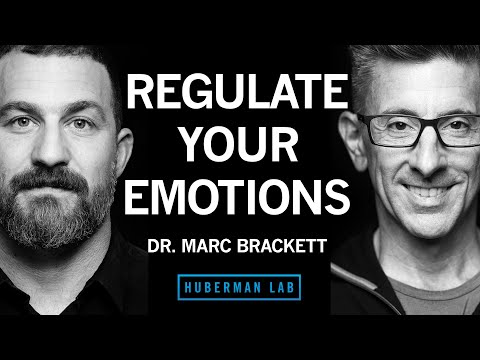
How to Increase Your Emotional Intelligence | Dr. Marc Brackett
Andrew Huberman (host), Marc Brackett (guest)
In this episode of Huberman Lab, featuring Andrew Huberman and Marc Brackett, How to Increase Your Emotional Intelligence | Dr. Marc Brackett explores transforming Emotions Into Intelligence: Practical Skills For Everyday Life Andrew Huberman and Yale psychologist Dr. Marc Brackett unpack what emotional intelligence really is and how it can be trained at any age using a concrete skills framework called RULER.
Transforming Emotions Into Intelligence: Practical Skills For Everyday Life
Andrew Huberman and Yale psychologist Dr. Marc Brackett unpack what emotional intelligence really is and how it can be trained at any age using a concrete skills framework called RULER.
They distinguish between different emotions (e.g., anger vs. disappointment, stress vs. envy) and show why precise labeling plus understanding the ‘why’ behind feelings is crucial for effective regulation.
The conversation explores how technology (texts, emojis, social media) is degrading emotional skills; the importance of in‑person, nonjudgmental listening; and how emotional education in schools and workplaces can improve learning, health, and relationships.
Brackett shares personal stories of bullying, abuse, and family conflict to illustrate how permission to feel, emotional vocabulary, and regulation strategies like distancing and reframing can turn painful experiences into resilience and leadership.
Key Takeaways
Emotional intelligence is a trainable set of skills, not a fixed trait.
Brackett defines emotional intelligence as “how we reason with and about emotions” and operationalizes it with RULER: Recognizing, Understanding, Labeling, Expressing, and Regulating emotions. ...
Get the full analysis with uListen AI
Granular emotion vocabulary radically improves regulation and decision making.
Most people lump many states into one word (e. ...
Get the full analysis with uListen AI
The Mood Meter (energy × pleasantness) is a simple daily self-awareness tool.
All feelings can be roughly mapped on two axes: pleasant–unpleasant and high–low energy, yielding four quadrants: Yellow (high energy, pleasant), Green (low energy, pleasant), Blue (low energy, unpleasant), Red (high energy, unpleasant). ...
Get the full analysis with uListen AI
Technology is eroding emotional skills when it replaces face-to-face connection.
Emoji and short texts compress rich emotional states into vague icons and one-word responses, encouraging ‘lumping’ instead of nuance. ...
Get the full analysis with uListen AI
Permission to feel—nonjudgmental, empathic listening—is the foundation of growth.
In large samples, only about one-third of adults felt they had an ‘Uncle Marvin’ figure growing up—someone nonjudgmental, empathic/compassionate, and an active listener who made it safe to share feelings. ...
Get the full analysis with uListen AI
Effective emotion regulation uses distancing, reframing, and gratitude, not suppression.
Suppressing feelings tends to intensify and prolong them in Western samples. ...
Get the full analysis with uListen AI
Bullying and shame demand systemic emotional education, not just rules and punishment.
Brackett’s own severe childhood bullying—paired with emotionally unavailable parents—generated chronic shame and despair. ...
Get the full analysis with uListen AI
Notable Quotes
“We have to know how we feel, we have to know what we want to do with those feelings, and we have to know how the people we live with and love and work with feel too.”
— Marc Brackett
“If you only have one word for anger, that means all you know is there’s one form of anger.”
— Marc Brackett
“Only about a third of adults felt that they had someone when they were young who created the conditions for them to have permission to feel.”
— Marc Brackett
“Emotionally intelligent people are not people who talk about their feelings all day long.”
— Marc Brackett
“My dream is that we need a world where everyone gets an emotion education… preschool to high school, and it’s got to continue in college and in the workforce.”
— Marc Brackett
Questions Answered in This Episode
You showed that much self-reported ‘stress’ in your Yale students was actually envy—how would you design a concrete, step-by-step ‘envy-to-gratitude’ protocol for a highly competitive workplace?
Andrew Huberman and Yale psychologist Dr. ...
Get the full analysis with uListen AI
In your own story of confronting the bullying colleague at age 50, what specific inner dialogue and bodily cues told you it was the right moment to speak up rather than stay silent or retaliate?
They distinguish between different emotions (e. ...
Get the full analysis with uListen AI
Given that suppression can worsen emotions but constant expression can be counterproductive, how do you decide when an unpleasant feeling should be ‘ridden out’ like the kindergartner’s blue mood versus actively regulated or acted upon?
The conversation explores how technology (texts, emojis, social media) is degrading emotional skills; the importance of in‑person, nonjudgmental listening; and how emotional education in schools and workplaces can improve learning, health, and relationships.
Get the full analysis with uListen AI
Your Mood Meter suggests using ‘red’ emotions strategically to drive change (as you did at the Department of Education). Where do you draw the line between productive moral anger and anger that becomes harmful to relationships or credibility?
Brackett shares personal stories of bullying, abuse, and family conflict to illustrate how permission to feel, emotional vocabulary, and regulation strategies like distancing and reframing can turn painful experiences into resilience and leadership.
Get the full analysis with uListen AI
If you were redesigning social media from scratch to support emotional intelligence instead of degrading it, what specific UX features or guardrails would you build to encourage nuance, nonjudgment, and genuine empathy?
Get the full analysis with uListen AI
Transcript Preview
(uptempo music) Welcome to the Huberman Lab Podcast, where we discuss science and science-based tools for everyday life. I'm Andrew Huberman, and I'm a professor of neurobiology and ophthalmology at Stanford School of Medicine. My guest today is Dr. Marc Brackett. Dr. Marc Brackett is a professor of psychology at Yale University and the director of the Yale Center for Emotional Intelligence. He is one of the world's foremost experts on emotions, meaning what emotions are and how they regulate our relationship to ourself and others. Today's discussion gets heavily into how we should think about our emotions and the emotional expressions of others and when and how we should regulate those emotions. This is a very important aspect of our life, because as we all know, emotions are present with us from the moment we are born until the moment we die. So much like having a body, we need to learn how to work with our emotions in order to have the best quality of life. We all know that we are supposed to pay attention to our emotions, but at the same time, we are often told that we shouldn't take all of our emotions seriously, nor should we react to all of our emotions with behaviors, and indeed, that is true. What's been lacking, however, and what Dr. Marc Brackett finally delivers to us, is a roadmap to think about our emotions in a very structured way and thereby to engage with our emotions, sometimes shift our emotions, and certainly to understand the emotional expressions of others in ways that best serve our quality of life. So today's discussion centers very heavily on scientific data that plays out in the real world that, that we can all use. We talk about conflict resolution. We talk about how to think about and work with emotions. We talk about bullying, both in children and in adults, how to deal with that sort of thing effectively, and we talk about emotional intelligence, which it turns out can be increased at any stage of life. So by the end of today's discussion, you will be armed with a tremendous amount of new knowledge and many new tools, many new protocols that you can immediately apply in your life in order to improve your relationship to yourself and to others. Before we begin, I'd like to emphasize that this podcast is separate from my teaching and research roles at Stanford. It is, however, part of my desire and effort to bring zero-cost-to-consumer information about science and science-related tools to the general public. In keeping with that theme, I'd like to thank the sponsors of today's podcast. Our first sponsor is BetterHelp. BetterHelp offers professional therapy with a licensed therapist carried out entirely online. I've been doing weekly therapy for well over 30 years. I consider doing regular therapy just as important as getting regular exercise. Now, there are essentially three things that great therapy provides. First of all, it provides good rapport with somebody that you can trust and talk to about the issues that are most critical to you. Second of all, it can provide support in the form of emotional support or directed guidance. And third, expert therapy should provide insights, insights that are useful in allowing you not just to feel better in your emotional life and your relationship life, but of course, to be better, to be better in terms of the relationship to yourself, your professional life, and to others, and of course, to things like your career goals. With BetterHelp, they make it very easy for you to find an expert therapist with whom you have these critical components of therapy. Also, because BetterHelp allows for therapy to be done entirely online, it's very time efficient and easy to fit into your busy schedule with no commuting to a therapist's office or looking for parking or sitting in a waiting room. If you'd like to try BetterHelp, go to betterhelp.com/huberman to get 10% off your first month. Again, that's betterhelp.com/huberman. Today's episode is also brought to us by Eight Sleep. Eight Sleep makes smart mattress covers with cooling, heating, and sleep tracking capacity. Now, I've spoken many times before on this podcast about the critical need for us to get adequate amounts of quality sleep each night. One of the best ways to ensure a great night's sleep is to control the temperature of your sleeping environment, and that's because in order to fall and stay deeply asleep, your body temperature actually has to drop by about one to three degrees. And in order to wake up feeling refreshed and energized, your body temperature actually has to increase by about one to three degrees. Eight Sleep makes it incredibly easy to control the temperature of your sleeping environment by allowing you to program the temperature of your mattress cover at the beginning, middle, and end of the night. I've been sleeping on an Eight Sleep mattress cover for well over three years now, and it has completely transformed my sleep for the better. Eight Sleep recently launched their newest generation pod cover, the Pod 4 Ultra. The Pod 4 Ultra has improved cooling and heating capacity, higher fidelity sleep tracking technology, and it also has snoring detection that, remarkably, will automatically lift your head a few degrees to improve your airflow and stop your snoring. If you'd like to try an Eight Sleep mattress cover, you can go to eightsleep.com/huberman to save $350 off their Pod 4 Ultra. Eight Sleep currently ships to the USA, Canada, UK, select countries in the EU, and Australia. Again, that's eightsleep.com/huberman. I'm excited to share that I'll be speaking at a health summit called Eudemonia, taking place in West Palm Beach, Florida, this November 1st, 2024, through the 3rd of November, 2024. Eudemonia is an in-person event that offers science-backed tools, live fitness classes, and a range of treatments and protocols to optimize your physical and your mental health. I'll be giving a keynote talk with none other than Dr. Gabrielle Lyon on Saturday. As some of you may know, she's a former guest on the Huberman Lab Podcast and has a terrific podcast of her own. That's going to be on November 2nd, and we will discuss all things neuroscience and neuroplasticity. We'll talk about some of the benefits and protocols related to cognition and mood and much more. Also presenting at Eudemonia are other excellent scientists and clinicians who've appeared on the Huberman Lab Podcast, including Dr. Sara Gottfried, Dr. Zachary Knight, and Dr. Robin Carhart-Harris, along with nearly 70 other experts. To see the full lineup of speakers and topics and to register, visit eudemonia.net, spelled E-U-D-E-M-O-N-I-A.net. It's sure to be a terrific gathering, and I hope to see you there. And now for my discussion with Dr. Marc Brackett.Dr. Marc Brackett, welcome.
Install uListen to search the full transcript and get AI-powered insights
Get Full TranscriptGet more from every podcast
AI summaries, searchable transcripts, and fact-checking. Free forever.
Add to Chrome