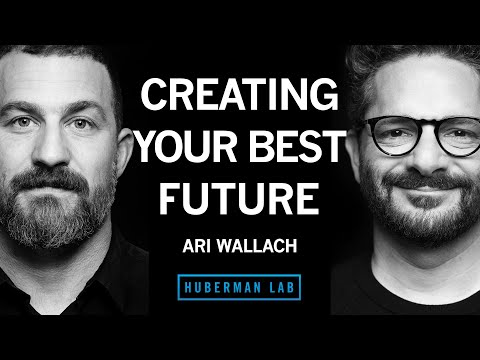
Create Your Ideal Future Using Science-Based Protocols | Ari Wallach
Andrew Huberman (host), Ari Wallach (guest), Guest (guest), Narrator
In this episode of Huberman Lab, featuring Andrew Huberman and Ari Wallach, Create Your Ideal Future Using Science-Based Protocols | Ari Wallach explores designing Protopian Futures: Longpath Thinking For Everyday Decisions Today Andrew Huberman and futurist Ari Wallach explore how our uniquely human ability for “mental time travel” can be redirected from short-term, stimulus–response behavior toward building long-term, pro-social futures. Wallach introduces his Longpath framework, built on transgenerational empathy, futures thinking, and a clear sense of telos (ultimate purpose), and shows how individual daily choices ripple out across generations. They discuss why modern technology and media compress our time horizon into an anxious present, how fear of death blocks real future-oriented thinking, and why we need new, hopeful narratives—“protopias” instead of dystopias. The conversation is highly practical, offering concrete protocols to relate to your future self, influence descendants you’ll never meet, and make better decisions today that contribute to a wiser civilization.
Designing Protopian Futures: Longpath Thinking For Everyday Decisions Today
Andrew Huberman and futurist Ari Wallach explore how our uniquely human ability for “mental time travel” can be redirected from short-term, stimulus–response behavior toward building long-term, pro-social futures. Wallach introduces his Longpath framework, built on transgenerational empathy, futures thinking, and a clear sense of telos (ultimate purpose), and shows how individual daily choices ripple out across generations. They discuss why modern technology and media compress our time horizon into an anxious present, how fear of death blocks real future-oriented thinking, and why we need new, hopeful narratives—“protopias” instead of dystopias. The conversation is highly practical, offering concrete protocols to relate to your future self, influence descendants you’ll never meet, and make better decisions today that contribute to a wiser civilization.
Key Takeaways
Train “transgenerational empathy” starting with self-compassion, then backward and forward in time.
Wallach argues that long-term thinking must begin with empathy for self—recognizing you were always doing your best with the tools and maturity you had at the time. ...
Get the full analysis with uListen AI
Use concrete tools to emotionally connect with your future self and change your behavior now.
Research by Hal Hershfield shows the brain treats “future you” like a stranger; this weak connection undermines saving, health behaviors, and planning. ...
Get the full analysis with uListen AI
Anchor everyday decisions to being “a great ancestor” instead of chasing short-term metrics.
Huberman and Wallach highlight that likes, clicks, promotions, and status are short-term, egoic rewards that rarely matter beyond a few years. ...
Get the full analysis with uListen AI
Create physical and symbolic “time capsules” to make your long-term impact tangible.
Because digital content has a short half-life, Wallach emphasizes concrete legacy cues at home: a family photo shelf that includes an intentionally empty frame representing future grandchildren or descendants, reminding you visually that your life is one segment in a chain. ...
Get the full analysis with uListen AI
Recognize how presentism and notification culture hijack ancient neural hardware.
Humans evolved mental time travel to plan hunts and migrations using the hippocampus’ recombination of episodic memories. ...
Get the full analysis with uListen AI
Face mortality directly to unlock genuine long-term thinking.
Drawing on Ernest Becker’s ‘The Denial of Death,’ Wallach argues that our fear of death drives much of our short-termism and status-seeking. ...
Get the full analysis with uListen AI
Shift cultural narratives from dystopias to “protopias” to act as a kedge anchor toward better futures.
Most popular future-oriented fiction consumed by young people is dystopian, which acts as an early warning system but offers little positive direction. ...
Get the full analysis with uListen AI
Notable Quotes
“We need to ask, ‘How do we become the great ancestors the future needs us to be?’”
— Ari Wallach
“Emotions aren’t just about the past. They’re there to help us make better decisions about the future.”
— Ari Wallach
“Life is not a 100-yard dash. It’s a relay. You’re carrying a baton that was handed to you and that you will hand off.”
— Ari Wallach
“Most of social media today is a kind of hall of mirrors for our culture—our way of saying, ‘Notice me. My life meant something.’”
— Ari Wallach
“If you really want the future to be different, you don’t just need more smartness. You need more wisdom.”
— Ari Wallach
Questions Answered in This Episode
You describe a daily practice of looking at an age-progressed photo of yourself. Can you walk through, step-by-step, how someone should set this up and what specific thoughts or prompts they should use while looking at that image to get the most behavioral change?
Andrew Huberman and futurist Ari Wallach explore how our uniquely human ability for “mental time travel” can be redirected from short-term, stimulus–response behavior toward building long-term, pro-social futures. ...
Get the full analysis with uListen AI
In your work with organizations and governments, have you seen concrete policy decisions or corporate strategies change after adopting Longpath and transgenerational empathy, and if so, can you share a specific before-and-after example?
Get the full analysis with uListen AI
You argued that denial of death is a major barrier to caring about futures we won’t live to see. For someone who finds the idea of a death meditation terrifying, what is a gentler entry-level exercise that still helps them begin to face mortality in a productive way?
Get the full analysis with uListen AI
Many young people today are immersed in dystopian media and feel that the system is too broken for their individual actions to matter. How would you practically convince a skeptical 18-year-old that small, Longpath-informed behaviors can have real, long-range impact?
Get the full analysis with uListen AI
You’ve criticized social media’s presentism but also noted that AI models are learning from our online discourse. If you were to design a ‘Longpath-friendly’ social platform from scratch, what specific features, incentives, or constraints would it include to promote protopian, long-term thinking rather than outrage and short-term dopamine hits?
Get the full analysis with uListen AI
Transcript Preview
(instrumental music) Welcome to the Huberman Lab Podcast, where we discuss science and science-based tools for everyday life. I'm Andrew Huberman, and I'm a professor of neurobiology and ophthalmology at Stanford School of Medicine. My guest today is Ari Wallach. Ari Wallach is an adjunct associate professor at Columbia University's School of International and Public Affairs. He is also the host of a new TV series, A Brief History of the Future. Today's discussion focuses on perhaps one of the most important questions that any and all of us have to ask ourselves at some point, which is, how is it that we are preparing this planet for the future? Not just for our children, if we happen to have children or want children, but for all people. The human brain, as we know, is capable of orienting its thoughts and its memories to the past, to the present, or to the future. But few people actually take the time to think about the future that they are creating on this planet and in culture, within our families, et cetera, for the next generation and generations that follow them. Ari Wallach is an expert in this topic, and he has centered his work around what he calls Longpath Labs, which is a focus on long-term thinking and coordinated behavior at the individual, organizational, and societal level in order to best ensure the thriving of our species. And while that may sound a bit aspirational, it is both aspirational and grounded in specific actions and logic. So during today's episode, Ari Wallach spells out for us not just the aspirations, not just what we want, but how to actually create that positive future and legacy for ourselves, for our families, and for society at large. It's an extremely interesting take on how to live now in a way that is positively building toward the future. So by the end of today's episode, you will have a unique perspective on how your brain works, how you frame time perception, and indeed, how you frame your entire life. Before we begin, I'd like to emphasize that this podcast is separate from my teaching and research roles at Stanford. It is, however, part of my desire and effort to bring zero-cost-to-consumer information about science and science-related tools to the general public. In keeping with that theme, I'd like to thank the sponsors of today's podcast. Our first sponsor is David. David makes a protein bar unlike any other. It has 28 grams of protein, only 150 calories, and zero grams of sugar. That's right, 28 grams of protein, and 75% of its calories come from protein. This is 50% higher than the next-closest protein bar. These bars from David also taste incredible. My favorite bar is the cake-flavored one, but then again, I also like the chocolate-flavored one and I like the berry-flavored one. Basically, I like all the flavors. They're all incredibly delicious. Now, for me personally, I try to get most of my calories from whole foods. However, when I'm in a rush or I'm away from home or I'm just looking for a quick afternoon snack, I often find that I'm looking for a high-quality protein source. And with David, I'm able to get 28 grams of high-quality protein with the calories of a snack, which makes it very easy to hit my protein goals of one gram of protein per pound of body weight, and it allows me to do so without taking on an excess of calories. As I mentioned before, they are incredibly delicious. In fact, they're surprisingly delicious. Even the consistency is great. It's more like a cookie consistency, kind of a chewy cookie consistency, which is unlike other bars, which I tend to kind of saturate on. I was never a big fan of bars until I discovered David bars. If you give them a try, you'll know what I mean. So if you'd like to try David, you can go to davidprotein.com/huberman. Again, the link is davidprotein.com/huberman. Today's episode is also brought to us by Helix Sleep. Helix Sleep makes mattresses and pillows that are customized to your unique sleep needs. Now, I've spoken many times before on this and other podcasts about the fact that getting a great night's sleep is the foundation of mental health, physical health, and performance. Now, the mattress we sleep on makes an enormous difference in terms of the quality of sleep that we get each night. We need a mattress that is matched to our unique sleep needs, one that is neither too soft nor too hard for you, one that breathes well and that won't be too warm or too cold for you. If you go to the Helix website, you can take a brief two-minute quiz, and it asks you questions such as, do you sleep on your back, your side, or your stomach? Do you tend to run hot or cold during the night? Things of that sort. Maybe you know the answers to those questions, maybe you don't. Either way, Helix will match you to the ideal mattress for you. For me, that turned out to be the Dusk mattress, D-U-S-K. I've been sleeping on a Dusk mattress for, gosh, now more than four years, and the sleep that I've been getting is absolutely phenomenal. So if you'd like to try Helix, you can go to helixsleep.com/huberman. Take that two-minute sleep quiz, and Helix will match you to a mattress that's customized for your unique sleep needs. Right now, Helix is giving up to 25% off all mattress orders. Again, that's helixsleep.com/huberman to get up to 25% off. Today's episode is also brought to us by ROKA. ROKA makes eyeglasses and sunglasses that are of the absolute highest quality. I've spent a lifetime working on the biology of the visual system, and I can tell you that your visual system has to contend with an enormous number of different challenges in order for you to be able to see clearly from moment to moment. ROKA understands all of that and has designed all of their eyeglasses and sunglasses with the biology of the visual system in mind. ROKA eyeglasses and sunglasses were first designed for use in sport, in particular for things like running and cycling. And as a consequence, ROKA frames are extremely lightweight, so much so that most of the time you don't even remember that you're wearing them, and they're also designed so that they don't slip off even if you get sweaty. Now, even though ROKA eyeglasses and sunglasses were initially designed for sport, they now have many different frames and styles, all of which can be used not just for sport, but also for wearing out to dinner, to work, essentially any time and any setting. I wear ROKA readers at night or ROKA eyeglasses if I'm driving at night, and I wear ROKA sunglasses in the middle of the day any time it's too bright for me to see clearly. My eyes are somewhat sensitive, so I need that. I particularly like the Hunter 2.0 frames, which I have as eyeglasses and now as sunglasses, too. If you'd like to try ROKA, you can go to roka.com/huberman to get 20% off your purchase. Again, that's roka.com/huberman to get 20% off. And now for my discussion with Ari Wallach. Ari Wallach, welcome.
Install uListen to search the full transcript and get AI-powered insights
Get Full TranscriptGet more from every podcast
AI summaries, searchable transcripts, and fact-checking. Free forever.
Add to Chrome