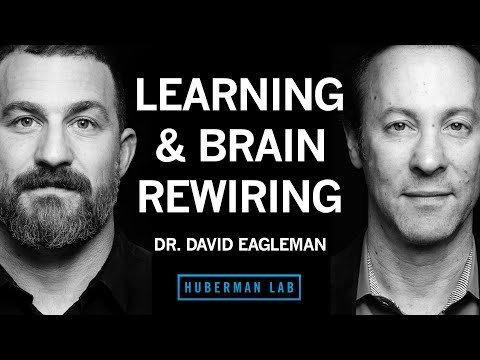
Science & Tools of Learning & Memory | Dr. David Eagleman
Dr. David Eagleman (guest), Andrew Huberman (host)
In this episode of Huberman Lab, featuring Dr. David Eagleman and Andrew Huberman, Science & Tools of Learning & Memory | Dr. David Eagleman explores eagleman explains how brains change, remember, and polarize society behaviors Dr. David Eagleman frames neuroplasticity as the brain’s constant rewiring in response to challenge, novelty, and the right neuromodulator “cocktail,” arguing that learning is the shift from effortful “software” to efficient “hardware.”
Eagleman explains how brains change, remember, and polarize society behaviors
Dr. David Eagleman frames neuroplasticity as the brain’s constant rewiring in response to challenge, novelty, and the right neuromodulator “cocktail,” arguing that learning is the shift from effortful “software” to efficient “hardware.”
He and Andrew Huberman explore how time perception is largely a memory phenomenon (dense memory makes events feel longer), why fear doesn’t literally increase perceptual “frame rate,” and how novelty can make life feel longer in retrospect.
They discuss directed plasticity (why “more plasticity” isn’t always good), tools like Ulysses contracts to protect the future self, and how sensory substitution/addition shows the cortex’s flexibility.
The episode ends with neuroscience-informed concerns about eyewitness testimony and a mechanistic view of polarization: in-group/out-group dynamics reduce empathy and can be amplified by propaganda and dehumanizing language.
Key Takeaways
Plasticity is driven by challenge—until you master it, then switch.
Eagleman’s rule of thumb: crossword puzzles are beneficial only until they become easy. ...
Get the full analysis with uListen AI
The cortex is highly repurposable; function depends on input.
He emphasizes cortex as a uniform algorithmic sheet defined by what it’s “plugged into,” citing experiments rerouting visual input to auditory cortex and observations that blindness/deafness reallocates cortical real estate to other modalities.
Get the full analysis with uListen AI
Practice makes skills efficient by moving them from “software” to “hardware.”
Elite performers (e. ...
Get the full analysis with uListen AI
Adult plasticity is real, but it’s more targeted than in childhood.
Eagleman argues primary sensory regions (e. ...
Get the full analysis with uListen AI
Seek novelty to extend functional plasticity across the lifespan.
Novel skills, new routes home, rearranging environments, switching hands for toothbrushing, and sustained social engagement keep the brain updating models and building “cognitive reserve,” illustrated by the Religious Orders (nuns) study.
Get the full analysis with uListen AI
Neuromodulators likely act as interacting ‘combination locks,’ not solo levers.
Huberman notes many modulators can open plasticity; Eagleman suggests the field over-focuses on single chemicals, though he highlights acetylcholine as especially central, shifting from global infant release to local adult release.
Get the full analysis with uListen AI
More plasticity isn’t inherently better—directed plasticity is the goal.
They caution that globally increasing plasticity (e. ...
Get the full analysis with uListen AI
Ulysses contracts help when you can’t trust your future self.
Precommitment tactics (lockboxes for phones, removing alcohol, social accountability, money-on-the-line penalties) “lash you to the mast,” preventing predictable lapses during tired, tempted, or emotional states.
Get the full analysis with uListen AI
Fear doesn’t make perception run faster; it makes memory denser.
Eagleman’s free-fall experiment found no increase in information uptake during terror, but participants later judged the event as lasting longer. ...
Get the full analysis with uListen AI
Novelty makes time feel longer in hindsight—so you can ‘expand’ lived time.
Because remembered duration correlates with how much new ‘footage’ you encode, varied weekends feel longer than routine scrolling. ...
Get the full analysis with uListen AI
Dreaming may defend the visual cortex from takeover during nightly darkness.
Eagleman proposes REM’s periodic volleys into primary visual cortex prevent cross-modal capture when vision is offline, aligning with cross-species patterns: more plastic species (and infants) show far more REM sleep.
Get the full analysis with uListen AI
Eyewitness testimony is vulnerable because memory drifts with recall.
Traumatic memories can change as much as mundane ones (9/11 studies). ...
Get the full analysis with uListen AI
Polarization is rooted in fast in-group/out-group circuitry that alters empathy.
fMRI ‘hand stabbing’ studies show reduced empathic responses for out-groups—even with arbitrary labels. ...
Get the full analysis with uListen AI
Complexifying identities can reduce dehumanization and soften polarization.
Eagleman cites the Iroquois clan cross-cutting strategy and describes a proposed social algorithm that surfaces shared traits first, building affiliation before disagreements emerge, making dialogue more likely.
Get the full analysis with uListen AI
Notable Quotes
“Yeah, it’s good until you get good at it, and then stop and do something that you’re not good at.”
— Dr. David Eagleman
“The cortex is a one-trick pony… it gets defined by what you plug into it.”
— Dr. David Eagleman
“Two words: seek novelty. That’s the whole game.”
— Dr. David Eagleman
“We don’t see in slow motion in fear… it’s all a trick of memory.”
— Dr. David Eagleman
“Directed plasticity is the goal.”
— Andrew Huberman
Questions Answered in This Episode
Eagleman says crossword puzzles help “until you get good at it.” What’s the best way to measure when a skill has become too automatic to drive further plasticity?
Dr. ...
Get the full analysis with uListen AI
He emphasizes acetylcholine as central to plasticity. How does that claim square with findings that serotonergic psychedelics and dopaminergic interventions also increase plasticity markers?
He and Andrew Huberman explore how time perception is largely a memory phenomenon (dense memory makes events feel longer), why fear doesn’t literally increase perceptual “frame rate,” and how novelty can make life feel longer in retrospect.
Get the full analysis with uListen AI
In the free-fall study, perception didn’t speed up but memory density increased. What specific lab tasks best isolate amygdala-driven encoding from attention and arousal effects?
They discuss directed plasticity (why “more plasticity” isn’t always good), tools like Ulysses contracts to protect the future self, and how sensory substitution/addition shows the cortex’s flexibility.
Get the full analysis with uListen AI
If novelty expands retrospective time, how do we balance novelty-seeking with the stress costs of constant change—especially for anxious individuals?
The episode ends with neuroscience-informed concerns about eyewitness testimony and a mechanistic view of polarization: in-group/out-group dynamics reduce empathy and can be amplified by propaganda and dehumanizing language.
Get the full analysis with uListen AI
Eagleman proposes dreams defend visual cortex from takeover. What predictions does this make for people living with artificial light exposure, shift work, or extended darkness (e.g., polar regions)?
Get the full analysis with uListen AI
Transcript Preview
oftentimes people will ask me, uh, like an older person will say, "Hey, I do crossword puzzles. Is that good?" Y- yeah, it's good until you get good at it, and then stop and do something that you're not good at.
Yeah.
And constantly find the next thing that's a real challenge for you. That's the key thing about plasticity. Your brain is locked in silence and darkness. It's trying to make a model of the outside world, and if you're constantly pushing and challenging it with things it doesn't understand, then it'll keep changing. [upbeat music]
Welcome to the Huberman Lab Podcast, where we discuss science and science-based tools for everyday life. I'm Andrew Huberman, and I'm a professor of neurobiology and ophthalmology at Stanford School of Medicine. My guest today is Dr. David Eagleman. Dr. David Eagleman is a neuroscientist, a bestselling author, and a longtime science public educator. Today, we discuss several different features of brain science that impact your everyday life, and once you understand the mechanisms behind these features, it will position you to make better decisions, and if you choose, to rewire your brain to be a more effective learner. We start by discussing neuroplasticity, which is your brain's ability to change in response to experience or any form of deliberate learning that you are trying to impose on yourself. We talk about the mechanisms for it and how you can get better at learning and unlearning in the context of skills and information. We also discuss memory formation and the relationship between stress and time perception, and why it is that people experience things in slow motion if those things are very stressful or traumatic, and how that can be useful for undoing traumatic memories. David also takes us through the neuroscience of cultural and political polarization, something that's very timely right now, false memories, deja vu, dreams, and the meaning of dreams, and a lot more. David is an absolutely legendary science communicator. I say this as a fellow neuroscientist. He is able to embed factual information about the brain into real-life stories, and in doing so, he's able to shed light on how we work as humans and how we can all improve our life experience. He's a true virtuoso of neuroscience and science education more generally. What David shares with us today will change the way that you think about thinking and your own mind, and no doubt will also change the way that you view the world. Before we begin, I'd like to emphasize that this podcast is separate from my teaching and research roles at Stanford. It is, however, part of my desire and effort to bring zero cost to consumer information about science and science-related tools to the general public. In keeping with that theme, today's episode does include sponsors. And now for my discussion with Dr. David Eagleman. Dr. David Eagleman, welcome.
Thanks! Great to see you, Andrew.
Man, I feel like the kid that was a freshman when you were a senior-
Install uListen to search the full transcript and get AI-powered insights
Get Full TranscriptGet more from every podcast
AI summaries, searchable transcripts, and fact-checking. Free forever.
Add to Chrome