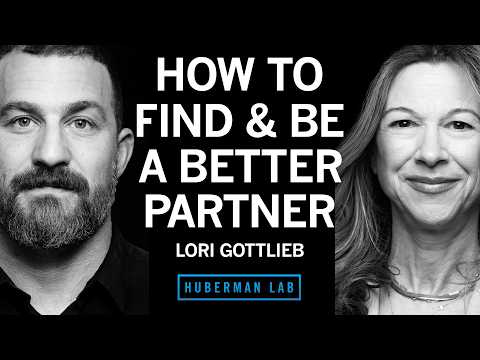
How to Find & Be a Great Romantic Partner | Lori Gottlieb
Andrew Huberman (host), Lori Gottlieb (guest)
In this episode of Huberman Lab, featuring Andrew Huberman and Lori Gottlieb, How to Find & Be a Great Romantic Partner | Lori Gottlieb explores rewriting Love Stories: Lori Gottlieb On Choosing Healthy Relationships Andrew Huberman and psychotherapist Lori Gottlieb explore how our internal narratives and early experiences shape whom we’re attracted to, how we behave in relationships, and why we often stay stuck in patterns that don’t serve us.
Rewriting Love Stories: Lori Gottlieb On Choosing Healthy Relationships
Andrew Huberman and psychotherapist Lori Gottlieb explore how our internal narratives and early experiences shape whom we’re attracted to, how we behave in relationships, and why we often stay stuck in patterns that don’t serve us.
They discuss emotional regulation, conflict repair, attraction to the wrong partners, fear of joy and change, and how technology and texting complicate modern dating and breakups.
Gottlieb emphasizes learning to read our feelings as data, distinguish guilt from shame, and rewrite faulty stories about ourselves so we can make better choices and experience more vitality in life.
Throughout, she offers concrete tools for communicating better, handling conflict, grieving breakups, and choosing partners based on how we feel in their presence rather than on rigid lists or familiar dysfunction.
Key Takeaways
Use your feelings as a compass, not something to suppress
From childhood many people are talked out of their feelings (“Don’t be sad,” “You’re too sensitive”), so they grow up seeing emotions as problems to eliminate. ...
Get the full analysis with uListen AI
Pause conflict until at least one person is regulated
When both partners are emotionally “dysregulated,” arguments escalate and nothing good happens. ...
Get the full analysis with uListen AI
Recognize when you’re replaying unfinished childhood business
We tend to be unconsciously drawn to partners who resemble the parent (or caregiver) who hurt or neglected us—not because it feels good but because it feels familiar. ...
Get the full analysis with uListen AI
Chemistry can be a red flag; give “calm” people a second date
What we call “instant chemistry” can actually be anxiety or the familiar charge of old wounds, not necessarily compatibility. ...
Get the full analysis with uListen AI
Invite vitality by facing mortality and taking smart risks
Gottlieb distinguishes fear of death from fear of “not having lived. ...
Get the full analysis with uListen AI
Focus on your own change, not fixing your partner
In couples therapy Gottlieb requires each person to name one concrete thing *about themselves* they want to work on, rather than what they want changed in their partner. ...
Get the full analysis with uListen AI
Modern tech amplifies miscommunication and hinders healing
Texting encourages having ‘big’ emotional conversations without tone, body language, or the regulating effect of being in the same room. ...
Get the full analysis with uListen AI
Notable Quotes
“Feelings are all positive because they're like a compass. They tell us what direction to go in, if we can access them.”
— Lori Gottlieb
“If it's hysterical, it's historical.”
— Lori Gottlieb
“The opposite of depression is not happiness, it's vitality.”
— Lori Gottlieb
“We don’t get to order up our partners à la carte.”
— Lori Gottlieb
“Sometimes the safest thing you can do is to take a risk.”
— Lori Gottlieb
Questions Answered in This Episode
You’ve said that intense chemistry can actually signal old wounds rather than compatibility. Could you walk through a specific example of how someone can distinguish between healthy excitement and that familiar-but-dangerous charge in real time on a date?
Andrew Huberman and psychotherapist Lori Gottlieb explore how our internal narratives and early experiences shape whom we’re attracted to, how we behave in relationships, and why we often stay stuck in patterns that don’t serve us.
Get the full analysis with uListen AI
For someone who recognizes they keep “marrying their unfinished business” but still *feels* pulled toward the same type, what are three concrete steps you’d have them take in the first 30 days of dating to interrupt that pattern?
They discuss emotional regulation, conflict repair, attraction to the wrong partners, fear of joy and change, and how technology and texting complicate modern dating and breakups.
Get the full analysis with uListen AI
You mentioned that crying can sometimes function as manipulation in conflict. How can a partner compassionately—but firmly—address this pattern without shaming genuine emotion or making the person feel unsafe to be vulnerable?
Gottlieb emphasizes learning to read our feelings as data, distinguish guilt from shame, and rewrite faulty stories about ourselves so we can make better choices and experience more vitality in life.
Get the full analysis with uListen AI
In the era of texting and social media, if a breakup has already gotten messy online (e.g., subtweets, call-out posts), what is your recommended, practical protocol for damage control, healing, and protecting future dating prospects?
Throughout, she offers concrete tools for communicating better, handling conflict, grieving breakups, and choosing partners based on how we feel in their presence rather than on rigid lists or familiar dysfunction.
Get the full analysis with uListen AI
You advised people to choose “the bigger life” when making decisions. How would you apply that heuristic to someone torn between staying in a basically good but passionless long-term relationship versus ending it to pursue an uncertain, more expansive-seeming path?
Get the full analysis with uListen AI
Transcript Preview
Welcome to the Huberman Lab Podcast, where we discuss science and science-based tools for everyday life. I'm Andrew Huberman, and I'm a professor of neurobiology and ophthalmology at Stanford School of Medicine. My guest today is Lori Gottlieb. Lori Gottlieb is a psychotherapist and best-selling author, and is considered one of the world's leading experts on relationships, how to find relationships, how to be in relationships effectively, how to leave relationships if necessary, how to grieve them after they're gone, and how to renew them, all from the perspective of looking inward at ourselves, and the stories about ourselves and others that we tell ourselves that can lead us to what we want and what's best for us, or that lead us away from those things. During today's episode, we discuss how the feelings we experience when we're with certain people are the absolute best guide of how poorly or how well those people are suited for us as partners, and the ways in which we miss key signals, both good and bad, in relationships by not paying attention to how we feel. Lori explains how to better our communication skills, how to determine if somebody's critique of us is valid or not, that certainly is important for everybody, and how texting and technology has changed relationships, and how to navigate all of that by leaning into our own sense of agency, the things that we can control. And last but not least, Lori explains how we can all access more vitality and enjoyment of life, and how so many people don't allow themselves to do that because the familiarity of their present circumstances overrides their willingness to move forward. This was a really eye-opening episode, and one that I'm certain will help you better understand yourself and what your needs really are and how you can be happier in or out of a relationship. Before we begin, I'd like to emphasize that this podcast is separate from my teaching and research roles at Stanford. It is, however, part of my desire and effort to bring zero-cost-to-consumer information about science and science-related tools to the general public. In keeping with that theme, this episode does include sponsors. And now for my discussion with Lori Gottlieb. Lori Gottlieb, welcome.
Thank you. Great to be here.
What's the first thing you ask a patient when you're meeting them for the first time?
Usually, it's something like, "Tell me what's going on. Tell me why you're here. Tell me what made you decide to come in."
And are you listening both to the content of their words and their tone, their physicality?
Everything.
Mm-hmm.
Yeah. Yeah. I think it's so interesting 'cause sometimes people will say, "I'm here because of," and they'll talk about something very difficult, but they're smiling through it.
Hm.
Um, you know, I think it's very nerve-wracking to come in and see a therapist, and you don't know this person, and you're about to share some very personal information that maybe you haven't told anyone in this way. And so, you wanna make somebody comfortable. You wanna make sure that, you know, you feel like they are not being rushed to share something that they're not ready to share. So, it's just the process. I think it's a very human interaction. Um, you know, therapy, to me, is not, like, expert, and this other person, and then it feels very asymmetrical. Of course, we're using our training, and that's why they're coming to us, but I feel like it's very much a human-to-human interchange.
Install uListen to search the full transcript and get AI-powered insights
Get Full TranscriptGet more from every podcast
AI summaries, searchable transcripts, and fact-checking. Free forever.
Add to Chrome