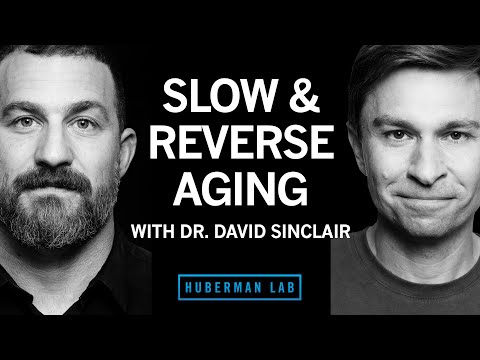
The Biology of Slowing & Reversing Aging | Dr. David Sinclair
Andrew Huberman (host), David Sinclair (guest)
In this episode of Huberman Lab, featuring Andrew Huberman and David Sinclair, The Biology of Slowing & Reversing Aging | Dr. David Sinclair explores harvard Geneticist Reveals How To Slow, Halt, And Reverse Aging Andrew Huberman interviews Harvard geneticist Dr. David Sinclair about the modern science of aging, why he classifies aging as a disease, and how it can be slowed or even reversed. Sinclair explains the central role of the epigenome—cellular information that controls gene expression—in driving aging, and describes how damage to that system accumulates like scratches on a CD. They detail how behaviors such as intermittent fasting, exercise, and cold exposure, plus compounds like resveratrol, NMN, and metformin, can activate longevity pathways (sirtuins, mTOR, NAD) and improve biological age. The conversation also covers practical protocols, measurement tools (blood work, epigenetic clocks), emerging gene therapies to reverse cellular age, and Sinclair’s broader vision for personalized, preventative longevity medicine.
Harvard Geneticist Reveals How To Slow, Halt, And Reverse Aging
Andrew Huberman interviews Harvard geneticist Dr. David Sinclair about the modern science of aging, why he classifies aging as a disease, and how it can be slowed or even reversed. Sinclair explains the central role of the epigenome—cellular information that controls gene expression—in driving aging, and describes how damage to that system accumulates like scratches on a CD. They detail how behaviors such as intermittent fasting, exercise, and cold exposure, plus compounds like resveratrol, NMN, and metformin, can activate longevity pathways (sirtuins, mTOR, NAD) and improve biological age. The conversation also covers practical protocols, measurement tools (blood work, epigenetic clocks), emerging gene therapies to reverse cellular age, and Sinclair’s broader vision for personalized, preventative longevity medicine.
Key Takeaways
Aging behaves like a disease driven largely by loss of epigenetic information, and treating it as such opens the door to prevention and reversal.
Sinclair argues the classical definition that ‘disease’ must affect less than 50% of people arbitrarily excludes aging, even though aging causes 80–90% of heart disease, Alzheimer’s, and many cancers. ...
Get the full analysis with uListen AI
The epigenome—not just genes—controls how fast you age, and it’s modifiable by lifestyle.
DNA is like the fixed music on a CD, while the epigenome is the player deciding which “songs” (genes) run in which cells. ...
Get the full analysis with uListen AI
When you eat may matter more for longevity than what you eat.
Animal studies across decades show that reducing eating windows—without necessarily reducing total calories—extends lifespan and healthspan significantly. ...
Get the full analysis with uListen AI
Periodic stressors (fasting, cold, exercise) are beneficial because they turn on longevity pathways, but they work best in pulses, not constantly.
Sinclair emphasizes hormesis: brief, manageable stress stimulates cellular defense programs. ...
Get the full analysis with uListen AI
Boosting NAD and activating sirtuins with NMN, resveratrol, and lifestyle may improve cellular repair and metabolic health with aging.
NAD, essential for over 400 reactions, declines with age and obesity due to reduced synthesis and increased degradation (via CD38). ...
Get the full analysis with uListen AI
Growth-promoting signals (growth hormone, high leucine/protein, chronic mTOR activation) likely trade short-term vitality and muscle gain for faster aging.
Long-lived animal models often have reduced growth hormone or IGF-1 signaling (e. ...
Get the full analysis with uListen AI
Tracking metrics like blood glucose, HbA1c, CRP, lipids, and biological age allows you to personalize interventions and verify what’s working.
Sinclair uses frequent blood panels (e. ...
Get the full analysis with uListen AI
Notable Quotes
“Aging is 80 to 90 percent the cause of heart disease, Alzheimer’s. If we didn’t get old and our bodies stayed youthful, we would not get those diseases.”
— David Sinclair
“I think aging is a loss of information in the same way that when you Xerox something a thousand times, you’ll lose that information.”
— David Sinclair
“If there’s one thing I could say, I would say definitely try to skip a meal a day.”
— David Sinclair
“What we found is that it’s not as important what you eat, it’s when you eat during the day.”
— David Sinclair (describing mouse time-restricted feeding study)
“My view of longevity is: I don’t burn both ends of the candle. I have one end of the candle lit, and I’m very careful. I don’t blow on it.”
— David Sinclair
Questions Answered in This Episode
You emphasize that rapid growth and high growth hormone can shorten lifespan, yet sarcopenia and frailty are major problems in older adults. For a 60-year-old who wants both longevity and functional strength, how would you concretely balance protein intake, resistance training, and mTOR activation across a typical week?
Andrew Huberman interviews Harvard geneticist Dr. ...
Get the full analysis with uListen AI
In your retinal reprogramming work, how do you ensure that partial reprogramming restores youthful function without pushing cells toward uncontrolled proliferation or cancer, especially if similar approaches are later used systemically?
Get the full analysis with uListen AI
You mentioned anecdotal improvements in marathon performance and subjective energy with NMN plus resveratrol. What specific objective metrics (VO2 max, lactate threshold, muscle biopsy markers, etc.) would you prioritize in future human trials to convincingly demonstrate performance and aging benefits?
Get the full analysis with uListen AI
Given that some long-lived populations (e.g., certain Blue Zones) eat relatively higher-carbohydrate diets but still have exceptional health and longevity, how do you reconcile those data with your strong emphasis on low glucose, low insulin, and fasting?
Get the full analysis with uListen AI
You argue that aging is predominantly epigenetic and reversible, yet telomere shortening, mitochondrial DNA mutations, and other hallmarks also accumulate. In the long run, do you think epigenetic reprogramming alone can overcome these other damage types, or will effective rejuvenation require multi-pronged interventions targeting several hallmarks in parallel?
Get the full analysis with uListen AI
Transcript Preview
(uptempo music) Welcome to the Huberman Lab Podcast, where we discuss science and science-based tools for everyday life. I'm Andrew Huberman, and I'm a professor of neurobiology and ophthalmology at Stanford School of Medicine. Today, my guest is Dr. David Sinclair, Professor of Genetics at Harvard Medical School and Co-Director of The Paul F. Glenn Center for the Biology of Aging. Dr. Sinclair's work is focused on why we age and how to slow or reverse the effects of aging by focusing on the cellular and molecular pathways that exist in all cells of the body, and that progress those cells over time from young cells to old cells. By elucidating the biology of cellular maturation and aging, Dr. Sinclair's group has figured out intervention points by which any of us, indeed all of us, can slow or reverse the effects of aging. What is unique about his work is that it focuses on behavioral interventions, nutritional interventions, as well as supplementation and prescription drug interventions that can help us all age more slowly and reverse the effects of aging in all tissues of the body. Dr. Sinclair holds a unique and revolutionary view of the aging process, which is that aging is not the normal and natural consequence that we all will suffer, but rather that aging is a disease that can be slowed or halted. Dr. Sinclair continually publishes original research articles in the most prestigious and competitive scientific journals. In addition to that, he's published a popular book that was a New York Times bestseller. The title of that book is Lifespan: Why We Age and Why We Don't Have To. He is also very active in public-facing efforts to educate people on the biology of aging and slowing the aging process. Dr. Sinclair and I share a mutual interest and excitement in public education about science. And so I'm thrilled to share with you that we've partnered, and Dr. David Sinclair is going to be launching the Lifespan podcast, which is all about the biology of aging and tools to intervene in the aging process. That podcast will launch Wednesday, January 5th. You can find it at the link in the show notes to this episode today. As well, you can subscribe to that podcast on YouTube, Apple, or Spotify, or anywhere that you get your podcasts. Again, the Lifespan podcast featuring Dr. David Sinclair begins Wednesday, January 5th, 2022. Be sure to check it out. You're going to learn a tremendous amount of information and you're going to learn both the mechanistic science behind aging, the mechanistic science behind reversing the aging process, and practical tools that you can apply in your everyday life. In today's episode, Dr. Sinclair and I talk about the biology of aging and tools to intervene in that process. And so you might view today's episode as a primer for the Lifespan podcast, because we delve deep into the behavioral tools, nutritional aspects, supplementation aspects of the biology of aging. We also talk about David's important discoveries of the sirtuins, particular molecular components that influence what is called the epigenome. And if you don't know what the epigenome is, you will soon learn in today's episode. Coming away from today's episode, you will have in-depth knowledge about the biology of aging at the cellular, molecular, and what we call the circuit level, meaning how the different organs and tissues of the bodies age independently and how they influence the aging of each other. Today's episode gets into discussion about many aspects of aging and tools to combat aging that have not been discussed on any other podcasts or in the book Lifespan. Before we begin, I'd like to emphasize that this podcast is separate from my teaching and research roles at Stanford. It is, however, part of my desire and effort to bring zero cost to consumer information about science and science-related tools to the general public. In keeping with that theme, I'd like to thank the sponsors of today's podcast. Our first sponsor is ROKA. ROKA makes eyeglasses and sunglasses that are of the absolute highest quality. I've spent a lifetime working on the visual system and I can tell you that the visual system has to contend with a number of different challenges, such as when you move from a bright area outside to an area where there are shadows, you have to adjust a number of things in your visual system so that you can still see things clearly. One problem with a lot of eyeglasses and sunglasses is they don't take that biological feature into account and you have to take off your glasses and put them back on depending on how bright or dim a given environment is. With ROKA eyeglasses and sunglasses, you always see things with the utmost clarity. In addition, they're very lightweight and they won't slip off your face. In fact, they were designed to be worn while biking or running and in various activities, but they also have a terrific aesthetic, so you could wear them to dinner or work. I wear readers at night and when I drive and I wear the sunglasses for most of the day. If you'd like to try ROKA sunglasses or eyeglasses, you can go to roka.com, that's R-O-K-A .com, and enter the code Huberman to save 20% off your first order. Again, that's ROKA, R-O-K-A .com and enter the code Huberman at checkout. Today's episode is also brought to us by InsideTracker. InsideTracker is a personalized nutrition platform that analyzes data from your blood and DNA to help you better understand your body and help you reach your health goals. I've long been a believer in getting regular blood work done, for the simple reason that many of the factors that impact your immediate and long-term health can only be assessed from a quality blood test. And now with the advent of modern DNA tests, you can also get a clear picture of what your biological age is and compare that to your chronological age. And obviously your biological age is the important one, because it predicts how long you will live and it's the one that you can control. The great thing about InsideTracker is that compared to a lot of other DNA tests and blood tests out there, is that with InsideTracker, you don't just get your numbers back at the levels of various hormones, metabolic factors, blood lipids, et cetera, but it also offers clear directives to lifestyle factors, nutritional factors and supplementation that you can use in order to get the numbers into the ranges that are best for you and for your health. If you'd like to try InsideTracker, you can go to insidetracker.com/huberman to get 25% off any of InsideTracker's plans. Just use the code Huberman at checkout. Again, that's insidetracker.com/huberman to get 25% off any of InsideTracker's plans.Today's episode is also brought to us by Magic Spoon. Magic Spoon is a zero sugar, grain-free, keto-friendly cereal. Now, I don't follow a strictly ketogenic diet. What works best for me is to eat according to my desire to be alert at certain times of day and to be sleepy at other times of day. So for me, that means fasting until about 11:00 AM or 12 noon most days, and then my lunch is typically a low carb, keto-ish lunch, maybe a small piece of grass-fed meat, some salad, something of that sort. And then in the afternoon, I might have a snack that's also keto-ish. And then at night is when I eat my carbohydrates, which for me, helps me with the transition to sleep and allows me to get great deep sleep. That's what works for me. What that means is then in the afternoon, I'm craving a snack, and the snack for me is Magic Spoon. What I do lately is I put in some Bulgarian yogurt, sometimes I just eat it straight. Each serving of Magic Spoon has zero sh- grams of sugar, 13 to 14 grams of protein, and only four grams of carbohydrates in each serving, so it really matches that low carb, keto-ish approach. There's only 140 calories per serving, and they have a variety of flavors, cocoa, fruity, peanut butter, frosted. I particularly like frosted 'cause it tastes like donuts. I try not to eat donuts, but I do love the frosted, and as I mentioned before, I lately mix it with yogurt, put a little cinnamon on there. I'm getting hungry just talking about it now. If you want to try Magic Spoon, you can go to magicspoon.com/huberman to grab a variety pack. Use the promo code Huberman at checkout to get $5 off your order. Again, that's magicspoon.com/huberman and use the code Huberman to get $5 off. And now my conversation with Dr. David Sinclair. Thank you for coming.
Install uListen to search the full transcript and get AI-powered insights
Get Full TranscriptGet more from every podcast
AI summaries, searchable transcripts, and fact-checking. Free forever.
Add to Chrome