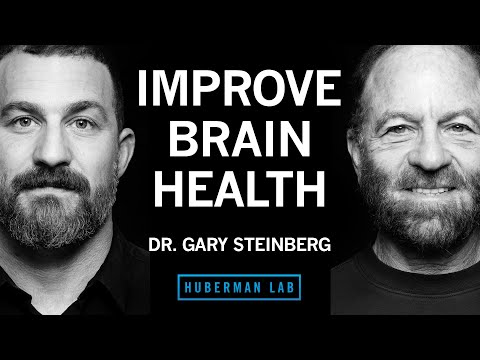
How to Improve Brain Health & Offset Neurodegeneration | Dr. Gary Steinberg
Andrew Huberman (host), Gary Steinberg (guest), Narrator
In this episode of Huberman Lab, featuring Andrew Huberman and Gary Steinberg, How to Improve Brain Health & Offset Neurodegeneration | Dr. Gary Steinberg explores preventing Stroke, Healing Brain Injury, And Harnessing Neuroplasticity With Steinberg Andrew Huberman hosts neurosurgeon Dr. Gary Steinberg to explain how blood flow supports brain function, what happens in stroke, aneurysm, and hemorrhage, and how to recognize and reduce those risks. They cover clotting and bleeding factors, lifestyle contributors such as smoking, alcohol, drugs, blood pressure, and cholesterol, and the sometimes subtle presentation of TIAs and spinal strokes. Steinberg describes remarkable advances in minimally invasive neurosurgery, concussion management, hypothermia for neuroprotection, and especially stem cell and vagus nerve–based therapies that can restore function long after stroke or traumatic brain injury. Throughout, they emphasize practical, evidence-based tools anyone can use to protect and improve brain health while debunking unsafe or overhyped practices like unregulated stem cell clinics and cervical chiropractic manipulation.
Preventing Stroke, Healing Brain Injury, And Harnessing Neuroplasticity With Steinberg
Andrew Huberman hosts neurosurgeon Dr. Gary Steinberg to explain how blood flow supports brain function, what happens in stroke, aneurysm, and hemorrhage, and how to recognize and reduce those risks. They cover clotting and bleeding factors, lifestyle contributors such as smoking, alcohol, drugs, blood pressure, and cholesterol, and the sometimes subtle presentation of TIAs and spinal strokes. Steinberg describes remarkable advances in minimally invasive neurosurgery, concussion management, hypothermia for neuroprotection, and especially stem cell and vagus nerve–based therapies that can restore function long after stroke or traumatic brain injury. Throughout, they emphasize practical, evidence-based tools anyone can use to protect and improve brain health while debunking unsafe or overhyped practices like unregulated stem cell clinics and cervical chiropractic manipulation.
Key Takeaways
Know What A Stroke Is And How It Manifests
A stroke is effectively a “heart attack of the brain”: a disruption of blood flow that deprives neurons of oxygen and glucose. ...
Get the full analysis with uListen AI
Target Modifiable Risk Factors: Smoking, Blood Pressure, Lipids, Drugs, Hormones
Smoking, uncontrolled hypertension, high LDL cholesterol, obesity, inactivity, and certain drugs (cocaine, methamphetamine) markedly increase stroke and aneurysm risk by damaging vessel walls and promoting clots. ...
Get the full analysis with uListen AI
Be Conservative With Neck Manipulation And Unregulated Stem Cells
Aggressive chiropractic manipulation of the neck can tear carotid or vertebral artery walls (arterial dissection), forming clots that embolize to the brain and cause stroke; Steinberg explicitly advises against cervical manipulation because even rare catastrophic outcomes are unacceptable. ...
Get the full analysis with uListen AI
Concussion Requires Rest, Not Sensory Deprivation Or Premature Return To Play
Concussions are molecular injuries that usually do not show on MRI but can be detected with sophisticated exams, including eye-tracking baselines and post‑injury testing. ...
Get the full analysis with uListen AI
Use Lifestyle Levers To Support Cerebrovascular And Brain Health
What’s good for the heart is generally good for the brain: prioritize blood pressure control (often aiming for ≤120 systolic but individualized), exercise regularly, eat minimally processed foods, manage weight, avoid smoking and recreational stimulants, and limit alcohol (emerging data suggest that no alcohol may be optimal, with <2 drinks/week likely low‑risk). ...
Get the full analysis with uListen AI
Neuroprotection Is Real But Time‑Sensitive And Context‑Dependent
In animal models, neuroprotection by drugs and mild hypothermia is robust, but most drugs failed in clinical stroke trials. ...
Get the full analysis with uListen AI
The Adult Brain Is More Plastic Than Once Thought: Stem Cells And Vagus Nerve Stimulation Offer Hope
Contrary to older dogma, adult brains can generate new cells and reorganize circuits, and chronic stroke and TBI patients can improve years after injury. ...
Get the full analysis with uListen AI
Notable Quotes
“A stroke is like a heart attack of the brain.”
— Dr. Gary Steinberg
“The brain represents only 2% of the body weight yet it draws 15% of the total blood flow and consumes 20% of the body’s oxygen.”
— Dr. Gary Steinberg
“The old notion that these circuits are dead is simply not true. They can be resurrected.”
— Dr. Gary Steinberg
“Even if it’s rare, it’s so devastating when it occurs that personally I would avoid neck manipulation by a chiropractor.”
— Dr. Gary Steinberg
“There’s a lot of hope for stem cells, but despite the hope there is still a lot of hype.”
— Dr. Gary Steinberg
Questions Answered in This Episode
You mentioned that the timing of intensive rehab and constraint therapy can make the difference between benefit and harm after stroke—how would you design an ideal, evidence‑based rehabilitation timeline for a 65‑year‑old patient with moderate arm weakness six weeks post‑stroke?
Andrew Huberman hosts neurosurgeon Dr. ...
Get the full analysis with uListen AI
For someone with a strong family history of stroke but currently normal blood pressure and lipids, are there specific lab tests or imaging (e.g., carotid ultrasound, brain MRI) you think are truly worth doing versus just creating anxiety and incidental findings?
Get the full analysis with uListen AI
Given your caution about cervical chiropractic manipulation, what forms of manual therapy or physical therapy do you consider safe and effective for chronic neck pain without increasing stroke risk?
Get the full analysis with uListen AI
In your stem cell trial patients who showed the most dramatic functional gains years after stroke, what common patterns did you see in terms of their baseline lesion location, type of rehab they did, or psychological factors like motivation and adherence?
Get the full analysis with uListen AI
If large randomized trials ultimately confirm that mild hypothermia benefits focal ischemic stroke, how do you envision emergency systems changing—would we see pre‑hospital cooling in ambulances, and what safeguards would be crucial to avoid misuse or overcooling?
Get the full analysis with uListen AI
Transcript Preview
(uptempo music) Welcome to the Huberman Lab Podcast, where we discuss science and science-based tools for everyday life. I'm Andrew Huberman, and I'm a professor of neurobiology and ophthalmology at Stanford School of Medicine. My guest today is Dr. Gary Steinberg. Dr. Gary Steinberg is a medical doctor, PhD, professor of neurosurgery, neurosciences, and neurology at Stanford University School of Medicine. He is a world expert in what is called the cerebrovascular architecture of our brain, which is a scientific term explaining how blood flow to the brain supplies oxygen and critical nutrients through our neurons, our nerve cells, as well as playing a critical role in removing waste products from our brain in order for our brain to function normally. During today's discussion, he explains in very clear terms how blood flow to the brain occurs and how disruptions in blood flow in things like stroke and aneurysm impact brain functioning. We also discuss concussions and TBI, or traumatic brain injuries, which unfortunately are very common, and what can be done to treat concussion and traumatic brain injury. Dr. Steinberg also shares with us recent findings from his laboratory and clinic, revealing how stem cells can be used to recover function in the human brain and spinal cord after things like concussion, TBI, stroke, and other disruptions to the cerebrovascular architecture. And he shares with us the science-supported tools, that is protocols, that any of us can use to improve the health and functioning of our brains. So if you or somebody that you know has experienced concussion or traumatic brain injury, stroke, or aneurysm, today's discussion is sure to include vital information for you. And for those fortunate enough to not have experienced those conditions, today's discussion will also review the latest science and protocols for improving brain health. Before we begin, I'd like to emphasize that this podcast is separate from my teaching and research roles at Stanford. It is, however, part of my desire and effort to bring zero-cost-to-consumer information about science and science-related tools to the general public. In keeping with that theme, I'd like to thank the sponsors of today's podcast. Our first sponsor is Eight Sleep. Eight Sleep makes smart mattress covers with cooling, heating, and sleep-tracking capacity. Now, I've spoken many times before on this podcast about the fact that sleep is the critical foundation for mental health, physical health, and performance. Now, one of the key things to getting the best possible night's sleep is to control the temperature of your sleeping environment, and that's because in order to fall and stay deeply asleep, your body temperature actually needs to drop by about one to three degrees. And in order to wake up feeling refreshed and alert, your body temperature actually has to increase by about one to three degrees. Eight Sleep mattress covers make it extremely easy to control the temperature of your sleeping environment, and thereby to control your core body temperature so that you fall and stay deeply asleep and wake up feeling your absolute best. I've been sleeping on an Eight Sleep mattress cover for about three years now, and it has completely transformed the quality of my sleep for the better. Eight Sleep recently launched their newest generation of pod cover, the Pod 4 Ultra. The Pod 4 cover has improved cooling and heating capacity, higher-fidelity sleep-tracking technology, and the Pod 4 cover has snoring detection that will automatically lift your head a few degrees to improve airflow and stop your snoring. This is really important. Snoring is associated with something called sleep apnea, and sleep apnea is known to disrupt brain health and body health in a number of ways. Put differently, being able to breathe clearly throughout the night is essential for not only feeling rested when you wake up, but also for brain health and body health. If you'd like to try an Eight Sleep mattress cover, you can go to EightSleep.com/Huberman to save $350 off their Pod 4 Ultra. Eight Sleep currently ships to the USA, Canada, UK, select countries in the EU, and Australia. Again, that's EightSleep.com/Huberman. Today's episode is also brought to us by ROKA. ROKA makes eyeglasses and sunglasses that are of the absolute highest quality. Now, I've spent a lifetime working on the biology of the visual system, and I can tell you that your visual system has to contend with an enormous number of different challenges in order for you to be able to see clearly. ROKA understands this and has developed their eyeglasses and sunglasses so that regardless of the conditions you're in, you always see with the utmost clarity. ROKA eyeglasses and sunglasses were initially designed for use in sport, in particular things like running and cycling. Now, as a consequence, ROKA frames are extremely lightweight, so much so that most of the time you don't even remember that they're on your face. They're also designed so that they don't slip off if you get sweaty. Now, even though they were initially designed for performance in sport, they now have many different frames and styles, all of which can be used in sport but also when out to dinner, at work, essentially any time and in any setting. If you'd like to try ROKA glasses, you can go to ROKA, that's ROKA.com, and enter the code Huberman to get 20% off. Again, that's ROKA.com and enter the code Huberman to get 20% off. Today's episode is also brought to us by AeroPress. AeroPress is like a French press, but a French press that always brews the perfect cup of coffee, meaning no bitterness and excellent taste. AeroPress achieves this because it uses a very short contact time between the hot water and the coffee, and that short contact time also means that you can brew an excellent cup of coffee very quickly. The whole thing takes only about three minutes. I started using an AeroPress over 10 years ago, and I learned about it from a guy named Alan Adler, who's a former Stanford engineer who's also an inventor. He developed things like the Aerobie Frisbee. In any event, I'm a big fan of Adler inventions, and when I heard he developed a coffee maker, the AeroPress, I tried it, and I found that indeed it makes the best possible tasting cup of coffee. It's also extremely small and portable, so I started using it in the laboratory, when I travel on the road, and also at home. And I'm not alone in my love of the AeroPress coffee maker. With over 55,000 five-star reviews, AeroPress is the best-reviewed coffee press in the world. If you'd like to try AeroPress, you can go to AeroPress.com/Huberman to get 20% off. AeroPress currently ships in the USA, Canada, and to over 60 other countries around the world. Again, that's AeroPress.com/Huberman. I usually mention this at the end of episodes, but if you're learning from and/or enjoying the Huberman Lab Podcast, please click the subscribe button on YouTube. And if you listen to the podcast on Spotify or Apple, make sure you click the follow tab on Spotify and/or Apple. And on both Spotify and Apple, you can also leave us up to a five-star review. And now for my discussion with Dr. Gary Steinberg.Dr. Gary Steinberg, welcome.
Install uListen to search the full transcript and get AI-powered insights
Get Full TranscriptGet more from every podcast
AI summaries, searchable transcripts, and fact-checking. Free forever.
Add to Chrome