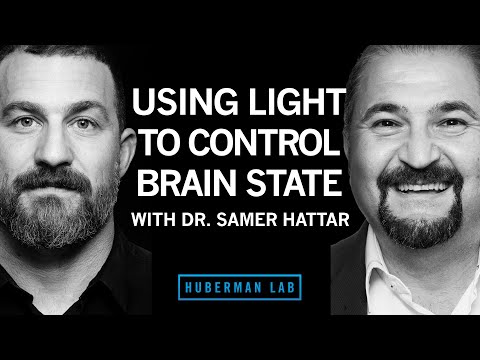
Timing Light, Food, & Exercise for Better Sleep, Energy & Mood | Dr. Samer Hattar
Andrew Huberman (host), Dr. Samer Hattar (guest)
In this episode of Huberman Lab, featuring Andrew Huberman and Dr. Samer Hattar, Timing Light, Food, & Exercise for Better Sleep, Energy & Mood | Dr. Samer Hattar explores mastering Light, Food, And Exercise Timing To Transform Sleep, Mood This episode features Dr. Samer Hattar, a leading circadian neuroscientist, explaining how light, food, and exercise timing interact to control sleep, mood, metabolism, and overall health. He describes the discovery of intrinsically photosensitive retinal ganglion cells (ipRGCs) that subconsciously measure environmental light and set the body’s internal clock. Hattar introduces a “tripartite model” in which three systems—circadian rhythm, sleep homeostasis, and direct environmental inputs like light and stress—must be aligned for optimal functioning. He then translates these mechanisms into practical protocols for morning and evening light exposure, meal timing, exercise scheduling, and jet lag management, including how he used these principles to lose significant weight and stabilize his own energy and mood.
Mastering Light, Food, And Exercise Timing To Transform Sleep, Mood
This episode features Dr. Samer Hattar, a leading circadian neuroscientist, explaining how light, food, and exercise timing interact to control sleep, mood, metabolism, and overall health. He describes the discovery of intrinsically photosensitive retinal ganglion cells (ipRGCs) that subconsciously measure environmental light and set the body’s internal clock. Hattar introduces a “tripartite model” in which three systems—circadian rhythm, sleep homeostasis, and direct environmental inputs like light and stress—must be aligned for optimal functioning. He then translates these mechanisms into practical protocols for morning and evening light exposure, meal timing, exercise scheduling, and jet lag management, including how he used these principles to lose significant weight and stabilize his own energy and mood.
Key Takeaways
Morning sunlight anchors your entire biological day; prioritize it daily.
Your internal clock runs slightly longer than 24 hours (about 24. ...
Get the full analysis with uListen AI
Evening and nighttime light strongly affect sleep quality—keep it extremely dim and indirect.
The same ipRGCs that set your clock are highly sensitive to bright light at night, regardless of color. ...
Get the full analysis with uListen AI
Light affects mood and cognition directly, via brain pathways separate from the circadian clock.
Hattar’s lab showed that light can worsen mood and impair learning even when sleep amount and the core circadian clock (SCN) are intact. ...
Get the full analysis with uListen AI
The ‘tripartite model’ explains why you must coordinate light, sleep pressure, and behavior.
Three interacting systems determine sleep, mood, and performance: (1) the circadian clock (timed primarily by light), (2) the homeostatic sleep drive (how long you’ve been awake and active), and (3) direct environmental inputs (light, stress, exercise, etc. ...
Get the full analysis with uListen AI
Regular, phase-consistent meal timing powerfully shapes hunger, metabolism, and weight.
Food is a major time cue for peripheral clocks (especially liver and metabolic tissues) and interacts with light timing. ...
Get the full analysis with uListen AI
Exercise timing should match your chronotype and be stable relative to your sleep-wake pattern.
Hattar found empirically that exercising in the morning (within his natural high-energy period) supports his sleep and weight regulation, whereas evening exercise disrupted his sleep, delayed his clock, and led to weight gain, despite the extra activity. ...
Get the full analysis with uListen AI
You can shift your internal clock for travel or schedule changes by precisely timing light.
Light given in the early biological evening (before your internal temperature minimum) *delays* the clock; light in the late night/early morning *after* the temperature minimum *advances* it. ...
Get the full analysis with uListen AI
Notable Quotes
“If you put humans in artificial conditions, the circadian system is very sensitive to light—but in the real environment, light is also affecting other aspects that are independent of setting the circadian pacemaker.”
— Dr. Samer Hattar
“I say, don’t take a pill—take a photon.”
— Dr. Samer Hattar
“You can literally get jet lag in New York without ever leaving New York.”
— Dr. Samer Hattar
“Most of the time we don’t eat because we really have low energy, but because we want to eat.”
— Dr. Samer Hattar
“You have to think of light, food, and sleep together. If you think of one alone, you will always miss something.”
— Dr. Samer Hattar
Questions Answered in This Episode
You mentioned that light directly affects mood via the perihabenular nucleus, independent of the circadian clock. In humans, what patterns of daytime and nighttime light exposure most reliably produce measurable mood improvements, and how many days or weeks of consistent behavior are typically needed?
This episode features Dr. ...
Get the full analysis with uListen AI
For someone who currently goes to bed at 1–2 a.m. and wakes at 9–10 a.m., how would you design a stepwise 2–3 week protocol using light, meal timing, and exercise to shift them earlier without causing severe daytime sleepiness or rebound late nights?
Get the full analysis with uListen AI
Your data suggest that people lacking normal light entrainment are actually *less* sensitive to food as a timing cue. Does this mean time-restricted eating and meal regularity are likely to fail unless light exposure patterns are corrected first, and have you tested this explicitly in humans or animals?
Get the full analysis with uListen AI
You are strongly critical of daylight saving time. If public policy were to follow circadian science, what specific national or regional guidelines on school/work start times and evening lighting would you recommend to reduce depression, metabolic disease, and accidents?
Get the full analysis with uListen AI
You’ve described your own N=1 experiences with morning exercise vs. evening exercise dramatically changing sleep and weight. If you were to run a controlled human study on exercise timing, what hypotheses would you test about interactions between chronotype, gym lighting conditions, and metabolic outcomes?
Get the full analysis with uListen AI
Transcript Preview
(Music) Welcome to the Huberman Lab Podcast, where we discuss science and science-based tools for everyday life. I'm Andrew Huberman, and I'm a professor of neurobiology and ophthalmology at Stanford School of Medicine. Today, I have the pleasure of introducing Dr. Samer Hattar as my guest on the Huberman Lab Podcast. Dr. Hattar is the Chief of the Section on Light and Circadian Rhythms at the National Institute of Mental Health in Bethesda, Maryland. Dr. Hattar has many important discoveries to his name. He was one of a handful of groups that discovered the light-sensing neurons in the eye that set the circadian clock. This was a fundamental discovery made in the early 2000s that has led to an enormous number of additional discoveries on how light regulates our sleep, our immune system, our mood, mental health, metabolism, feeding, and many other important processes. If ever there was somebody who understands how all of these processes interact and can inform best practices for our daily behaviors, it's Dr. Hattar. During our discussion today, Dr. Hattar answers questions that are absolutely essential for us to know about our health and well-being. For instance, how to align our sleep schedule with our activity schedule, such as exercise, and how to align light, activity, and exercise with our feeding rhythms. He presents a new model of how light, activity, and feeding rhythms converge to support optimal health, and when those are not aligned correctly, how our mental and physical health can suffer. It's a discussion that is rich with scientific mechanism, made clearly of course, so everybody can understand, as well as specific protocols to deal with shifts in day length, shifts in activity, and in order to optimize sleep, metabolism, and well-being of various kinds. I learned so much from Samer, as I always do. He is an absolute wealth of knowledge on all things related to light and circadian rhythms, physiology, and neuroscience. I don't think you'll find anyone else as knowledgeable about these topics as Samer, and so I'm delighted that he joined us here on the podcast to share this information. Before we begin, I'd like to emphasize that this podcast is separate from my teaching and research roles at Stanford. It is however part of my desire and effort to bring zero cost to consumer information about science and science-related tools to the general public. In keeping with that theme, I'd like to thank the sponsors of today's podcast. Our first sponsor is Roka. Roka makes eyeglasses and sunglasses that are of the absolute highest quality. I've spent my career working on the science of the visual system, and I can tell you that one of the things that our visual system has to contend with is adjusting so that when we go from a very bright area to a dim or shadowed area, we can still see things clearly. Roka eyeglasses and sunglasses were designed with the science of the visual system in mind, and so they make those transitions seamless. You always see things with crystal clarity. Another great thing about these glasses is that they're very lightweight, so you don't even really remember that they're on your face, and they won't slip off if you get sweaty. The glasses were designed initially for running and for cycling and for active wear, but they work great for that, and they work great, and they also happen to look great, for work, if you go out to dinner, for social settings, so they can really be worn in essentially any circumstances. If you'd like to try Roka glasses, you can go to Roka, that's ROKA.com, and enter the code Huberman to get 20% off your first order. That's ROKA.com, enter the code Huberman at checkout. Today's podcast is also brought to us by InsideTracker. InsideTracker is a personalized nutrition platform that analyzes data from your blood and DNA to help you better understand your body and help you reach your health goals. I've long been a believer in getting blood work done, for the simple reason that many of the factors that impact our immediate and long-term health can only be detected in a quality blood test. The problem with a lot of blood tests out there, however, is you get numbers back but you don't know what to do about those numbers specifically. Roka solved that problem at a number of levels. First of all, they make getting the blood tests very easy. They'll come to your house if you like, or you can go to a local clinic. Second of all, once you get your numbers back, there's a very easy to use dashboard where you can identify obviously what the numbers are, but also the various things that you can do to bring those numbers into the ranges that you want, through either behavioral practices like exercise, through nutritional practices, or supplementation, et cetera. So they made the whole thing very easy start to finish, in a way that allows you to best direct your health goals. If you'd like to try InsideTracker, you can visit InsideTracker.com/Huberman to get 25% off any of InsideTracker's plans. Just use the code Huberman at checkout. Today's episode is also brought to us by Magic Spoon. Magic Spoon is a zero sugar, grain-free, keto-friendly cereal. I am not ketogenic, meaning I don't follow a purely ketogenic diet. I tend to fast in the early part of the day, I tend to eat kind of low carb-ish through the middle of the day, and then in the evening I eat carbohydrates. That's what works best for me, and allows me to feel alert all day long and to sleep really well at night. Magic Spoon is a terrific snack for me because it tastes terrific, it's got some sweetness, but it doesn't take me out of that state that I want to be in during the day where I'm sort of keto-ish I would say. I'm not actually in ketosis, but I'm following more or less a low carb diet during the day, which keeps me alert, so either fasting or low carb, and Magic Spoon is consistent with that, and then as I mentioned before in the evening I do eat carbohydrates. Magic Spoon has 0 grams of sugar, 13 to 14 grams of protein, and only four net grams of carbohydrates in each serving, so I think it qualifies as low carb-ish or low carb. In addition, it only has 140 calories per serving. It's also just delicious. They have flavors like cocoa, fruity, pea- peanut butter, frosted. I particularly like the frosted one because it tastes like donuts and I particularly like donuts, although I try not to eat them too often, if ever. If you want to try Magic Spoon, you can go to MagicSpoon.com/Huberman to grab a variety pack. You can use the promo code Huberman at checkout and you'll get $5 off your order. Again, that's MagicSpoon.com/Huberman and use the code Huberman to get $5 off. And now my conversation with Dr. Samer Hattar.Sammer, thanks for sitting down with me.
Install uListen to search the full transcript and get AI-powered insights
Get Full TranscriptGet more from every podcast
AI summaries, searchable transcripts, and fact-checking. Free forever.
Add to Chrome