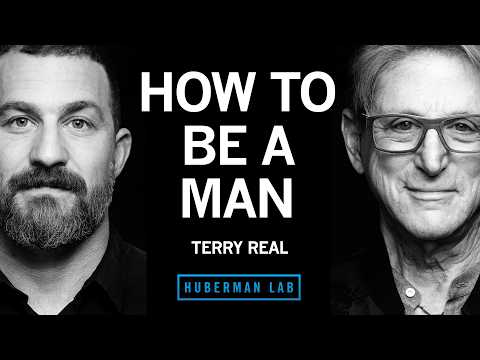
Defining Healthy Masculinity & How to Build It | Terry Real
Terry Real (guest), Andrew Huberman (host), Narrator, Narrator, Narrator
In this episode of Huberman Lab, featuring Terry Real and Andrew Huberman, Defining Healthy Masculinity & How to Build It | Terry Real explores terry Real Redefines Masculinity: From Stoicism To Relational Mastery Andrew Huberman and therapist Terry Real explore the current crisis in male mental health, arguing that traditional, stoic masculinity has left men disconnected, lonely, and confused about their role. Real proposes a model of “progressive masculinity” rooted in relational skill, emotional accountability, and genuine connection rather than dominance or passivity. They unpack how patriarchy harms both men and women, why self-esteem for men is often performance-based and fragile, and how unprocessed childhood dynamics sabotage adult relationships. Throughout, Real offers concrete tools for handling conflict, expressing emotion without burdening others, building male friendships, and replacing harshness—especially self‑harshness—with firm but loving relational behavior.
Terry Real Redefines Masculinity: From Stoicism To Relational Mastery
Andrew Huberman and therapist Terry Real explore the current crisis in male mental health, arguing that traditional, stoic masculinity has left men disconnected, lonely, and confused about their role. Real proposes a model of “progressive masculinity” rooted in relational skill, emotional accountability, and genuine connection rather than dominance or passivity. They unpack how patriarchy harms both men and women, why self-esteem for men is often performance-based and fragile, and how unprocessed childhood dynamics sabotage adult relationships. Throughout, Real offers concrete tools for handling conflict, expressing emotion without burdening others, building male friendships, and replacing harshness—especially self‑harshness—with firm but loving relational behavior.
Key Takeaways
Redefine strength as relational skill, not stoic toughness or softness.
Real argues that being a “real man” means being skilled—able to stay connected, negotiate, repair conflict, and adapt (fierce when needed, tender when needed)—rather than defaulting to emotional shutdown or endless vulnerability dumping.
Get the full analysis with uListen AI
Treat connection, not just feelings, as the primary goal.
Feelings matter because they are the pathway to connection, but Real emphasizes that simply “having emotions” isn’t enough; men must learn when and how to share them so they build intimacy instead of offloading responsibility onto partners.
Get the full analysis with uListen AI
Shift from criticism to clear requests in relationships.
Real teaches people to strip complaints down to the underlying request (“inside every complaint is a request”) and to ask directly and humbly for what they want, which is far more effective than attacking or assuming the other person should “just know.”
Get the full analysis with uListen AI
Develop healthy self-esteem to become truly accountable.
Many men rely on performance-based worth (“I matter if I win”), which makes criticism intolerable and drives defensiveness or shame. ...
Get the full analysis with uListen AI
Use “relational mindfulness” to interrupt automatic, reactive patterns.
When flooded, people drop into an “adaptive child” state (fight, flight, or fix) and lose access to relational tools. ...
Get the full analysis with uListen AI
Men must actively build male community and deeper friendships.
Given the epidemic of male loneliness, Real urges men to experiment with taking friendships deeper—sharing small vulnerabilities and seeing who responds—and to cultivate groups (men’s groups, sports, 12-step meetings) that support relational growth, not just venting or entitlement.
Get the full analysis with uListen AI
Eliminate harshness; replace it with loving firmness—especially internally.
Real insists that harshness has “no redeeming value” and that everything harshness tries to do can be done better with firm, loving communication. ...
Get the full analysis with uListen AI
Notable Quotes
““We need models of progressive masculinity, not regressive masculinity.””
— Terry Real
““The essence of traditional masculinity is stoicism. The essence of being a man is being invulnerable—and that’s a lie.””
— Terry Real
““All relationships are an endless dance of harmony, disharmony, and repair.””
— Terry Real
““There is no redeeming value in harshness. Nothing harshness does that loving firmness doesn’t do better.””
— Terry Real
““What makes a great Merani is knowing which moment is which.””
— Terry Real (relaying the Maasai elder’s answer about warrior manhood)
Questions Answered in This Episode
How can men start building genuine male friendships and fraternity if they currently have no close male friends?
Andrew Huberman and therapist Terry Real explore the current crisis in male mental health, arguing that traditional, stoic masculinity has left men disconnected, lonely, and confused about their role. ...
Get the full analysis with uListen AI
What practical steps can a man take this week to move from performance-based self-worth to a more stable, inherent self-esteem?
Get the full analysis with uListen AI
How do you know when it’s the right time to express emotions to a partner versus process them alone or with a friend or therapist?
Get the full analysis with uListen AI
In what ways might my own “adaptive child” show up in conflict, and how can I train myself to recognize and shift out of it in real time?
Get the full analysis with uListen AI
How can couples co-create clear agreements about breaks, criticism, and repair so that both partners feel safe and heard during conflict?
Get the full analysis with uListen AI
Transcript Preview
When the moment calls for fierceness, a good Mirani is a killer. And they- they are, they're warriors. They'll kill you, don't cross them. When the moment calls for tenderness, a good Mirani will lay down his sword and shield and be sweet like a baby. What makes a great Mirani is knowing which moment is which.
(instrumental music plays) Welcome to the Huberman Lab Podcast, where we discuss science, and science-based tools for everyday life. I'm Andrew Huberman, and I'm a professor of neurobiology and ophthalmology at Stanford School of Medicine. My guest today is Terry Real. Terry Real is a therapist and considered one of the world's foremost experts on male psychology, and on male/female dynamics in romantic relationships. Today we discuss what it means to be a man, and the mental health crisis that men are facing nowadays. As you may have heard, rates of depression and suicide are at an all-time high in men right now. Fewer and fewer men are in romantic relationships, and many don't even have a single close friend. And for those that are in romantic relationships, the public messaging about how to show up in those relationships is very conflicted. Today we address all of these issues head-on. Terry explains that to thrive in life, men have to look at relating as a skill that requires action and, yes, feelings, but also processing and communicating those feelings in a specific way, and sometimes not communicating them at all. We also discuss the critical importance of fraternity. Not necessarily college fraternities, but finding and belonging to a group of men that you can trust, that you can enjoy time with, that give you honest feedback, and that hold you accountable. What I appreciate so much about Terry Real is that he's willing to answer the hard questions about men and women very directly, and frankly, most therapists are not willing to do that publicly. For example, he explains that in his extensive work with couples, women and men are equally bad at relationships, but in different ways. And he offers solutions for them both if they actually want their relationship to thrive. Thanks to his honesty and providing practical tools, Terry Real provides us today with essential information for men and women of all ages. It cuts through all the generational differences that certainly exist, to highlight the practical ways that men can build and support their mental health, and thrive at work, school, and in romantic relationships, and also, just as importantly, in their relationship to themselves. That is, how men can build a strong self-concept, sense of agency, and confidence. Before we begin, I'd like to emphasize that this podcast is separate from my teaching and research roles at Stanford. It is however part of my desire and effort to bring zero-cost-to-consumer information about science and science-related tools to the general public. In keeping with that theme, today's episode does include sponsors. And now for my discussion with Terry Real. Terry Real, welcome.
Install uListen to search the full transcript and get AI-powered insights
Get Full TranscriptGet more from every podcast
AI summaries, searchable transcripts, and fact-checking. Free forever.
Add to Chrome