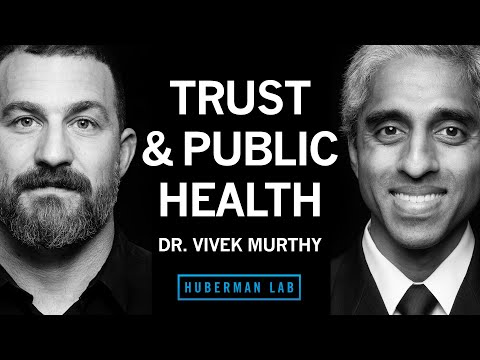
Efforts & Challenges in Promoting Public Health | Dr. Vivek Murthy
Andrew Huberman (host), Dr. Vivek Murthy (guest)
In this episode of Huberman Lab, featuring Andrew Huberman and Dr. Vivek Murthy, Efforts & Challenges in Promoting Public Health | Dr. Vivek Murthy explores surgeon General Murthy Confronts Loneliness, Food, Pharma and Trust Andrew Huberman interviews U.S. Surgeon General Dr. Vivek Murthy about the current and future landscape of public health, emphasizing both disease treatment and health optimization. Murthy explains the dual role of his office: communicating science-based guidance to the public and overseeing 6,000 Public Health Service officers deployed for crises like Ebola, COVID, and natural disasters. They examine systemic issues in food policy, mental health care access, social media’s impact on youth, and how industry and politics shape public health decisions without directly controlling his office. A major through-line is the crisis of loneliness and social disconnection, which Murthy frames as a foundational public health threat on par with other major risk factors, requiring cultural, educational, and policy changes.
Surgeon General Murthy Confronts Loneliness, Food, Pharma and Trust
Andrew Huberman interviews U.S. Surgeon General Dr. Vivek Murthy about the current and future landscape of public health, emphasizing both disease treatment and health optimization. Murthy explains the dual role of his office: communicating science-based guidance to the public and overseeing 6,000 Public Health Service officers deployed for crises like Ebola, COVID, and natural disasters. They examine systemic issues in food policy, mental health care access, social media’s impact on youth, and how industry and politics shape public health decisions without directly controlling his office. A major through-line is the crisis of loneliness and social disconnection, which Murthy frames as a foundational public health threat on par with other major risk factors, requiring cultural, educational, and policy changes.
Key Takeaways
Public health must shift from an illness-only frame to optimizing well-being.
Murthy argues that medical and public health systems are built chiefly to diagnose and treat disease, not to help people reach their best physical and mental functioning. ...
Get the full analysis with uListen AI
The U.S. food environment structurally pushes people toward unhealthy choices.
Highly processed, sugar- and sodium-rich foods dominate affordable options, especially in low‑income areas and “food deserts” where convenience stores replace grocery stores. ...
Get the full analysis with uListen AI
Public trust eroded during COVID due to opaque, shifting guidance and politicization.
Murthy acknowledges that early pandemic messaging—like the about-face on masks—damaged trust, especially without clear explanations of uncertainty, evolving evidence, and explicit “we got this wrong” admissions. ...
Get the full analysis with uListen AI
Industry incentives often conflict with public health, requiring insulation and reform.
Murthy is explicit that his office takes no industry money and that his agenda is not set by the President or pharma, but by science and public interest. ...
Get the full analysis with uListen AI
The youth mental health crisis is tightly linked to social media overuse and sleep loss.
On average, adolescents spend 3. ...
Get the full analysis with uListen AI
Loneliness and social disconnection are widespread and as dangerous as other major risk factors.
Murthy reports that about 50% of U. ...
Get the full analysis with uListen AI
Practical relational habits and coordinated care models can meaningfully improve health outcomes.
Murthy advocates small, concrete behaviors: five minutes a day reaching out to someone, giving full attention in conversations (no phones), and serving others as ways to strengthen connection and self-worth. ...
Get the full analysis with uListen AI
Notable Quotes
“We have operated primarily through an illness frame when we look at health, and in my mind, that's only one half of the equation.”
— Dr. Vivek Murthy
“We have made unhealthy foods cheap and healthy foods expensive. We've put health, from a dietary perspective, out of reach for millions of Americans.”
— Dr. Vivek Murthy
“If I go out knowing I did the right thing here, then I'm fine with that. I'm not looking to build a lifelong career in government.”
— Dr. Vivek Murthy
“If we're divided the way we were during COVID during the next pandemic, that's a huge national security issue for us.”
— Dr. Vivek Murthy
“We are not fundamentally a nation of bystanders who just stand by while other people suffer. We're a nation of healers and hope makers who can restore hope that the future can be better.”
— Dr. Vivek Murthy
Questions Answered in This Episode
When you say you’d like a national initiative on diet similar to your reports on e‑cigarettes and opioids, what specific kinds of food policies or labeling changes would you push for first if you suddenly had the necessary budget and political backing?
Andrew Huberman interviews U. ...
Get the full analysis with uListen AI
You mentioned that a third of adolescents are online past midnight and that more than three hours of social media daily doubles anxiety and depression symptoms—if you were writing a simple, enforceable federal standard for platforms or devices used by minors, what would it actually require?
Get the full analysis with uListen AI
In practice, how should clinicians balance your caution about industry influence with the reality that many cutting-edge treatments (including for mental health and obesity) are developed and trialed by pharmaceutical companies?
Get the full analysis with uListen AI
You were candid about the trust damage caused by shifting COVID guidance; looking ahead, what concrete mechanisms would you put in place so that in the next pandemic, reversals like the mask flip are paired with immediate, honest explanations that the public can see and understand in real time?
Get the full analysis with uListen AI
On loneliness, you framed reconnection as a values and identity issue as much as a policy issue—what would it look like for schools, workplaces, and local governments to operationalize those values of love, service, and community in their day-to-day practices rather than just in mission statements?
Get the full analysis with uListen AI
Transcript Preview
Welcome to the Huberman Lab podcast, where we discuss science and science-based tools for everyday life. I'm Andrew Huberman, and I'm a professor of neurobiology and ophthalmology at Stanford School of Medicine. Today my guest is Dr. Vivek Murthy. Dr. Vivek Murthy is a medical doctor and acting Surgeon General of the United States. As Surgeon General of the United States, Dr. Murthy oversees more than 6,000 dedicated public health officers whose job is to protect, promote, and advance our nation's public health. Dr. Murthy received his bachelor's degree from Harvard University and his medical degree from the Yale University School of Medicine. Today's discussion covers some of the most important issues in public health, not just within the United States but worldwide, including nutrition and the obesity crisis as well as food additives and why certain food chemicals and additives are allowed in the United States versus in other countries. We also discuss mental health, the youth mental health crisis, the adult mental health crisis, and the global crisis of loneliness and isolation. We also talk about corporate interests, that is whether or not big food and big pharma industries actually impact the research and/or decisions that the US Surgeon General takes in his directives toward public health. And, of course, we discuss some of the major public health events that occurred over the last five years and the current and future landscape of how to restore faith both in public health officials, in public health policy, and science more generally. By the end of today's episode, you not only will have learned a tremendous amount about public health and why you hear the particular public health directives that you do, but also how to better interpret future public health directives. You will also come to learn that as Surgeon General, Dr. Murthy has both an extremely challenging job, but one that he meets with a tremendous amount of both rigor and compassion. Before we begin, I'd like to emphasize that this podcast is separate from my teaching and research roles at Stanford. It is however part of my desire and effort to bring zero cost to consumer information about science and science-related tools to the general public. In keeping with that theme, I'd like to thank the sponsors of today's podcast. Our first sponsor is Maui Nui Venison. Maui Nui Venison is the most nutrient dense and delicious red meat available. I've spoken before on this podcast in solo episodes and with guests about the need to get approximately one gram of high quality protein per pound of body weight each day for optimal nutrition. Now, there are many different ways that one can do that, but a key thing is to make sure that you're not doing that by ingesting excessive calories. Maui Nui Venison has the highest density of quality protein per calorie, and it achieves that in delicious things like ground meats, venison steaks, jerky, and bone broth. I particularly like the ground venison. I make those into venison burgers probably five times a week or more. I also like the jerky for its convenience, especially when I'm traveling or I'm especially busy with work and know that I'm getting an extremely nutrient-dense, high quality source of protein. If you'd like to try Maui Nui Venison, you can go to mauinuivenison.com/huberman and get 20% off your first order. Again, that's mauinuivenison.com/huberman to get 20% off. Today's episode is also brought to us by ROKA. ROKA makes eyeglasses and sunglasses that are of the absolute highest quality. I've spent a lifetime working on the biology of the visual system, and I can tell you that your visual system has to contend with an enormous number of challenges in order for you to be able to see clearly in different environments. ROKA understands the biology of the visual system and has designed their eyeglasses and sunglasses so that you always see with crystal clarity. Originally, their glasses were designed for performance, that is for running and cycling and for sport, and indeed they can still be used for performance. They won't slip off your face if you get sweaty. They're extremely lightweight. But I should mention that ROKA eyeglasses and sunglasses come in some of the aesthetics more typically associated with performance glasses, like those cyborg-style glasses, but they also have a number of styles that you would be perfectly comfortable wearing out to dinner or to work. I wear readers at night or when I drive, and I wear sunglasses during the day if I happen to be driving into bright light or outside and it's just overwhelmingly bright. I do not wear sunglasses when I do my morning sunlight viewing to set my circadian rhythm, and I suggest that you do the same. If you'd like to try ROKA eyeglasses or sunglasses, you can go to ROKA, roka.com and enter the code Huberman to save 20% off your first order. Again, that's ROKA, roka.com and enter the code Huberman at checkout. And now for my discussion with Dr. Vivek Murthy. Dr. Vivek Murthy, welcome.
Install uListen to search the full transcript and get AI-powered insights
Get Full TranscriptGet more from every podcast
AI summaries, searchable transcripts, and fact-checking. Free forever.
Add to Chrome