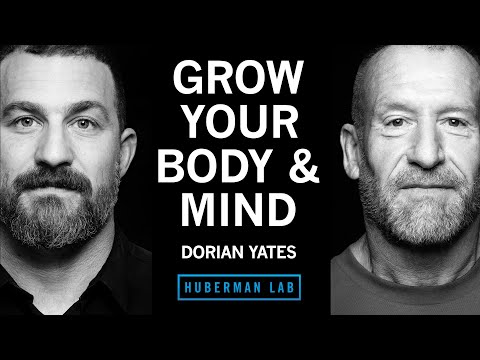
Build Muscle & Strength & Forge Your Life Path | Dorian Yates
Dorian Yates (guest), Andrew Huberman (host)
In this episode of Huberman Lab, featuring Dorian Yates and Andrew Huberman, Build Muscle & Strength & Forge Your Life Path | Dorian Yates explores dorian Yates on intensity training, recovery, mindset, and consciousness exploration Dorian Yates explains why most people can build strength and muscle with surprisingly little gym time by focusing on true muscular failure, perfect mechanics, and adequate recovery rather than high volume.
Dorian Yates on intensity training, recovery, mindset, and consciousness exploration
Dorian Yates explains why most people can build strength and muscle with surprisingly little gym time by focusing on true muscular failure, perfect mechanics, and adequate recovery rather than high volume.
He argues the “pump” is often mistaken for progress, emphasizes deloads and occasional full rest, and cautions that steroid-enhanced recovery makes many elite-bodybuilder routines inappropriate for natural lifters.
Beyond training, Yates shares how meticulous logging, disciplined routines, and “transmuting anger” fueled his rise—and how identity shifts after reaching the top can trigger depression unless you reframe purpose.
The discussion expands into nutrition, sunlight and health, cannabis benefits/risks and individual variability, and Yates’ psychedelic experiences (DMT/ayahuasca) that reshaped his worldview toward connection, perspective, and service.
Key Takeaways
Train to real failure—but only after you learn correct mechanics.
Yates insists true muscular failure is the growth trigger, but beginners should first master movement patterns, understand what the target muscle does, and learn to maintain form as effort increases to avoid compensation and injury.
Get the full analysis with uListen AI
Do the minimum effective volume; recovery is the limiting factor.
His core principle is “do enough to stimulate, not more than necessary,” because extra sets often just add fatigue that delays adaptation—especially for natural lifters balancing work, family, and sleep.
Get the full analysis with uListen AI
Most non-competitors can thrive on 2–3 brief sessions per week.
Yates repeatedly claims 45 minutes twice weekly (or ~3x/week initially) can “change your life” if intensity and diet are in place, challenging the common belief that progress requires daily long workouts.
Get the full analysis with uListen AI
Deloads (and occasional full weeks off) can unlock plateaus.
He recommends ~5–6 hard weeks followed by ~2 lighter weeks (no failure) and suggests a full week off a couple times per year; many trainees return stronger because accumulated fatigue dissipates.
Get the full analysis with uListen AI
The pump is feedback, not the goal—and can be misleading.
A pump can confirm you hit the right area, but Yates argues it’s achievable with light weights and doesn’t guarantee hypertrophy; progressive overload and high effort do.
Get the full analysis with uListen AI
Steroids change the recovery equation, so copying pros is risky.
Yates stresses that anabolic use accelerates recovery, meaning high-frequency/high-volume routines that some pros tolerate can backfire for natural trainees; he also describes the “merry-go-round” of mental and hormonal crash when coming off.
Get the full analysis with uListen AI
Use time-efficient HIIT sprints if time is the barrier to cardio.
He favors an air bike: warm up briefly, then 3 all-out 20-second sprints with ~60 seconds easy pedaling between; he cites research suggesting comparable benefits to much longer steady-state sessions.
Get the full analysis with uListen AI
Track everything to turn training into an experiment.
Yates kept detailed logs (sets, reps, feelings, diet, later drug protocols) from 1983–1997; he credits this methodical approach for identifying what worked, when to reduce volume, and how to progress.
Get the full analysis with uListen AI
Channel negative emotion into focused execution—then ‘switch off.’
He describes “fuck-you motivation” as a way to convert anger into training intensity (alchemy), leaving him calmer afterward; the gym becomes a controlled arena for self-mastery rather than outward destructiveness.
Get the full analysis with uListen AI
Winning requires a mindset pivot: from hungry underdog to vigilant champion.
After Lee Haney retired, Yates struggled with being the favorite; he reframed it as earned entitlement through dedication and adopted a “don’t get comfortable” mentality to keep improving while others tried to dethrone him.
Get the full analysis with uListen AI
After reaching the summit, identity must evolve or depression follows.
He describes retirement at 35 as destabilizing: the annual goal-tunnel disappears, dopamine from pursuit drops, and meaning must be rebuilt by exploring new values, freedoms, and service beyond trophies.
Get the full analysis with uListen AI
Psychedelics can catalyze perspective shifts—but require screening and intention.
Yates reports DMT/ayahuasca helped him process upheavals and adopt a “everything is one” worldview; he warns against casual ‘psychedelic tourism’ and recommends reputable programs with medical vetting, especially for psychosis risk.
Get the full analysis with uListen AI
Cannabis effects are highly individual and product-dependent.
He argues THC/cannabinoids may offer benefits (and cites a long UCLA study he interprets as showing minimal long-term lung harm vs tobacco), but acknowledges some people (including his wife) experience paranoia and that modern high-THC/low-CBD strains can increase adverse effects.
Get the full analysis with uListen AI
Notable Quotes
““Our objective is to get an exercise and go to real muscular failure.””
— Dorian Yates
““Do enough to stimulate, but not more than that, because this is an overload that you’ve gotta recover from.””
— Dorian Yates
““Don’t be fooled by the pump.””
— Dorian Yates
““If you could give me 45 minutes twice a week, that’s all you need to do.””
— Dorian Yates
““Fuck-you motivation is a great one… use it all like fire.””
— Dorian Yates
Questions Answered in This Episode
For a true beginner, what exact signs tell you a set reached “real” muscular failure versus just discomfort or poor technique?
Dorian Yates explains why most people can build strength and muscle with surprisingly little gym time by focusing on true muscular failure, perfect mechanics, and adequate recovery rather than high volume.
Get the full analysis with uListen AI
If someone only has two 45-minute sessions per week, what are your top 8–10 “whole-body” exercises and set/rep targets (including warm-ups)?
He argues the “pump” is often mistaken for progress, emphasizes deloads and occasional full rest, and cautions that steroid-enhanced recovery makes many elite-bodybuilder routines inappropriate for natural lifters.
Get the full analysis with uListen AI
When you prescribe a 5–6 week hard phase and 2-week deload, how should load, reps, and proximity-to-failure change during the deload?
Beyond training, Yates shares how meticulous logging, disciplined routines, and “transmuting anger” fueled his rise—and how identity shifts after reaching the top can trigger depression unless you reframe purpose.
Get the full analysis with uListen AI
You argue once-per-week direct training often beats 48-hour MPS-based frequency—what practical markers (strength, soreness, sleep, motivation) should people use to decide frequency?
The discussion expands into nutrition, sunlight and health, cannabis benefits/risks and individual variability, and Yates’ psychedelic experiences (DMT/ayahuasca) that reshaped his worldview toward connection, perspective, and service.
Get the full analysis with uListen AI
What’s your decision framework for “do another set” when the first failure set didn’t feel like it “nailed it”?
Get the full analysis with uListen AI
Transcript Preview
...When people come to train with me, I said, "Our objective is to get an exercise and go to real muscular failure." You gotta give it more than it's used to. The body does not wanna change. It wants to keep status quo, so you gotta give it a bloody good reason, as we would say in England, to change, right? So you gotta put more stress on the body than it's used to, and then you need to recover from that. That's the idea, to do enough to stimulate, but not more than that, because this is an overload that you've gotta recover from. And the number one thing that I hear from people is, "I don't really have time for that. I have a business. I have a family." I said, "Uh, if you could give me 45 minutes twice a week, that's all you need to do." And it's not theory, because I've done it. You change your life, literally, with that and a good diet. So the whole time thing excuse is, it's not relevant. I'm not listening. You don't need a lot of time. [upbeat music]
Welcome to the Huberman Lab Podcast, where we discuss science and science-based tools for everyday life. I'm Andrew Huberman, and I'm a professor of neurobiology and ophthalmology at Stanford School of Medicine. My guest today is Dorian Yates. Dorian Yates is a legendary six-time Mr. Olympia winner, who is also considered one of the greatest pioneers of training methods for bodybuilding, health, and fitness. He is known for using and recommending low-volume, high-intensity workouts, meaning very few sets done with maximal focus, perfect form, and directed muscle engagement, taken to muscular failure and beyond. Today, Dorian teaches us how the typical person, who is not interested in competitive bodybuilding, should train for health and fitness and overall best results. We cover muscle building, fat loss, mobility, what forms of cardio are best, when to do them, and much more. The advice Dorian provides today is immensely valuable and applicable to everyone, men, women, young, and old. He explains how, for most people, the best muscle building and strength results will be achieved by training no more than three, and in some cases, only two days per week. Dorian also shares valuable insights on how to mentally frame and navigate your life and goals, how to use your hardships as fuel, he has a lot to say about that based on his own experience, but also how to recognize and lean into your natural strengths, how to be practical in choosing what dreams you chase, and how to know when to pivot from one endeavor to another. We also discuss cannabis. In fact, even though I, of course, knew who he was, Dorian and I first connected because of an episode that I did about cannabis, both the potential benefits of cannabis, as well as the very serious risks that may exist for certain people. Dorian's experience and read of the data on cannabis contrasted with mine, and that led us to an ongoing discussion that we continue today on the podcast, and that has me now reading into some newer studies, and I promise that I'll update everyone on my take of those studies once I get through them. Oh, yes, and Dorian also took me through a Yates-style high-intensity workout at Gold's Gym Venice. We trained back, we filmed it, and it's posted to our Clips channel, so you can check that out. It's linked in the show note caption. Before we begin, I'd like to emphasize that this podcast is separate from my teaching and research roles at Stanford. It is, however, part of my desire and effort to bring zero cost to consumer information about science and science-related tools to the general public. In keeping with that theme, today's episode does include sponsors. And now for my discussion with Dorian Yates. The Dorian Yates. [chuckles]
Install uListen to search the full transcript and get AI-powered insights
Get Full TranscriptGet more from every podcast
AI summaries, searchable transcripts, and fact-checking. Free forever.
Add to Chrome