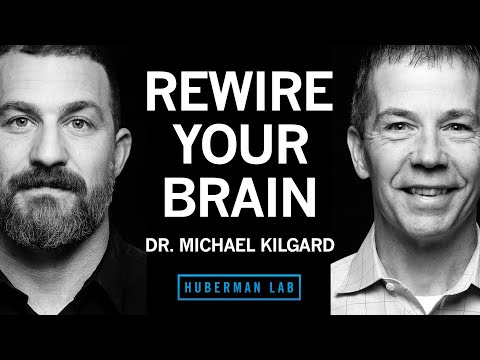
How to Rewire Your Brain & Learn Faster | Dr. Michael Kilgard
Andrew Huberman (host), Dr. Michael Kilgard (guest), Narrator
In this episode of Huberman Lab, featuring Andrew Huberman and Dr. Michael Kilgard, How to Rewire Your Brain & Learn Faster | Dr. Michael Kilgard explores rewire Adult Brains: Vagus Stimulation, Plasticity, and Learning Explained Andrew Huberman and neuroplasticity expert Dr. Michael Kilgard discuss how the adult brain can be massively rewired when neuromodulators like acetylcholine, norepinephrine, serotonin, and dopamine are precisely engaged. They describe how childhood and adult plasticity differ, why real-world, multisensory experiences matter, and how modern technology and overstimulation may distort normal learning processes. Kilgard explains his groundbreaking work using vagus nerve stimulation (VNS) to time neuromodulator release and amplify the effects of physical therapy, cognitive therapy, and sensory training in conditions such as stroke, spinal cord injury, tinnitus, and PTSD. Throughout, they emphasize that effective, lasting change requires a combination of focused effort, friction (challenge), reflection, sleep, and—in some cases—carefully timed devices or drugs to open plasticity windows.
Rewire Adult Brains: Vagus Stimulation, Plasticity, and Learning Explained
Andrew Huberman and neuroplasticity expert Dr. Michael Kilgard discuss how the adult brain can be massively rewired when neuromodulators like acetylcholine, norepinephrine, serotonin, and dopamine are precisely engaged. They describe how childhood and adult plasticity differ, why real-world, multisensory experiences matter, and how modern technology and overstimulation may distort normal learning processes. Kilgard explains his groundbreaking work using vagus nerve stimulation (VNS) to time neuromodulator release and amplify the effects of physical therapy, cognitive therapy, and sensory training in conditions such as stroke, spinal cord injury, tinnitus, and PTSD. Throughout, they emphasize that effective, lasting change requires a combination of focused effort, friction (challenge), reflection, sleep, and—in some cases—carefully timed devices or drugs to open plasticity windows.
Key Takeaways
Adult brains can rewire massively when neuromodulators are precisely timed to activity.
Classic work from Kilgard and Merzenich showed that pairing a specific sound with direct stimulation of nucleus basalis (releasing acetylcholine) in adult animals could radically expand cortical representation of that sound—changes previously believed possible only in development. ...
Get the full analysis with uListen AI
Plasticity depends on focus, friction, reflection, and sleep—not passive exposure.
Both speakers distinguish between merely being exposed to stimuli and actively engaging with them. ...
Get the full analysis with uListen AI
Real-world multisensory experiences build more robust brain wiring than artificial, decontextualized inputs.
Kilgard contrasts natural environments—full of coherent visual, auditory, vestibular, tactile, and social cues—with highly simplified or manipulated digital environments (video games, endless short-form videos, phones). ...
Get the full analysis with uListen AI
Overdriving neuromodulators or sensory systems can create maladaptive plasticity such as tinnitus, chronic pain, and PTSD.
The same plasticity mechanisms that help us learn can lock in pathological patterns when inputs are extreme, persistent, or paired with intense emotion. ...
Get the full analysis with uListen AI
Vagus nerve stimulation (VNS) can ‘tag’ specific moments as important, amplifying therapy and rehabilitation.
Kilgard’s group uses tiny implanted VNS devices to trigger brief bursts of activity in vagal afferents that signal heart–lung status. ...
Get the full analysis with uListen AI
Clinical trials show VNS can significantly improve function in stroke, spinal cord injury, and tinnitus—but it must be paired with targeted training.
In a randomized, double-blind, controlled trial published in The Lancet, adding VNS to standard post-stroke physical therapy for 18 sessions produced markedly greater hand and arm function than therapy alone, leading to FDA approval for ischemic stroke rehabilitation. ...
Get the full analysis with uListen AI
Drugs that boost neuromodulators open plasticity windows but are blunt tools without timing and behavioral context.
Kilgard notes that simply elevating acetylcholine, serotonin, or dopamine with drugs (e. ...
Get the full analysis with uListen AI
Notable Quotes
“There’s not hundreds of new connections, not thousands, not millions, not billions, but trillions of new connections every second of your day trying to decide, should I strengthen this one, should I weaken this one, or should I leave them the same?”
— Michael Kilgard
“We’re kind of in a hurry. You’ve got to hook up all these neurons… every experience is contributing to that. Bedtime stories and songs and walks in the park are all making those changes.”
— Michael Kilgard
“The vast majority of inputs we take in, we just throw away. We’re not memorizing every place I ever was, every place I ever set my keys, every word everyone ever said. We’re picking which moments are the moments that are useful, and that’s hard to know.”
— Michael Kilgard
“We used to think selective serotonin reuptake inhibitors worked by increasing serotonin, therefore we concluded people’s serotonin was low with depression… It’s a plasticity tool.”
— Michael Kilgard
“No one is trying to control anyone’s brain… Find serious problems and see if we can help. The toolbox we’ve created is just so rich, and how to use them all together, that’s the problem.”
— Michael Kilgard
Questions Answered in This Episode
In your stroke and spinal cord injury trials, how did you decide which specific movements or tasks to pair with VNS, and what have you learned about choosing ‘the right’ behaviors to tag for plasticity?
Andrew Huberman and neuroplasticity expert Dr. ...
Get the full analysis with uListen AI
You showed that stimulating any of several neuromodulator systems (acetylcholine, norepinephrine, dopamine, serotonin) can drive plasticity in animals—do you now see any clear functional differences between them when it comes to designing human therapies?
Get the full analysis with uListen AI
Given your concern about artificial sensory statistics in video games and social media, what concrete guidelines would you give parents of a 10-year-old today about daily screen time and types of digital content that are least likely to distort normal brain development?
Get the full analysis with uListen AI
For tinnitus patients who can’t stop paying attention to the sound, how would you practically coach them to avoid reinforcing it while they wait for or undergo more targeted treatments like sound therapy or VNS?
Get the full analysis with uListen AI
If you had full control over future research funding, how would you prioritize between advancing VNS and other device-based approaches, developing better pharmacologic plasticity tools (e.g., next-generation psychedelics), and scaling high-quality cognitive-behavioral therapies for conditions like PTSD and chronic pain?
Get the full analysis with uListen AI
Transcript Preview
Welcome to the Huberman Lab podcast, where we discuss science and science-based tools for everyday life. I'm Andrew Huberman, and I'm a professor of neurobiology and ophthalmology at Stanford School of Medicine. My guest today is Dr. Michael Kilgard. Dr. Michael Kilgard is a professor at the University of Texas at Dallas, and he is one of the world's leading experts in neuroplasticity, which is the brain's ability to change in response to experience. Since the beginning of the field of neuroscience, meaning for well over 100 years, it was understood that the young brain can change. Kids can learn things. They can learn languages, new skills. And young adults can learn. But that the adult brain was less capable of learning. Then in the late '90s, it was Dr. Kilgard, in collaboration with his colleagues, that discovered that indeed, the adult brain can change massively if the right conditions are set. His work showed that if specific neuromodulators, meaning acetylcholine, norepinephrine, serotonin, or dopamine, are triggered to be released in the adult brain, you can achieve massive rewiring of brain circuits and learning, even as an adult. This opened up an entire new field within neuroscience, and of course, has profound implications for health and disease. It's also completely changed the way that we think about learning, longevity, and brain health. More recently, Dr. Kilgard's research has focused on vagus nerve stimulation to precisely control the timing of neuromodulator release. As you may know, the vagus nerve connects the body with the brain and the brain with the body, and by stimulating a particular branch of the vagus nerve pathway, his laboratory has shown that people can overcome debilitating conditions such as tinnitus, stroke, and even restore mobility to people who have suffered spinal cord injuries. During today's episode, we discuss the specific actionable strategies that you or anyone can use to rewire your brain at any stage of life. So as you'll soon see, Dr. Kilgard has an exceptionally clear and practical understanding of how to apply what we know about neuroplasticity so that you can learn better and improve your brain health. Before we begin, I'd like to emphasize that this podcast is separate from my teaching and research roles at Stanford. It is, however, part of my desire and effort to bring zero-cost-to-consumer information about science and science-related tools to the general public. In keeping with that theme, today's episode does include sponsors. I have a brief announcement to make about my upcoming book, Protocols: An Operating Manual for the Human Body. I've completed the book now several times, and yet it's not quite ready for release, and I'll tell you why. Some years ago, somebody I highly respect in the research science field that I was working with on a project said to us as a group, "If you have the opportunity to make something better, you do it." Now, I realize that runs counter to what we all so often hear, which is, "Never let perfect get in the way of completed." But I must say, when it comes to providing the public health protocols, I absolutely insist that you have the most up-to-date science and information in the Protocols book. And so that's the reason why I've decided to go through and basically revise each and every chapter, adding some things based on new research and improving the protocols overall. I strongly feel that's my obligation to the data and to all of you. I confess, part of the delay is also because I've decided to do all the illustrations for the book myself. As a consequence, my book is now going to be released in September 2026. If you'd like to pre-order the book, it's available in English and other languages, and yes, it will be available in audio form. If you'd like to pre-order, go to Protocolsbook.com. Thank you for your patience. I'm excited to share the book with you next year. And now for my discussion with Dr. Michael Kilgard. Dr. Michael Kilgard, welcome.
Install uListen to search the full transcript and get AI-powered insights
Get Full TranscriptGet more from every podcast
AI summaries, searchable transcripts, and fact-checking. Free forever.
Add to Chrome