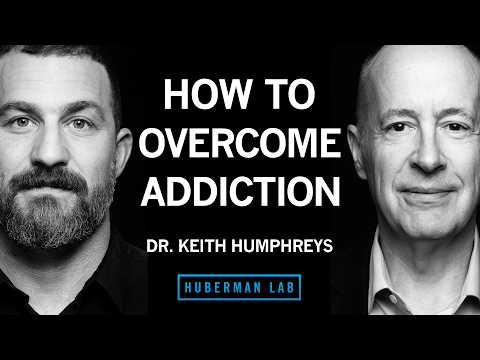
How to Overcome Addiction to Substances or Behaviors | Dr. Keith Humphreys
Dr. Keith Humphreys (guest), Andrew Huberman (host)
In this episode of Huberman Lab, featuring Dr. Keith Humphreys and Andrew Huberman, How to Overcome Addiction to Substances or Behaviors | Dr. Keith Humphreys explores practical science-based frameworks to prevent, treat, and outsmart addiction today Dr. Keith Humphreys defines addiction as persistent engagement in a rewarding behavior despite serious harm, often accompanied by a progressive narrowing of what feels pleasurable and meaningful. He explains how genetics, age/brain plasticity, and individual drug response shape risk, while emphasizing that exposure is still the prerequisite for addiction.
Practical science-based frameworks to prevent, treat, and outsmart addiction today
Dr. Keith Humphreys defines addiction as persistent engagement in a rewarding behavior despite serious harm, often accompanied by a progressive narrowing of what feels pleasurable and meaningful. He explains how genetics, age/brain plasticity, and individual drug response shape risk, while emphasizing that exposure is still the prerequisite for addiction.
The conversation compares health risks and social dynamics of alcohol and modern high-potency cannabis, including why “red wine is healthy” is largely misinformation and why today’s cannabis differs dramatically from prior decades. Humphreys also details how “addiction-for-profit” industries (alcohol, nicotine, cannabis, gambling, social media) use marketing and product design to increase consumption, making regulation and norms important public-health tools.
On treatment, Humphreys outlines clinician tactics (motivational interviewing, cue analysis, behavior restructuring, peer support) and strongly supports mutual-help groups—especially AA—citing rigorous evidence that AA/12-step facilitation performs as well as or better than leading therapies for abstinence outcomes. He also covers emerging approaches (GLP-1 agonists, TMS/brain stimulation, psychedelics) and policy levers (insurance parity, Medicaid, drug courts) that influence recovery access and outcomes.
Key Takeaways
Addiction isn’t “doing something a lot”; it’s doing it to the point of harm.
Humphreys emphasizes the hallmark is persistence despite destruction—relationships, work, health, safety—when a person “should” be able to stop but can’t.
Get the full analysis with uListen AI
Genetics load the gun, but environment pulls the trigger.
Heritability for addictions is sizable (often ~0. ...
Get the full analysis with uListen AI
People differ radically in how rewarding a drug feels—and that changes addiction risk.
Some individuals experience fewer punishing effects (less hangover/impairment) or unusually strong relief/euphoria, making escalation more likely; preferences can be substance-specific.
Get the full analysis with uListen AI
Alcohol’s “heart benefit” narrative is outweighed by cancer and whole-body risk.
Even if small cardiovascular benefits exist, Humphreys argues net mortality benefit is not supported; low intake may carry small added risk, but “healthy drinking” is not evidence-based.
Get the full analysis with uListen AI
Modern cannabis is effectively a different drug than in the 80s/90s.
Average THC in legal markets (~20%) plus near-daily use for a large share of users massively increases brain exposure; parents’ personal “weed was harmless” memories can mislead.
Get the full analysis with uListen AI
Psychosis risk from cannabis is most concerning for genetically vulnerable youth.
Humphreys is increasingly persuaded the risk is real, especially with stronger products and heavy use; he advises avoiding cannabis if there’s first-degree family history of psychotic/bipolar disorders.
Get the full analysis with uListen AI
Gambling products are engineered to addict via speed, novelty, and “losses disguised as wins.”
Machine timing and constant reinforcement outperform human dealers; casino profitability has shifted heavily toward slots because they optimize continuous play, not rational “winning.”
Get the full analysis with uListen AI
Withdrawal is often mistaken for a drug’s “benefit.”
Nicotine (and cannabis/opioids) can feel like they improve mood/sleep/focus largely because they relieve withdrawal symptoms created by dependence—making “run the experiment” of stopping informative.
Get the full analysis with uListen AI
AA is a uniquely scalable, evidence-supported intervention for alcohol addiction.
Humphreys cites a Cochrane review showing AA/12-step facilitation yields higher abstinence rates than several leading therapies and similar results on other outcomes—at near-zero cost and high accessibility.
Get the full analysis with uListen AI
Recovery is improved by clarifying motives, mapping cues, and joining accountability communities.
Effective change strategies include eliciting personal reasons for quitting, identifying triggers/contexts, making use harder (remove alcohol at home), learning social skills for non-use, and “hang out with people making the same change.”
Get the full analysis with uListen AI
Relapse risk is driven by cues and stress—but can also happen after success.
Reward-circuit responses to drug cues can predict relapse better than self-report; some relapse when life improves because confidence returns and the person assumes the problem is “behind them.”
Get the full analysis with uListen AI
Promising emerging tools include GLP-1 agonists and brain stimulation, but hype needs controlled trials.
GLP-1s may reduce alcohol craving/consumption while aiding weight loss; rTMS/TMS and psychedelics show potential, yet scaling, safety, and rigorous controls (especially in psychedelic studies) remain key challenges.
Get the full analysis with uListen AI
Notable Quotes
“Addiction is… the persistence of doing something that is harmful.”
— Dr. Keith Humphreys
“There is no customer like an addicted customer.”
— Dr. Keith Humphreys
“Red wine… it’s not healthy.”
— Dr. Keith Humphreys
“In AA… you can’t suddenly quit drinking for the rest of your life… But can you not drink today?”
— Dr. Keith Humphreys
“Ten percent of our country drinks about half the alcohol.”
— Dr. Keith Humphreys
Questions Answered in This Episode
On alcohol studies: How exactly do “sick quitters” and AA members in the non-drinker category distort the J-shaped curve findings?
Dr. ...
Get the full analysis with uListen AI
Cannabis potency: Humphreys cites ~20% average THC and a large share of near-daily users—what datasets support those numbers and how do they vary by state/product type?
The conversation compares health risks and social dynamics of alcohol and modern high-potency cannabis, including why “red wine is healthy” is largely misinformation and why today’s cannabis differs dramatically from prior decades. ...
Get the full analysis with uListen AI
Psychosis risk: What would a “most convincing” causal study look like, given psychosis is rare and randomized exposure is unethical?
On treatment, Humphreys outlines clinician tactics (motivational interviewing, cue analysis, behavior restructuring, peer support) and strongly supports mutual-help groups—especially AA—citing rigorous evidence that AA/12-step facilitation performs as well as or better than leading therapies for abstinence outcomes. ...
Get the full analysis with uListen AI
Edibles vs smoking: If users can’t reliably titrate potency, what labeling/manufacturing regulations would most reduce overdose/paranoia events from edibles?
Get the full analysis with uListen AI
Addiction-for-profit: Which regulatory levers (ad restrictions, taxes, product caps, outlet density) show the strongest evidence for reducing harm without driving black markets?
Get the full analysis with uListen AI
Transcript Preview
someone says, "I want to quit smoking," a, a good clinician will say, "Why, why would you want to do that?" Just say, "So tell me, w- why would you wanna-- what, what do you wanna get out of this? 'Cause it's work. I mean, I'm happy to work with you, but, you know, what, what is it? What are your, what are your motives?" And, and sort of helping them build up, you know, in their own mind, 'cause again, this is about them, not you, what do you get? And that's what the therapist does. The other thing that's really important is that, like any other-- any time you're making a behavior change, hang out with other people who are trying to make the same change. You want to start jogging? Join a jogging group. You want to stop drinking, I would, you know, suggest go, go check into an A- AA meeting or one of the other fellowships we have. Having other people on the same journey is good for us. It sh- I mean, everything shows that no matter what you're doing, I'm losing weight, I'm exercising, I'm more whatever, I'm quitting smoking, because it gives you two things: it gives you support, but it also gives you some accountability. Say, "Hey, you were going jogging, and, uh, on Tuesday you weren't there. What's up? Are, are you gonna be part of this group or not?" And that is, uh, helpful for people. [upbeat music]
Welcome to the Huberman Lab podcast, where we discuss science and science-based tools for everyday life. I'm Andrew Huberman, and I'm a professor of neurobiology and ophthalmology at Stanford School of Medicine. My guest today is Dr Keith Humphreys. Dr Keith Humphreys is a professor of psychiatry and behavioral sciences at Stanford School of Medicine, and he is one of the world's foremost experts on addictive substances and behaviors and how to overcome addictions of all kinds. He is also an expert on how science, commercial marketing, lobbying, and the legal system interact to create what are called addiction for profit businesses. The alcohol, food, and opioid industries come to mind as just a few examples of these, and he's an expert on how all of that shapes things like legal policy. Today, we discuss all the major addictions to give you the most up-to-date information on alcohol, cannabis, opioids, gambling, and much more. Dr Humphreys gives us the unbiased facts, and more importantly, he explains how to think about the health risks of any substance or behavior in a logical way. For instance, while it may be true that a certain amount of alcohol could afford you some heart health benefits, we hear this, then we hear it's not true, it goes back and forth, he explains that any heart benefits that exist from alcohol are greatly offset by the increased cancer and other risks of alcohol. And with respect to cannabis, he explains who may be okay to use it, but who should absolutely not. We also discuss the most effective ways to get over any addiction. That includes alcohol, pornography, stimulants, and much more. As you'll soon see, Dr Keith Humphreys is no ordinary scientist or psychologist or addiction expert. He has the big picture on addiction and what it means to try and navigate life nowadays in an ocean of addiction-for-profit marketing and confusing health information. I assure you that today he doesn't tell you what to think or what to do about various substances and addictive behaviors, but rather how to think about them, and in doing so, how to avoid and overcome essentially any addiction. It's a powerful conversation that I'm certain will help millions of people make better decisions. Before we begin, I'd like to emphasize that this podcast is separate from my teaching and research roles at Stanford. It is, however, part of my desire and effort to bring zero cost to consumer information about science and science-related tools to the general public. In keeping with that theme, today's episode does include sponsors. And now for my discussion with Dr Keith Humphreys. Dr Keith Humphreys, welcome.
Install uListen to search the full transcript and get AI-powered insights
Get Full TranscriptGet more from every podcast
AI summaries, searchable transcripts, and fact-checking. Free forever.
Add to Chrome