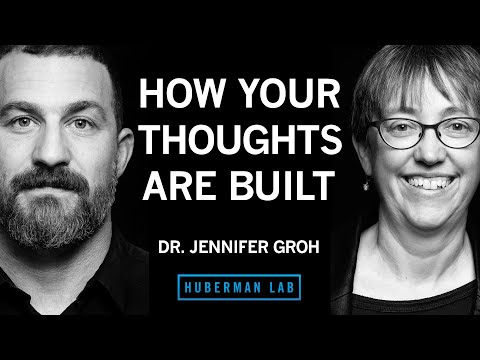
How Your Thoughts Are Built & How You Can Shape Them | Dr. Jennifer Groh
Dr. Jennifer Groh (guest), Andrew Huberman (host)
In this episode of Huberman Lab, featuring Dr. Jennifer Groh and Andrew Huberman, How Your Thoughts Are Built & How You Can Shape Them | Dr. Jennifer Groh explores shape Your Thoughts: Sensory Simulations, Attention, and Brain Design Revealed Neuroscientist Dr. Jennifer Groh explains how the brain builds thoughts by running multi-sensory simulations—using the same visual, auditory, and motor circuits we use to perceive and act in the world.
Shape Your Thoughts: Sensory Simulations, Attention, and Brain Design Revealed
Neuroscientist Dr. Jennifer Groh explains how the brain builds thoughts by running multi-sensory simulations—using the same visual, auditory, and motor circuits we use to perceive and act in the world.
She describes how the brain integrates sight and sound for spatial awareness, why eye movements literally change what we hear (down to the eardrum), and how environments and devices like phones hijack or support our attention.
The conversation explores music, rhythm, and emotion, the physics and biology of sound localization, and why focus behaves more like interval training or endurance sport than a simple on/off switch.
Throughout, Groh and Huberman connect lab findings to practical tools for better focus, learning, and self-management of brain states, including visual techniques, environment design, and realistic expectations about concentration.
Key Takeaways
Thoughts Are Built as Multi-Sensory Simulations in Sensory Cortex
Groh proposes that thinking is the brain running internal simulations in the same sensory and motor circuits used for perception and action. ...
Get the full analysis with uListen AI
Eye Position Literally Changes What You Hear, Starting at the Eardrum
Classically, audio processing was thought to flow bottom-up from the ear. ...
Get the full analysis with uListen AI
Sound Localization Relies on Microsecond Timing and Ear-Specific Filtering
To locate sound in space, the brain exploits tiny differences in arrival time and loudness between the two ears—up to only about 0. ...
Get the full analysis with uListen AI
Perception of Sound Sources Is Highly Constructed and Often Misleading
The brain routinely overrides raw ear input to create coherent sound sources. ...
Get the full analysis with uListen AI
Music and Rhythm Likely Evolved to Coordinate Group Action and Emotion
Music appears in every culture, but its evolutionary function is less obvious than language. ...
Get the full analysis with uListen AI
Attention Functions Like a Limited, Trainable Resource—More Like Exercise Than a Switch
Both speakers emphasize that focus is not a simple willpower issue: it’s constrained by neurochemical resources (e. ...
Get the full analysis with uListen AI
Visual Focus Strongly Steers Brain State and Attention (Chickens Are a Clue)
The discussion of chickens illustrates a general principle: where and how the eyes focus can lock overall brain state. ...
Get the full analysis with uListen AI
Notable Quotes
“What goes on in our brains when we think might be that we're running simulations related to the thought using that sensory, sensory motor infrastructure of the brain.”
— Jennifer Groh
“If you moved the eyes, the neurons' receptive field... would shift as the eyes moved. And that blew my mind.”
— Jennifer Groh
“Half a millisecond is less than the duration of a single action potential.”
— Andrew Huberman
“Your ears are making sounds, folks.”
— Jennifer Groh
“Being blocked can mean you don't know yet what needs to come next.”
— Jennifer Groh
Questions Answered in This Episode
Your theory of thought as sensory simulation is compelling—what specific neuroimaging or electrophysiological experiments would most decisively test whether thinking ‘cat’ actually replays cat-like patterns in visual and auditory cortex?
Neuroscientist Dr. ...
Get the full analysis with uListen AI
In your work on eye-movement–driven eardrum motions, have you identified any behavioral situations (e.g., in noise or with ambiguous locations) where disrupting that eardrum modulation measurably impairs sound localization?
She describes how the brain integrates sight and sound for spatial awareness, why eye movements literally change what we hear (down to the eardrum), and how environments and devices like phones hijack or support our attention.
Get the full analysis with uListen AI
If rhythm originally evolved to coordinate group action and scare off predators, how do you interpret modern musical forms (like complex harmony or very fast, dense music) that would have been acoustically useless in an open savannah?
The conversation explores music, rhythm, and emotion, the physics and biology of sound localization, and why focus behaves more like interval training or endurance sport than a simple on/off switch.
Get the full analysis with uListen AI
Given that attention seems highly individual—some people being more ‘interval’ and others more ‘endurance’ focused—what concrete methods would you recommend for a person to profile their own attentional style and then design a daily work structure around it?
Throughout, Groh and Huberman connect lab findings to practical tools for better focus, learning, and self-management of brain states, including visual techniques, environment design, and realistic expectations about concentration.
Get the full analysis with uListen AI
The chicken ‘hypnosis’ example suggests using visual-vergence drills to improve human focus; do you see ethical or practical risks in applying such techniques at scale in classrooms or workplaces, and how would you design a careful trial to evaluate benefits vs. potential downsides?
Get the full analysis with uListen AI
Transcript Preview
What goes on in our brains when we think might be that we're running simulations related to the thought using that sensory, sensory motor infrastructure of the brain.
Could you elaborate?
So the theory is that, like, maybe when you think about a cat, for example, or you think the concept of a cat, that the mental instantiation of that, or the, the brain mechanism instantiation of having that thought is to run a little simulation in visual cortex that kind of includes what a cat looks like. A simulation in auditory cortex that, what does a cat sound like? And as I'm telling you this I'm, you know, I've used the word cat, um, what color cat are you thinking?
I'm thinking of a, a gray cat, but I keep smelling kitty litter.
Okay.
'Cause my sister had cats and it drove me, the smell of kitty litter is just so aversive to me.
Right. And s- (laughs) so you had no hesitation in telling me the color and adding an additional sensory quality. It provides an explanation for why you might, you know, be driving on the freeway and having to merge into difficult traffic and telling your, your passenger, "Okay, be quiet. I've got to, I've got to pay attention now." Like-
Hmm. Mm-hmm. Mm-hmm.
... why would speech impair you from visual motor-
Mm-hmm.
... if it wasn't all part of a kind of cognitive system that's, that's in operation, and maybe you need to shift some resources away from processing-
Mm-hmm.
... the conversation and towards some, you know, actually dealing with the here and now sensory motor task?
Welcome to the Huberman Lab Podcast, where we discuss science and science-based tools for everyday life. (instrumental music plays) I'm Andrew Huberman, and I'm a professor of neurobiology and ophthalmology at Stanford School of Medicine. My guest today is Dr. Jennifer Groh. Dr. Jennifer Groh is a professor of psychology and neuroscience at Duke University. Her laboratory studies how our brain represents the world around us, in particular how our different senses are merged in the brain so that we can focus and learn more effectively, including how our eye movements fundamentally shape not just what we pay attention to, but how they dynamically control what our brain is capable of. What she shares is fundamental to understanding how your brain works, and also how best to focus on and learn different types of information, not just information that you might read on a page, although including that, but also what you hear, what you remember, and the very thoughts you have about your life experiences. We also discuss thinking itself. In fact, we discuss what thoughts really are, and there Dr. Groh shares with us what is perhaps the clearest and most useful definition of what thoughts are and how you can control them. As someone who has been in the field of neuroscience for nearly three decades, I must say that her explanation of what thinking is, at the neural level, at the psychological level, and at the experiential level, is the most compelling and useful one I've ever come across. Today, Dr. Groh explains how to use your experiences, the information you encounter, and knowledge of how thoughts are built up in the brain to become a better thinker, and indeed smarter. I'm certain that the information you'll learn from Dr. Groh today is not like any other discussion you've heard about the brain or psychology. I'm also certain that it will be extremely useful for anyone wishing to better understand how the brain works, how their thoughts and emotions arise, and anyone who wants to get better at learning, thinking more deeply, or simply experiencing life with more richness. Before we begin, I'd like to emphasize that this podcast is separate from my teaching and research roles at Stanford. It is, however, part of my desire and effort to bring zero cost to consumer information about science and science-related tools to the general public. In keeping with that theme, today's episode does include sponsors. And now for my discussion with Dr. Jennifer Groh. Dr. Jennifer Groh, welcome.
Install uListen to search the full transcript and get AI-powered insights
Get Full TranscriptGet more from every podcast
AI summaries, searchable transcripts, and fact-checking. Free forever.
Add to Chrome