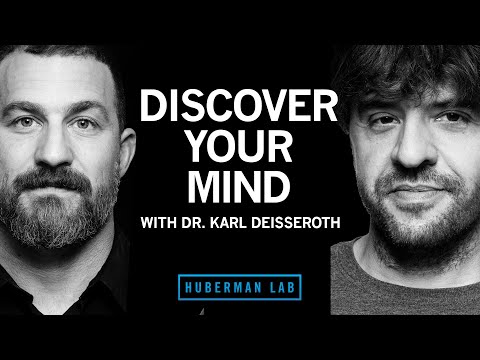
Understanding & Healing the Mind | Dr. Karl Deisseroth
Andrew Huberman (host), Karl Deisseroth (guest), Narrator, Narrator
In this episode of Huberman Lab, featuring Andrew Huberman and Karl Deisseroth, Understanding & Healing the Mind | Dr. Karl Deisseroth explores rewiring Mind and Brain: Deisseroth’s Vision For Future Psychiatry Andrew Huberman interviews psychiatrist and neuroscientist Dr. Karl Deisseroth about how we understand, measure, and heal the mind. They contrast neurology and psychiatry, explore why psychiatric diagnosis still relies so heavily on words, and discuss stigma and the urgent need for earlier treatment. Deisseroth explains optogenetics and CLARITY, tools his lab developed to causally probe brain circuits and visualize intact brains, and how these are reshaping our understanding of depression, autism, dissociation, and more.
Rewiring Mind and Brain: Deisseroth’s Vision For Future Psychiatry
Andrew Huberman interviews psychiatrist and neuroscientist Dr. Karl Deisseroth about how we understand, measure, and heal the mind. They contrast neurology and psychiatry, explore why psychiatric diagnosis still relies so heavily on words, and discuss stigma and the urgent need for earlier treatment. Deisseroth explains optogenetics and CLARITY, tools his lab developed to causally probe brain circuits and visualize intact brains, and how these are reshaping our understanding of depression, autism, dissociation, and more.
They review current psychiatric treatments—from talk therapy and medications to electroconvulsive therapy and vagus nerve stimulation—highlighting both their real effectiveness and their lack of specificity. The conversation also examines psychedelics, ketamine, and MDMA as emerging tools for depression and trauma, emphasizing both their therapeutic promise and risks. Woven through is Deisseroth’s personal trajectory from poetry-obsessed youth to clinician–scientist, and how he structures his own thinking and days to manage a demanding lab, clinic, and family life while remaining optimistic about the future of mental health care.
Key Takeaways
Psychiatry’s core limitation is measurement; everything still flows through words.
Unlike neurology, which has scans and EEGs that visibly reveal strokes or seizures, psychiatry has no blood test or imaging marker that can diagnose depression, schizophrenia, or autism in an individual. ...
Get the full analysis with uListen AI
Effective psychiatric treatments already exist, but they are often crude and nonspecific.
Cognitive behavioral therapy can largely resolve panic disorder in 6–12 structured sessions for motivated patients. ...
Get the full analysis with uListen AI
Optogenetics provides causal circuit-level insight that can ultimately make medications far more precise.
Channelrhodopsins originated as light-sensing proteins in single-celled algae that swim to optimal light levels. ...
Get the full analysis with uListen AI
Dissociation, depression, and social deficits have identifiable circuit mechanisms that can be probed across species.
Deisseroth’s group showed that dissociation—a separation of self from bodily experience common in trauma and certain drugs like ketamine—can be modeled in mice and linked to specific activity patterns in a conserved brain region. ...
Get the full analysis with uListen AI
Future psychiatry will likely combine brain–machine interfaces, circuit knowledge, and better drugs, not just implants.
Deisseroth views invasive tools like closed-loop deep brain stimulation and brain–machine interfaces as part of psychiatry’s future, especially for severe, refractory conditions. ...
Get the full analysis with uListen AI
Psychedelics and MDMA may help by loosening rigid internal models and enabling new learning, but they carry real risks.
Deisseroth conceptualizes the cortex as a hypothesis-testing machine that builds models of the world; most tentative or incorrect models are filtered before reaching consciousness. ...
Get the full analysis with uListen AI
Structured introspection and deliberate ‘thinking time’ can be trained and are central to high-level cognitive work.
Deisseroth describes himself as an extremely verbal thinker who reasons in internal sentences and even hears the rhythm of prose in his head. ...
Get the full analysis with uListen AI
Notable Quotes
“We’ve got the most complex, beautiful, mysterious, incredibly engineered object in the universe, and yet all we have are words to find our way in.”
— Karl Deisseroth
“Almost every psychiatric treatment has been serendipitously identified… noted by chance that something done for some person also had a side effect.”
— Karl Deisseroth
“Electroconvulsive therapy is extraordinarily effective for depression… and yet we’re causing a brain‑wide seizure. How could you be less specific than that?”
— Karl Deisseroth
“Optogenetics’ broader significance clinically is understanding. Once you understand how the circuitry works and which cells actually matter, then any kind of treatment becomes more grounded, logical, specific, and principled.”
— Karl Deisseroth
“I became interested in the brain because of poetry. I was amazed that words, even separate from their meaning, could trigger specific emotions.”
— Karl Deisseroth
Questions Answered in This Episode
In your dissociation work, how do you separate the specific circuit pattern that causes dissociation from other global changes ketamine produces in the brain—what convinced you that this particular activity was causal rather than just correlated?
Andrew Huberman interviews psychiatrist and neuroscientist Dr. ...
Get the full analysis with uListen AI
You noted that clozapine is both the most effective and most side‑effect–laden antipsychotic; based on your optogenetic insights, what would a next‑generation ‘clozapine without the collateral damage’ actually target at the circuit or receptor level?
They review current psychiatric treatments—from talk therapy and medications to electroconvulsive therapy and vagus nerve stimulation—highlighting both their real effectiveness and their lack of specificity. ...
Get the full analysis with uListen AI
Given that early‑morning awakening can be an early sign of depression, what would a minimally invasive, ethically acceptable ‘early warning system’ for mood disorders look like in practice—phones, wearables, voice analysis, or something else?
Get the full analysis with uListen AI
You described psychedelics as lowering the threshold for unusual internal models to reach consciousness; do you worry that, outside carefully controlled clinical settings, increased psychedelic use could push some vulnerable individuals toward psychosis by stabilizing maladaptive models?
Get the full analysis with uListen AI
For conditions like autism, where social interaction is an extreme high–bandwidth integration problem, how confident are you that mouse circuits for ‘social behavior’ map onto human social cognition sufficiently to guide treatments—and where do you see the biggest translational risks?
Get the full analysis with uListen AI
Transcript Preview
(music plays) Welcome to the Huberman Lab Podcast, where we discuss science and science-based tools for everyday life. I'm Andrew Huberman, and I'm a professor of neurobiology and ophthalmology at Stanford School of Medicine. Today, I have the pleasure of introducing the first guest of the Huberman Lab Podcast. My guest is Dr. Karl Deisseroth. Dr. Karl Deisseroth is a medical doctor. He's a psychiatrist and a research scientist at Stanford School of Medicine. In his clinical practice, he sees patients dealing with a range of nervous system disorders, including obsessive-compulsive disorder, autism, attention deficit disorders, schizophrenia, mania, anxiety disorders, and eating disorders. His laboratory develops and explores tools with which to understand how the nervous system works in the healthy situation as well as in disorders of the mind. Dr. Deisseroth's laboratory has pioneered the development and use of what are called channelopsins, proteins that come from algae, which can now be introduced to the nervous systems of animals and humans in order to precisely control the activity of neurons in the brain and body with the use of light. This is a absolutely transformative technology, because whereas certain drug treatments can often relieve certain symptoms of disorders, they often carry various side effects. And in some individuals, often many individuals, these drug treatments simply do not work. The channelopsins and their related technologies stand to transform the way that we treat psychiatric illness and various disorders of movement and perception. In fact, just recently, the channelopsins were applied in a human patient to allow an adult fully blind human being to see light for the very first time. We also discuss Dr. Deisseroth's newly released book, which is entitled Projections: A Story of Human Emotions. This is an absolutely remarkable book that uses stories about his interactions with his patients to teach you how the brain works in the healthy and diseased state and also reveals the motivation for and discovery of these channelopsins and other technologies by Karl's laboratory that are being used now to treat various disorders of the nervous system and that in the future are certain to transform the fields of psychiatry, mental health, and health in general. I found our conversation to be an absolutely fascinating one about how the brain functions in the healthy state and why and how it breaks down in disorders of the mind. We also discuss the current status and future of psychedelic treatments for psychiatric illness as well as for understanding how the brain works more generally. We also discuss issues of consciousness and we even delve into how somebody like Karl, who's managing a full-time clinical practice and a 40-plus person laboratory and a family of five children and is happily married, how he organizes his internal landscape, his own thinking in order to manage that immense workload and to progress forward for the sake of medicine and his pursuits in science. I found this to be an incredible conversation. I learned so much. I also learned, through the course of reading Karl's book, Projections, that not only is he an accomplished psychiatrist and obviously an accomplished research scientist and a family man, but he's also a phenomenal writer. Projections is absolutely masterfully written. It's just beautiful and it's accessible to anybody, even if you don't have a science background. So I hope that you'll enjoy my conversation with Karl Deisseroth as much as I did, and thank you for tuning in. Before we begin, I want to point out that this podcast is separate from my teaching and research roles at Stanford. In my desire and effort to bring zero cost to consumer information about science and science-related tools to the general public, I'd like to acknowledge the sponsors of today's podcast. Our first sponsor is ROKA. ROKA makes eyeglasses and sunglasses that, in my opinion, are the very highest quality out there. The company was founded by two all-American swimmers from Stanford, and everything about the eyeglasses and sunglasses was developed with performance in mind. One of the things I really love about ROKA sunglasses is that unlike other sunglasses that make it hard to see when there's a lot of cloud cover or when the shadows change or environmental conditions change, with ROKA sunglasses, they clearly understand the science of the visual system. Because when I put them on for the first time, I noticed that as I moved into shadows or the cloud cover changed or the day got brighter or dimmer, everything was still crystal clear. And that's also because the lenses are tremendously high optical clarity and the glasses are really lightweight. You don't even notice that they're on. The other thing is that the eyeglasses, I wear readers at night, they're incredibly lightweight, and for both the sunglasses and eyeglasses, the aesthetic is terrific. Unlike a lot of performance eyewear, which frankly can look kind of cyborg-like and kind of ridiculous, the aesthetic of the glasses is such that you could really wear them anywheres, indoors or outdoors. If you'd like to try ROKA eyeglasses, you can go to ROKA, that's R-O-K-A.com and enter the code Huberman to save 20% on your first order. That's ROKA, R-O-K-A.com and enter the code Huberman at checkout. Today's podcast is also brought to us by InsideTracker. InsideTracker is a personalized nutrition platform that analyzes data from your blood and DNA to help you better understand your body and reach your health goals. I am a big believer in getting regular blood work done, and now with the advent of good genetic DNA tests, I'm also a believer in analyzing your DNA. The simple reason for this is that many of the factors that impact our immediate and long-term health can only be measured and evaluated with a quality blood test. And now, the DNA tests further inform our immediate and long-term health. One of the problems with a lot of DNA tests and blood tests out there, however, is that you get the information back and you don't know what to do with that information. With InsideTracker, you get the numbers back of different metabolic factors, hormones, et cetera, but it also provides simple directives as to how perhaps you might want to change your nutritional intake or your exercise regimen or other lifestyle factors to bring those numbers into alignment with where you'd like them to be. InsideTracker also makes this really easy. They have a dashboard that makes organizing that all very simple, and they can even have someone come to your house to take the blood and DNA test. If you'd like to try InsideTracker, you can visit insidetracker.com/huberman to get 25% off any of InsideTracker's plans. Just use the code Huberman at checkout. Today's episode is also brought to us by Athletic Greens. Athletic Greens is an all-in-one vitamin mineral probiotic drink.I started taking Athletic Greens way back in 2012, and I've taken it ever since, so I'm delighted that they're sponsoring the podcast. The reason I started taking Athletic Greens and that I continue to take Athletic Greens is that it covers all my vitamin and mineral bases, and it covers my probiotic needs. There's now a wealth of data showing that probiotics support a healthy gut microbiome, and that a healthy gut microbiome supports the gut-brain axis for healthy mood. It also supports metabolism, immune function, endocrine, that means hormone function, and a host of other important biological functions. I drink it once or twice a day. I mix it with water and a little bit of lemon juice or some lime juice, and it's absolutely delicious. If you'd like to try Athletic Greens, you can go to athleticgreens.com/huberman, and if you do that, you can claim a special offer where they will give you a year's supply of vitamin D3. In addition, they'll give you five free travel packs. Vitamin D3, as we all know, is very important for a huge range of biological functions and health. Again, that's athleticgreens.com/huberman for your Athletic Greens, the five free travel packs, and the year's supply of vitamin D3. And now, my conversation with Dr. Karl Deisseroth. Well, thanks for being here.
Install uListen to search the full transcript and get AI-powered insights
Get Full TranscriptGet more from every podcast
AI summaries, searchable transcripts, and fact-checking. Free forever.
Add to Chrome