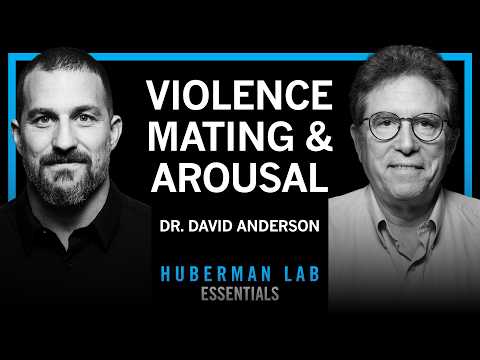
Essentials: The Biology of Aggression, Mating & Arousal | Dr. David Anderson
Andrew Huberman (host), Dr. David Anderson (guest)
In this episode of Huberman Lab, featuring Andrew Huberman and Dr. David Anderson, Essentials: The Biology of Aggression, Mating & Arousal | Dr. David Anderson explores neural circuits and hormones shaping aggression, mating, pain, and emotion Emotions are best viewed as internal brain states that control behavior, with subjective feelings representing only the “tip of the iceberg.”
Neural circuits and hormones shaping aggression, mating, pain, and emotion
Emotions are best viewed as internal brain states that control behavior, with subjective feelings representing only the “tip of the iceberg.”
Two defining properties that distinguish emotion-like states from reflexes and many drives are persistence (they outlast triggers) and generalization (they influence responses across contexts).
Aggression is a behavior that can reflect multiple underlying states (anger, fear, predation), and in mice distinct hypothalamic cell populations can causally evoke offensive aggression that is sometimes rewarding.
Hormonal control of aggression is more nuanced than “testosterone causes aggression,” with estrogen receptors and testosterone-to-estrogen aromatization playing key roles in male mouse aggression circuits.
Social isolation can dramatically increase aggression, fear, and anxiety via tachykinin neuropeptide upregulation, and blocking tachykinin receptors can reverse these effects in mice without sedation.
Key Takeaways
Emotions can be studied as neurobiological states, not just feelings.
Anderson frames emotions as internal states that alter the brain’s input–output mapping (like sleep or arousal), while feelings are the reportable, conscious “tip” of the underlying process.
Get the full analysis with uListen
Persistence and generalization help define emotion-like states.
Unlike reflexes that end when a stimulus ends, emotion states can linger and bias future perception and action (e. ...
Get the full analysis with uListen
“Aggression” is a behavioral label that can arise from different internal causes.
The same outward behavior can reflect anger, fear (defensive), or hunger (predatory), implying that effective interventions require identifying the underlying state and circuit.
Get the full analysis with uListen
VMH contains adjacent, interacting nodes for fear and aggression, with fear often dominating.
Fear-related neurons are positioned near aggression-related neurons in VMH, and activating fear neurons can abruptly stop an ongoing fight—suggesting hierarchical suppression of offensive aggression by fear.
Get the full analysis with uListen
Aggressive drive can be conceptualized as rising neural “pressure” with thresholds.
Similar to homeostatic set-point models, increasing activity in relevant hypothalamic circuits can lower the trigger threshold for attack, while VMH integrates multisensory inputs and broadcasts to many downstream regions.
Get the full analysis with uListen
Estrogen signaling is central to male aggression circuitry in mice.
Key VMH aggression neurons express estrogen receptors; castration-related loss of aggression can be rescued by estrogen, consistent with testosterone acting partly through aromatization into estrogen.
Get the full analysis with uListen
Social isolation may amplify aggression through tachykinin biology—and may be druggable.
Isolation upregulates tachykinins (tachykinin-2 in mice), increasing aggression, fear, and anxiety; a tachykinin receptor blocker (osanetant) reverses these effects and even enables safe re-socialization in mice without sedating them.
Get the full analysis with uListen
Notable Quotes
“I see emotions as a type of internal state… They change the input to output transformation of the brain.”
— Dr. David Anderson
“If you think of an iceberg, it’s the part… below the surface… The feeling part is the tip.”
— Dr. David Anderson
“Male mice will learn to… get the opportunity to beat up a subordinate male mouse. It has a positive valence.”
— Dr. David Anderson
“If we deliberately stimulate those fear neurons… it just stops the fight dead in its tracks.”
— Dr. David Anderson
“Putting a violent prisoner in solitary confinement is absolutely the worst… thing you could do.”
— Dr. David Anderson
Questions Answered in This Episode
How do you experimentally distinguish whether a mouse’s “aggression” is driven by anger-like state versus fear or predatory motivation?
Emotions are best viewed as internal brain states that control behavior, with subjective feelings representing only the “tip of the iceberg.”
Get the full analysis with uListen AI
What evidence supports the claim that VMH-evoked offensive aggression is rewarding, and how is reward measured behaviorally and neurally?
Two defining properties that distinguish emotion-like states from reflexes and many drives are persistence (they outlast triggers) and generalization (they influence responses across contexts).
Get the full analysis with uListen AI
If fear hierarchically suppresses offensive aggression in VMH, what are the synaptic mechanisms—direct inhibition, downstream gating, or both?
Aggression is a behavior that can reflect multiple underlying states (anger, fear, predation), and in mice distinct hypothalamic cell populations can causally evoke offensive aggression that is sometimes rewarding.
Get the full analysis with uListen AI
What are the practical implications of aromatization (testosterone → estrogen) for how people interpret hormone–behavior links in humans?
Hormonal control of aggression is more nuanced than “testosterone causes aggression,” with estrogen receptors and testosterone-to-estrogen aromatization playing key roles in male mouse aggression circuits.
Get the full analysis with uListen AI
In females, how do the two VMH estrogen-receptor neuron subsets switch dominance across reproductive states (virgin vs nursing)?
Social isolation can dramatically increase aggression, fear, and anxiety via tachykinin neuropeptide upregulation, and blocking tachykinin receptors can reverse these effects in mice without sedation.
Get the full analysis with uListen AI
Transcript Preview
Welcome to Huberman Lab Essentials, where we revisit past episodes for the most potent and actionable science-based tools for mental health, physical health, and performance. [music] I'm Andrew Huberman, and I'm a professor of neurobiology and ophthalmology at Stanford School of Medicine. And now for my discussion with Dr. David Anderson. David, great to be here and great to finally sit down and chat with you.
Great to be here, too. Thank you so much.
I want to start with something fairly basic, and that's the difference between emotions and states. How should we think about them, and why might states be at least as useful a thing to think about, if not more useful?
The short answer to your question is that I see emotions as a type of internal state in the sense that arousal is also a type of internal state. Motivation's a type of internal state. Sleep is a type of internal state. They change the input to output transformation of the brain. When you're asleep, you don't hear something that you would hear if you were awake. So from that broad perspective, I see emotion as a class of state that controls behavior. The reason I think it's useful to think about it as a state is it puts the focus on it as a neurobiological process rather than as a psychological process. Many people equate emotion with feeling, which is a subjective sense that we can only study in humans, because to find out what someone's feeling, you have to ask them, and people are the only animals that can talk that we can understand. That's how I think about emotion. It's the, if you think of an iceberg, it's the part of the iceberg that's below the surface of the water. The feeling part is the tip.
What are some of the other features of states that represent below the tip of the iceberg?
Right. There have been people who have thought of emotions as having just really two dimensions, a, an arousal dimension and a valence dimension. Ralph Adolphs and I have tried to expand that a little bit to think about components of emotion, particularly those that distinguish emotion states from motivational states, because they are very closely related. One of those important properties is persistence. This is something that distinguishes state-driven behaviors from simple reflexes. Reflexes tend to terminate when the stimulus turns off, like the doctor hitting your knee with a hammer. It initiates with the stimulus onset, and it terminates with the stimulus offset. Emotions tend to outlast, often, the stimulus that evoke them. If you're walking along a trail here in Southern California, you hear a rattlesnake rattling, you're going to jump in the air, your heart is going to continue to beat, and your palms sweat for a while after it's slithered off in the bush, and you're going to be hypervigilant. If you see something that even remotely looks snake-like, a stick, you're going to stop. Not all states have persistence. So for example, you think about hunger. Once you've eaten, the state is gone. You're not hungry anymore. But if you're really angry and you get into a fight with somebody, even after the fight is over, you may remain riled up for a long time, and it takes you a while to calm down. And then generalization is an important component of emotion states, um, that, uh, make them, if they have been, uh, triggered in one situation, they can apply to another situation. My favorite example of that is you come home from work and your kid is screaming. If you had a good day at work, you might pick it up and, and soothe it, and if you had a bad day at work, you might react very differently to it.
Install uListen to search the full transcript and get AI-powered insights
Get Full TranscriptGet more from every podcast
AI summaries, searchable transcripts, and fact-checking. Free forever.
Add to Chrome