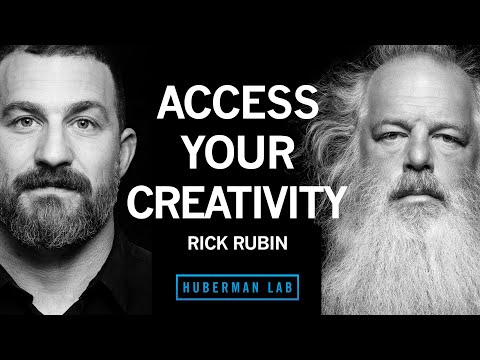
How to Access Your Creativity | Rick Rubin
Andrew Huberman (host), Rick Rubin (guest)
In this episode of Huberman Lab, featuring Andrew Huberman and Rick Rubin, How to Access Your Creativity | Rick Rubin explores rick Rubin Reveals How Anyone Can Access Deep Creative Source Andrew Huberman and legendary producer Rick Rubin explore creativity as a universal human capacity, not a talent reserved for a few. Rubin frames ideas as clouds or gifts on a conveyor belt that pass through us from a larger “source” that includes nature, subconscious processes, and the external world. They dissect how to sense when real creative energy is present, how to separate it from external validation, and how to work through self‑doubt without letting it paralyze you. Rubin also shares concrete practices—attention training, environment design, phased workflows, and meditation—that help anyone reliably access and shape creative work.
Rick Rubin Reveals How Anyone Can Access Deep Creative Source
Andrew Huberman and legendary producer Rick Rubin explore creativity as a universal human capacity, not a talent reserved for a few. Rubin frames ideas as clouds or gifts on a conveyor belt that pass through us from a larger “source” that includes nature, subconscious processes, and the external world. They dissect how to sense when real creative energy is present, how to separate it from external validation, and how to work through self‑doubt without letting it paralyze you. Rubin also shares concrete practices—attention training, environment design, phased workflows, and meditation—that help anyone reliably access and shape creative work.
Key Takeaways
Creativity is a relationship with an external ‘source,’ not a solo mental act.
Rubin rejects the idea that creativity lives only inside our heads. ...
Get the full analysis with uListen AI
Use your body and feelings—not social feedback—as your primary creative compass.
Rubin repeatedly emphasizes that the key signal in creative work is how the work feels in your body: a surge of energy, curiosity, or a sense of “leaning forward. ...
Get the full analysis with uListen AI
Limitations and rules can enhance creativity by forcing novel solutions.
Infinite choice is not helpful. ...
Get the full analysis with uListen AI
Separate the phases of creative work—and only use deadlines at the right stage.
Rubin describes four overlapping phases: (1) seed collecting (ongoing, curiosity‑driven intake of ideas and influences), (2) experimentation (playing with seeds to see what they want to become), (3) crafting (shaping viable material using skills and taste), and (4) completion (final editing and sign‑off). ...
Get the full analysis with uListen AI
Self‑doubt can be an asset—if you use it to refine, not to quit.
Rubin argues that self‑doubt lives in everyone and is not something to eradicate. ...
Get the full analysis with uListen AI
Protect your attention: fully engage while working, fully disengage when you leave.
When Rubin is with a project, he gives it total focus—no phones, no multitasking, no thinking about anything else. ...
Get the full analysis with uListen AI
Liminal and ‘low‑stakes’ states can reset the mind and recharge creativity.
Rubin uses seemingly unrelated activities—watching pro wrestling, walking on the beach, listening to lectures or unfamiliar music, meditation—as palate cleansers that relax him and quiet self‑talk. ...
Get the full analysis with uListen AI
Notable Quotes
“Language is insufficient to drill down on creativity. It’s closer to magic than it is science.”
— Rick Rubin
“Kids are open and they have no baggage… they don't know how things are supposed to work.”
— Rick Rubin
“Most creativity can be boiled down to this: when you have two choices, you know which one you like better.”
— Rick Rubin
“We don't know anything. Everything we know is made up. Maybe it's true.”
— Rick Rubin
“Pro wrestling is closer to reality than anything else we can watch… Wrestling’s real and the world’s fake.”
— Rick Rubin
Questions Answered in This Episode
You’ve described ideas as gifts on a conveyor belt passing by—can you walk through a specific project where you almost ignored a ‘gift’ but decided to grab it, and how that changed the final work?
Andrew Huberman and legendary producer Rick Rubin explore creativity as a universal human capacity, not a talent reserved for a few. ...
Get the full analysis with uListen AI
When you’re in the experimentation phase and a powerful idea appears that doesn’t fit an artist’s current identity or audience expectations, how do you decide whether to pursue it or protect them from that risk?
Get the full analysis with uListen AI
You argue that self‑doubt can be useful; what concrete signs tell you, in the moment, that your doubt is helping you refine a piece versus sabotaging you from finishing it?
Get the full analysis with uListen AI
You often talk about kids’ purity and adults’ learned rules—if a mid‑career creator feels boxed in by their own success formula, what are three specific exercises you’d prescribe to help them rediscover that childlike openness?
Get the full analysis with uListen AI
Your love of pro wrestling comes from its honest artificiality and unpredictability; do you think music and film would benefit from being more explicit about their constructed nature, or is there creative value in audiences believing they’re seeing ‘reality’?
Get the full analysis with uListen AI
Transcript Preview
(peaceful music) Welcome to the Huberman Lab Podcast, where we discuss science and science-based tools for everyday life. I'm Andrew Huberman, and I'm a professor of neurobiology and ophthalmology at Stanford School of Medicine. Today my guest is Rick Rubin. Rick Rubin is credited with being one of the most creative and prolific music producers of all time. The range of artists with whom he's worked with and discovered is absolutely staggering, ranging from artists such as LL Cool J, Public Enemy, Minor Threat, Fugazi, Beastie Boys, Jesus and Mary Chain, Jay-Z, Red Hot Chili Peppers, Metallica, Green Day, Tom Petty, System of a Down, Joe Strummer, Kanye West, Johnny Cash, Adele, and many, many more. Not surprisingly, therefore, Rick is considered somewhat of an enigma. That is, people want to know how it is that one individual is able to extract the best creative artistry from so many different people in so many different genres of music. Well, as today's discussion reveals, Rick's expertise in the creative process extends well beyond music. In fact, our conversation takes us into the realm of what the creative process is specifically and generally across domains, including music, of course, but also writing, film, science, and essentially all domains in which new original thought, ideas, and production of anything becomes important. Our conversation ventures from abstract themes, such as what is creativity and where does it stem from? To the more concrete, everyday tool-based approaches to creativity, including those that Rick himself uses and that he's seen other people use to great success. That took us down some incredible avenues ranging from a discussion about the subconscious, to how the subconscious interacts with our conscious mind, and how the subconscious and conscious mind interact with nature around us and within us. Indeed, our conversation got rather scientific at times, but all with an eye and an ear toward understanding the practical tools that any and all of us can use in order to access the creative process. We also spent some time talking about Rick's new book, which is all about creativity and ways to access creativity. The title of the book is The Creative Act: A Way of Being by Rick Rubin. This is a book that I've now read three times from cover to cover, and I'm now reading it a fourth time, because it is so rich with wisdom and information that I'm applying in multiple domains of my life. Not just my work, but my everyday life. I cannot recommend it highly enough. Rick has an incredible ability to translate his understanding of the creative process in a way that is meaningful for anybody. So if you're in music, if you're a musician, it will certainly be meaningful for you. But it is not about music. It is about the creative process. And so whether or not you consider yourself somebody creative or not, or whether or not you seek to be more creative, Rick's book and today's conversation sheds light on what I believe to be the fundamental features of what makes us human beings. That is, what allows us, unlike other animals, to look out on the landscape around us, to examine our inner landscape, and to come up with truly novel ideas that thrill us, entertain us, entertain other people, scare us, make us laugh, make us cry. All the things that make life rich are essentially contained in the creative process, and to be able to sit down and learn from the Rick Rubin how the creative process emerges in him and his observations about how it can best emerge in others is and was truly a gift. So I'm excited to share his knowledge with you today. One thing that you'll quickly come to notice about today's conversation is that Rick is incredibly generous with his knowledge about the creative process. In fact, he very graciously and spontaneously, I should add, offered to answer your questions about creativity. So if you have questions about the creative process for Rick, please put those in the comment section on YouTube. And in order to make those questions a bit easier for me to find, please put "QUESTION FOR RICK RUBIN" in capitals, then colon or dash, whichever you choose, and then put your question there. I do ask that you keep the questions relatively short so that I can ask Rick as many of those questions as possible. We will record that conversation and we will post it as a clip on the Huberman Lab Clips channel. Before we begin, I'd like to emphasize that this podcast is separate from my teaching and research roles at Stanford. It is, however, part of my desire and effort to bring zero cost to consumer information about science and science-related tools to the general public. In keeping with that theme, I'd like to thank the sponsors of today's podcast. Our first sponsor is Maui Nui, which I can confidently say is the most nutrient-dense and delicious red meat available. Maui Nui spent nearly a decade building a USDA-certified wild harvesting system to help balance invasive deer populations on the island of Maui. I've talked before on this podcast, and we've had guests on this podcast that have emphasized the critical role of getting quality protein, not just for muscle repair and protein synthesis, but also for repair of all tissues, including brain tissue on a day-to-day basis. And the general rule of thumb for that is one gram of quality protein per pound of body weight per day. With Maui Nui meats, you can accomplish that very easily, and you can do that without ingesting an excess of calories, which is also critical for immediate and long-term health. I should say that Maui Nui meats are not only extremely high quality, but they are also delicious. I particularly like their jerky, so their venison jerky. I also have had Maui Nui venison in various recipes, including...... ground venison, some venison steaks, and I love the taste of the venison. It's lean, but it doesn't taste overly lean or dry at all. It's incredibly delicious. So if you'd like to try Maui Nui Venison, go to mauinuivenison.com/huberman to get 20% off your first order. Again, that's mauinuivenison.com/huberman to get 20% off your first order. Today's episode is also brought to us by Thesis. Thesis makes custom nootropics, and as many of you have probably heard me say before, I am not a fan of the word nootropics, because nootropics means smart drugs, and frankly, the brain doesn't work that way. The brain has neural circuits for focus. It also has neural circuits for creativity and neural circuits for task switching and for imagination and for memory. There is no such thing as a neural circuit for being smart, and therefore the word nootropics doesn't really apply to anything specific neurobiologically speaking. Thesis understands this, and therefore has designed custom nootropics that are tailored to your unique needs. I've been using Thesis for over a year now, and their nootropic formulas have been a game changer for me, in particular in the realm of cognitive work. My go-to formula for when I'm doing any kind of cognitive work is their Clarity formula. That's the one I've been using most often lately. If you'd like to try Thesis customized nootropics, you can go online to takethesis.com/huberman. You'll take a brief three-minute quiz, and Thesis will send you four different formulas to try in your first month. Again, that's takethesis.com/huberman and use the code huberman at checkout for 10% off your first box. Today's episode is also brought to us by Whoop. Whoop is a fitness wearable device that tracks your daily activity and sleep but goes beyond activity and sleep tracking to provide real-time feedback on how to adjust your training and sleep schedules in order to feel and perform better. Six months ago, I started working with Whoop as a member of their scientific advisory council as a way to help Whoop advance their mission of unlocking human performance, and as a Whoop user, I've experienced firsthand the health benefits of their technology. It's clear based on quality research that Whoop can inform you how well you're sleeping, how to change your sleep habits, how to change your activity habits, even how to modify different aspects of your nutrition, exercise, sleep, and lifestyle in order to maximize your mental health, physical health, and performance. So whether or not you're an athlete or you're exercising simply for health, Whoop can really help you understand how your body functions under different conditions and how to really program your schedule, nutrition, and exercise and many other factors of your life in order to really optimize your health and performance, including your cognition. If you're interested in trying Whoop, you can go to joinwhoop, spelled W-H-O-O-P, .com/huberman. That's joinwhoop.com/huberman today and get your first month free. Huberman Lab Podcast is proud to announce that we are now partnered with Momentous supplements, because Momentous supplements are of the very highest quality, they ship internationally, and they have single ingredient formulations. If you'd like to access the supplements discussed on the Huberman Lab Podcast, you can go to livemomentous, spelled O-U-S, so livemomentous.com/huberman. And now for my discussion with Rick Rubin. Great to have you here today, Rick.
Install uListen to search the full transcript and get AI-powered insights
Get Full TranscriptGet more from every podcast
AI summaries, searchable transcripts, and fact-checking. Free forever.
Add to Chrome