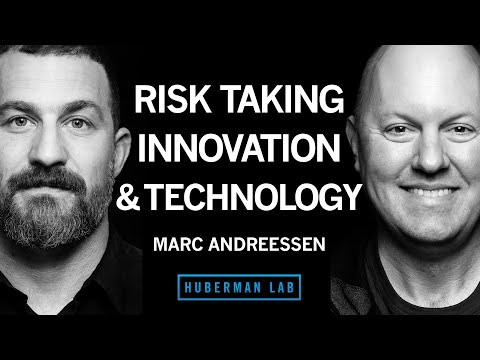
How Risk Taking, Innovation & Artificial Intelligence Transform Human Experience | Marc Andreessen
Andrew Huberman (host), Marc Andreessen (guest), Narrator, Narrator
In this episode of Huberman Lab, featuring Andrew Huberman and Marc Andreessen, How Risk Taking, Innovation & Artificial Intelligence Transform Human Experience | Marc Andreessen explores risk, Rebels, And AI: Marc Andreessen On Rewiring Human Civilization Andrew Huberman and Marc Andreessen dissect what makes rare, world‑changing innovators: specific personality traits, an appetite for pain and risk, and the environments that either unleash or suppress them. Andreessen argues that true innovators are statistical outliers—high in openness, conscientiousness, disagreeableness, intelligence, and relatively low in neuroticism—and that most large institutions are structurally incapable of nurturing them.
Risk, Rebels, And AI: Marc Andreessen On Rewiring Human Civilization
Andrew Huberman and Marc Andreessen dissect what makes rare, world‑changing innovators: specific personality traits, an appetite for pain and risk, and the environments that either unleash or suppress them. Andreessen argues that true innovators are statistical outliers—high in openness, conscientiousness, disagreeableness, intelligence, and relatively low in neuroticism—and that most large institutions are structurally incapable of nurturing them.
They explore why small, “wild duck” teams repeatedly outcompete massive bureaucracies, how elite-driven moral panics and cancel culture are throttling innovation, and why attempts to enforce precautionary principles (e.g., around nuclear power) have often backfired catastrophically. Andreessen distinguishes between public sentiment and elite behavior, emphasizing that many ‘grassroots’ outrage campaigns are in fact orchestrated by organized activist and media complexes.
A substantial portion of the discussion focuses on artificial intelligence: its history, current capabilities (vision, language, medical empathy), and its likely future as a personal coach, therapist, and cognitive partner. Andreessen contends that AI, like nuclear power and CRISPR, is a general‑purpose technology that will dramatically improve human life—provided we resist fear‑based overregulation and instead use AI as a defense and amplifier of human capability.
Throughout, the conversation returns to individual agency: innovators must accept contact-sport levels of conflict and social discomfort, while society must decide whether to cling to decaying institutions or allow new, more effective systems—from universities to energy to information platforms—to emerge.
Key Takeaways
Exceptional Innovators Are Extreme Personality Outliers
Andreessen maps breakthrough innovators onto the Big Five traits: very high openness (broad curiosity and tolerance for new ideas), very high conscientiousness (willingness to grind for years), high disagreeableness (resistance to social pressure and willingness to withstand ostracism), high intelligence (fast synthesis under complexity), and relatively low neuroticism (ability to endure chronic stress). ...
Get the full analysis with uListen AI
Disagreeableness And Social Pain Tolerance Are Non‑Negotiable
New ideas are reflexively met with ‘that’s dumb’ by most people. ...
Get the full analysis with uListen AI
Environment Matters: Clusters Help, But Herds Are Dangerous
Innovation clusters (Silicon Valley, Hollywood, Florence, Athens) provide crucial psychological and practical support: you’re surrounded by others attempting non‑standard things, which normalizes the struggle and raises your ambition ceiling. ...
Get the full analysis with uListen AI
Elite Moral Panics And The Precautionary Principle Throttle Progress
Andreessen argues that many contemporary panics (around AI, nuclear energy, social media) are driven not by the public but by elites and institutions defending status and control. ...
Get the full analysis with uListen AI
AI Is A General‑Purpose Cognitive Partner, Not An Inevitable Overlord
Modern AI is built on neural networks that approximate some brain‑like functions, particularly in pattern recognition (vision, speech, text). ...
Get the full analysis with uListen AI
Personal AI Assistants Will Transform Health, Therapy, And Daily Decisions
Andreessen expects everyone to have one or more always‑on AI companions—coach, therapist, tutor, assistant—that know their history, preferences, physiology, and weaknesses. ...
Get the full analysis with uListen AI
Small ‘Wild Duck’ Teams Are The Real Engines Of Change
Large institutions accumulate combinatorial communication overhead, internal status wars, and risk aversion. ...
Get the full analysis with uListen AI
Notable Quotes
“Being an entrepreneur or being a creator is like getting punched in the face over and over again. Eventually, you start to like the taste of your own blood.”
— Marc Andreessen (quoting Sean Parker)
“The reason you have the Picassos and the Beethovens and all these people is because they're willing to take these extreme levels of risk… I call them martyrs to civilizational progress.”
— Marc Andreessen
“The people who are like great at running the big companies, they don't have to be mob bosses. They can work inside the system. They don't need to take the easy out.”
— Marc Andreessen
“The one thing you know as an innovator is that at the end of the day, the truth actually matters. If it's real, it's real.”
— Marc Andreessen
“Our world has been shaped by computers built as calculating machines, not as brains. AI is finally the other path starting to work.”
— Marc Andreessen
Questions Answered in This Episode
You describe certain innovators as ‘martyrs to civilizational progress’ whose self‑destruction is tied to their risk profile. How should investors, boards, or even friends ethically decide when to support versus restrain someone who is clearly flying too close to the sun?
Andrew Huberman and Marc Andreessen dissect what makes rare, world‑changing innovators: specific personality traits, an appetite for pain and risk, and the environments that either unleash or suppress them. ...
Get the full analysis with uListen AI
If we accept your view that accreditation bodies form a cartel blocking new universities, what concrete legal or policy mechanisms would you implement first to crack that system open without collapsing higher education funding overnight?
They explore why small, “wild duck” teams repeatedly outcompete massive bureaucracies, how elite-driven moral panics and cancel culture are throttling innovation, and why attempts to enforce precautionary principles (e. ...
Get the full analysis with uListen AI
You argue strongly that AI ‘waking up’ and killing us is science fiction, yet you also advocate for AI‑driven bio‑defense and cybersecurity. What would a realistic, worst‑case AI misuse scenario look like to you, and how would you design a defensive architecture around it?
A substantial portion of the discussion focuses on artificial intelligence: its history, current capabilities (vision, language, medical empathy), and its likely future as a personal coach, therapist, and cognitive partner. ...
Get the full analysis with uListen AI
On nuclear power, you contend that anti‑nuclear environmentalism has been catastrophic for carbon emissions. What specific narrative, branding, or institutional steps would you take if you were tasked with making nuclear politically acceptable in the U.S. within a decade?
Throughout, the conversation returns to individual agency: innovators must accept contact-sport levels of conflict and social discomfort, while society must decide whether to cling to decaying institutions or allow new, more effective systems—from universities to energy to information platforms—to emerge.
Get the full analysis with uListen AI
You’ve said that small ‘wild duck’ teams are the true engines of innovation, yet most ambitious young people still aim for elite institutional careers. If you were advising a 20‑year‑old today who wants to maximize positive impact, what concrete path would you urge them to take in the next 5–10 years—and what would you tell them to explicitly avoid?
Get the full analysis with uListen AI
Transcript Preview
(music plays) Welcome to the Huberman Lab Podcast, where we discuss science and science-based tools for everyday life. I'm Andrew Huberman, and I'm a professor of neurobiology and ophthalmology at Stanford School of Medicine. Today my guest is Marc Andreessen. Marc Andreessen is a software engineer and an investor in technology companies. He co-founded and developed Mosaic, which was one of the first widely used web browsers. He also co-founded and developed Netscape, which was one of the earliest widespread used web browsers. And he co-founded and is a general partner at Andreessen Horowitz, one of the most successful Silicon Valley venture capital firms. All of that is to say that Marc Andreessen is one of the most successful innovators and investors ever. I was extremely excited to record this episode with Marc for several reasons. First of all, he himself is an incredible innovator. Second of all, he has an uncanny ability to spot the innovators of the future. And third, Marc has shown over and over again the ability to understand how technologies not yet even developed are going to impact the way that humans interact at large. Our conversation starts off by discussing what makes for an exceptional innovator as well as what sorts of environmental conditions make for exceptional innovation and creativity more generally. In that context, we talk about risk-taking, not just in terms of risk-taking in one's profession, but about how some people, not all, but how some people who are risk-takers and innovators in the context of their work also seem to take a lot of risks in their personal life and some of the consequences that can bring. Then we discuss some of the most transformative technologies that are now emerging such as novel approaches to developing clean energy as well as AI or artificial intelligence. With respect to AI, Marc shares his views as to why AI is likely to greatly improve human experience, and we discuss the multiple roles that AI is very likely to have in all of our lives in the near future. Marc explains how, not too long from now, all of us are very likely to have AI assistants, for instance, assistants that give us highly informed health advice, highly informed psychological advice. Indeed, it is very likely that all of us will soon have AI assistants that govern most if not all of our daily decisions. And Marc explains how, if done correctly, this can be a tremendously positive addition to our life. In doing so, Marc provides a stark counter-argument for those that argue that AI is going to diminish human experience. So if you're hearing about and/or concerned about the ways that AI is likely to destroy us, today you are going to hear about the many different ways that AI technologies now in development are likely to enhance our human experience at every level. What you'll soon find is that while today's discussion does center around technology and technology development, it is really a discussion about human beings and human psychology. So whether you have an interest in technology development and/or AI, I'm certain that you'll find today's discussion to be an important and highly lucid view into what will soon be the future that we all live in. Before we begin, I'd like to emphasize that this podcast is separate from my teaching and research roles at Stanford. It is, however, part of my desire and effort to bring zero-cost-to-consumer information about science and science-related tools to the general public. In keeping with that theme, I'd like to thank the sponsors of today's podcast. Our first sponsor is LMNT. LMNT is an electrolyte drink that has everything you need and nothing you don't. That means plenty of the electrolytes sodium, magnesium, and potassium in the correct ratios, but no sugar. The electrolytes and hydration are absolutely key for mental health, physical health, and performance. Even a slight degree of dehydration can impair our ability to think, our energy levels, and our physical performance. LMNT makes it very easy to achieve proper hydration, and it does so by including the three electrolytes in the exact ratios they need to be present. I drink LMNT first thing in the morning when I wake up. I usually mix it with about 16 to 32 ounces of water. If I'm exercising, I'll drink one while I'm exercising, and I tend to drink one after exercising as well. Now many people are scared off by the idea of ingesting sodium because obviously we don't want to consume sodium in excess. However, for people that have normal blood pressure, and especially for people that are consuming very clean diets, that is, consuming not so many processed foods or highly processed foods, oftentimes we are not getting enough sodium, magnesium, and potassium, and we can suffer as a consequence. And with LMNT, simply by mixing in water, it tastes delicious, it's very easy to get that proper hydration. If you'd like to try LMNT, you can go to DrinkLMNT, that's L-M-N-T, .com/huberman to claim a free LMNT sample pack with your purchase. Again, that's Drink LMNT, L-M-N-T,.com/huberman. Today's episode is also brought to us by Eight Sleep. Eight Sleep makes smart mattress covers with cooling, heating, and sleep tracking capacity. I've spoken many times before on this podcast about the fact that sleep, that is getting a great night's sleep, is the foundation of all mental health, physical health, and performance. When we're sleeping well, everything goes far better. When we are not sleeping well or enough, everything gets far worse at the level of mental health, physical health, and performance. And one of the key things to getting a great night's sleep and waking up feeling refreshed is that you have to control the temperature of your sleeping environment, and that's because in order to fall and stay deeply asleep, you need your core body temperature to drop by about one to three degrees, and in order to wake up feeling refreshed and energized, you want your core body temperature to increase by about one to three degrees. With Eight Sleep, it's very easy to induce that drop in core body temperature by cooling your mattress early and throughout the night and warming your mattress toward morning. I started sleeping on an Eight Sleep mattress cover a few years ago, and it has completely transformed the quality of the sleep that I get, so much so that I actually loathe traveling because I don't have my Eight Sleep mattress cover when I travel. If you'd like to try Eight Sleep, you can go to eightsleep.com/huberman, and you'll save up to $150 off their Pod 3 cover. Eight Sleep currently ships in the USA, Canada, UK, select countries in the EU, and Australia. Again, that's eightsleep.com/huberman. And now for my discussion with Marc Andreessen.Mark, welcome.
Install uListen to search the full transcript and get AI-powered insights
Get Full TranscriptGet more from every podcast
AI summaries, searchable transcripts, and fact-checking. Free forever.
Add to Chrome