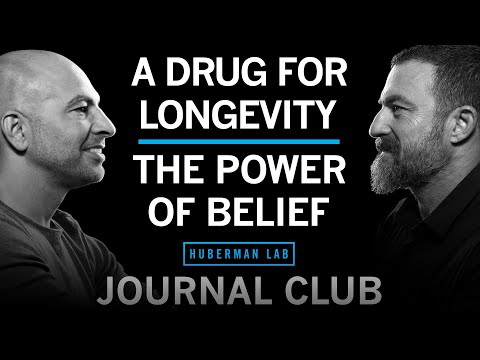
Journal Club with Dr. Peter Attia | Metformin for Longevity & The Power of Belief Effects
Andrew Huberman (host), Peter Attia (guest), Guest (unidentified, brief interjection) (guest)
In this episode of Huberman Lab, featuring Andrew Huberman and Peter Attia, Journal Club with Dr. Peter Attia | Metformin for Longevity & The Power of Belief Effects explores metformin Myths, Nicotine Beliefs: Attia & Huberman Redefine Longevity Science Andrew Huberman and Peter Attia host a live ‘journal club’ to dissect two papers: a large epidemiological reassessment of metformin and a human neuroimaging study on belief‑driven nicotine effects.
Metformin Myths, Nicotine Beliefs: Attia & Huberman Redefine Longevity Science
Andrew Huberman and Peter Attia host a live ‘journal club’ to dissect two papers: a large epidemiological reassessment of metformin and a human neuroimaging study on belief‑driven nicotine effects.
Attia walks through how the new Danish registry data challenge a famous 2014 study that suggested metformin users with type 2 diabetes outlive non‑diabetics, underscoring the limits of observational epidemiology and his own reasons for stopping metformin.
Huberman presents a placebo/belief paper showing that smokers’ brains respond in a dose‑dependent way to how much nicotine they think they vaped, despite all receiving the same low dose, revealing that expectations can scale neural and behavioral drug effects.
Across both discussions they model how to read scientific papers, think statistically, and separate mechanistic plausibility, biomarkers, and hype from data that meaningfully inform health and longevity decisions.
Key Takeaways
The best current epidemiology does *not* support metformin as a longevity drug in healthy, non‑diabetic people.
The 2014 Bannister study found that type 2 diabetics on metformin had a ~15% lower all‑cause mortality than matched non‑diabetics. ...
Get the full analysis with uListen AI
Epidemiologic studies can look very convincing but are inherently limited by confounding and model choices.
Attia walks through Table 1 of the Keys paper to show how, even after matching age, sex, BMI, etc. ...
Get the full analysis with uListen AI
Lifestyle interventions remain the foundation for glucose control and longevity; drugs are adjuncts, not substitutes.
Attia emphasizes that the primary causes of insulin resistance and type 2 diabetes are energy imbalance, low physical activity, excess ectopic fat (fat in muscle, liver, pancreas), poor sleep, and chronic stress/hypercortisolemia. ...
Get the full analysis with uListen AI
Metformin has meaningful mechanistic downsides for performance and possibly hypertrophy, which matter in cost–benefit decisions.
Metformin weakly inhibits mitochondrial complex I, shifting fuel partitioning and raising basal lactate. ...
Get the full analysis with uListen AI
Beliefs about drug dose can scale real brain responses in a dose‑dependent manner, not just subjective feelings.
In the Gu et al. ...
Get the full analysis with uListen AI
Placebo, nocebo, and belief effects can meaningfully alter physiology, behavior, and treatment outcomes.
Huberman connects the nicotine paper to Alia Crum’s work: stress‑is‑bad vs stress‑is‑helpful brief videos change performance by ~10–30%; labeling identical milkshakes as ‘indulgent’ vs ‘diet’ changes ghrelin suppression and satiety; hotel workers told their activity “counts as exercise” lose more weight than controls without moving more. ...
Get the full analysis with uListen AI
Learning to read papers critically—beyond abstracts—changes how you view health claims and media headlines.
Both hosts repeatedly model a paper‑reading workflow: identify the main question, the method/approach, what was actually found (figures, tables, statistics), and then ask whether the conclusions logically follow. ...
Get the full analysis with uListen AI
Notable Quotes
“The Keys paper makes it undeniably clear that in that population, there was no advantage offered by metformin that undid the disadvantage of having type 2 diabetes.”
— Peter Attia
“We have to walk around with an appropriate degree of humility about what we know and what we don’t know.”
— Peter Attia
“What we are told about the dose of a drug changes the way that our physiology responds to the dose of the drug.”
— Andrew Huberman
“Your brain is a prediction‑making machine, and one of the most important pieces of data it uses is your beliefs about what things do to you.”
— Andrew Huberman
“Without good biomarkers of aging, we’re basically flying blind on most geroprotective interventions.”
— Peter Attia
Questions Answered in This Episode
Given the Keys et al. findings, under what specific clinical scenarios would you still consider metformin for a non‑diabetic, and how would you monitor for potential performance or mitochondrial side effects?
Andrew Huberman and Peter Attia host a live ‘journal club’ to dissect two papers: a large epidemiological reassessment of metformin and a human neuroimaging study on belief‑driven nicotine effects.
Get the full analysis with uListen AI
If the TAME trial ultimately shows a modest geroprotective effect of metformin in non‑diabetics, how should we weigh that against the evidence that it may blunt exercise adaptations and elevate resting lactate?
Attia walks through how the new Danish registry data challenge a famous 2014 study that suggested metformin users with type 2 diabetes outlive non‑diabetics, underscoring the limits of observational epidemiology and his own reasons for stopping metformin.
Get the full analysis with uListen AI
In the nicotine belief study, how might including a true zero‑nicotine condition (with ‘high‑dose’ instructions) change your interpretation of the thalamus–prefrontal dose–response effect?
Huberman presents a placebo/belief paper showing that smokers’ brains respond in a dose‑dependent way to how much nicotine they think they vaped, despite all receiving the same low dose, revealing that expectations can scale neural and behavioral drug effects.
Get the full analysis with uListen AI
Could the kind of belief‑driven circuit modulation seen with nicotine be deliberately harnessed in ADHD treatment—for example, to taper kids to lower stimulant doses while maintaining focus—and how would you design that trial safely?
Across both discussions they model how to read scientific papers, think statistically, and separate mechanistic plausibility, biomarkers, and hype from data that meaningfully inform health and longevity decisions.
Get the full analysis with uListen AI
Given the large role of expectations and framing in stress responses, drug side effects, and even weight loss, how should clinicians ethically communicate risks and benefits so as to leverage beneficial belief effects without misleading patients?
Get the full analysis with uListen AI
Transcript Preview
(mellow music) Welcome to the Huberman Lab Podcast, where we discuss science and science-based tools for everyday life. I'm Andrew Huberman, and I'm a professor of neurobiology and ophthalmology at Stanford School of Medicine. Today marks the first journal club episode between myself and Dr. Peter Attia. For any of you that are not familiar with Dr. Peter Attia, he is a medical doctor, an MD, who is an expert in all aspects of health and lifespan. He is the author of a best-selling book entitled Outlive, which is a phenomenal resource on all things healthspan and lifespan. And he is the host of the very popular podcast, The Drive, where he interviews various experts in all domains of medicine, and scientists as well. Today, Peter and I hold our first online collaborative journal club. For those of you that aren't familiar with what a journal club is, a journal club is a common practice in graduate school and/or medical school, whereby students get together to discuss one or two papers, to critique those papers, and to really compare their own conclusions of those papers with the conclusions of the authors and to highlight any key takeaways. Peter and I have been wanting to do a journal club together for a very long time, and we decided to do that journal club and to record it for you. So today, you will be sitting in on the first Huberman-Attia Journal Club. By the way, it could just have easily been called the Attia-Huberman Journal Club. And we will discuss two papers. First, Peter is going to discuss a paper on metformin, which is a drug that many people are interested in for its potential role in longevity. I want to highlight potential there. He's going to compare that paper to previous findings on metformin, and by the end of that discussion, he will advise as to whether or not he himself would take metformin and whether or not other people might be well-advised or ill-advised to take metformin based on the data in that paper and at this time. Then I present a paper which is about the placebo effect. Uh, I have to imagine that most of you have heard of the placebo effect, but what's interesting about the paper that we discuss today is that it shows that the placebo effect can actually follow a dose response. So it's not just all or none. It actually is the case that you can scale the degree of placebo effect depending on whether or not you're thinking you're taking low doses, moderate doses, or high doses of a particular drug. And the particular drug that's discussed in the paper that I cover is nicotine. So for those of you that are interested in cognitive enhancement by way of pharmacology, or frankly, for people who are simply interested in how our beliefs can shape our physiology, I think you'll find that discussion to be very interesting. So by the end of today's episode, you will not only have learned about two novel sets of findings, one in the realm of longevity as it relates to metformin, and another in the realm of neurobiology and placebos or placebo effects, but you will also learn how a journal club is conducted. I think you'll see in observing how we parse these papers and discuss them, even arguing in them at times, that what scientists and clinicians do is they take a look at the existing peer-reviewed research, and they look at that peer-reviewed research with a fresh eye, asking, "Does this paper really show what it claims to show or not?" And in some cases, the answer is yes, and in other cases, the answer is no. What I know is for certain is that by the end of today's episode, you will learn a lot of science, you'll learn a lot about health practices, some of which you may want to apply or avoid, and you'll learn a lot about how science and medicine is carried out. Before we begin, I'd like to emphasize that this podcast is separate from my teaching and research roles at Stanford. It is, however, part of my desire and effort to bring zero-cost-to-consumer information about science and science-related tools to the general public. In keeping with that theme, I'd like to thank the sponsors of today's podcast. Our first sponsor is Helix Sleep. Helix Sleep makes customized mattresses to give you the best possible night's sleep. Now, sleep is the foundation of mental health, physical health, and performance. When we are sleeping well and enough, mental health, physical health, and performance all stand to be at their best. One of the key things to getting a great night's sleep is to make sure that your mattress is tailored to your unique sleep needs. Helix Sleep has a brief two-minute quiz that if you go to their website, you take that quiz and answer questions such as, do you tend to sleep on your back, your side, or your stomach? Do you tend to r-run hot or cold in the middle of the night? Maybe you don't know the answers to those questions, and that's fine. At the end of that two-minute quiz, they will match you to a mattress that's ideal for your sleep needs. I sleep on the Dusk, D-U-S-K, mattress, and when I started sleeping on a Dusk mattress about two years ago, my sleep immediately improved. So if you're interested in upgrading your mattress, go to helixsleep.com/huberman, take their two-minute sleep quiz, and they'll match you to a customized mattress for you. And you'll get up to $350 off any mattress order and two free pillows. Again, if interested, go to helixsleep.com/huberman for up to $350 off and two free pillows. Today's episode is also brought to us by Levels. Levels is a program that lets you see how different foods and behaviors affect your health by giving you real-time feedback using a continuous glucose monitor. One of the most important factors impacting your immediate and long-term health is the way that your body manages its blood glucose or sometimes referred to as blood sugar levels. To maintain energy and focus throughout the day, you want to keep your blood glucose steady without big spikes or dips. Using Levels, you can monitor how different types of foods and different food combinations, as well as food timing and things like exercise, combine to impact your blood glucose levels. I started using Levels a little over a year ago, and it gave me a lot of insight into how specific foods were spiking my blood sugar and then leaving me feeling tired for several hours afterwards, as well as how the spacing of exercise and my meals was impacting my overall energy. And in doing so, it really allowed me to optimize how I eat, what I eat, when I exercise, and so on, such that my blood glucose levels and energy levels are stable throughout the day. If you're interested in learning more about Levels and trying a continuous glucose monitor yourself, go to levels.link/huberman. Right now, Levels is offering an additional two free months of membership. Again, that's levels.link, L-I-N-K, /huberman to get two free months of membership.And now for my journal club discussion with Dr. Peter Attia. Peter, so good to have you here.
Install uListen to search the full transcript and get AI-powered insights
Get Full TranscriptGet more from every podcast
AI summaries, searchable transcripts, and fact-checking. Free forever.
Add to Chrome