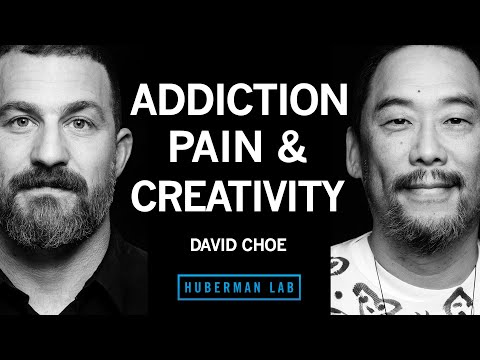
Transform Pain & Trauma Into Creative Expression | David Choe
David Choe (guest), Andrew Huberman (host), David Choe (guest), David Choe (guest), Andrew Huberman (host)
In this episode of Huberman Lab, featuring David Choe and Andrew Huberman, Transform Pain & Trauma Into Creative Expression | David Choe explores david Choe on addiction, shame, and turning trauma into art David Choe joins Andrew Huberman for an intensely raw conversation about addiction, shame, creativity, and survival. He describes a life shaped by childhood abuse, abandonment, and self-hatred, and how those forces drove him into graffiti, crime, compulsive work, and severe gambling addiction. Through stories of hustling his way into art, pornography illustration, Facebook’s early murals, and collaborations with figures like Anthony Bourdain and Pee-wee Herman, he shows how delusion, pain, and blind faith powered both his success and self-destruction. Now in long-term recovery, Choe talks about learning to sit still, accept himself, and reorient his creativity toward connection, healing, and helping others.
David Choe on addiction, shame, and turning trauma into art
David Choe joins Andrew Huberman for an intensely raw conversation about addiction, shame, creativity, and survival. He describes a life shaped by childhood abuse, abandonment, and self-hatred, and how those forces drove him into graffiti, crime, compulsive work, and severe gambling addiction. Through stories of hustling his way into art, pornography illustration, Facebook’s early murals, and collaborations with figures like Anthony Bourdain and Pee-wee Herman, he shows how delusion, pain, and blind faith powered both his success and self-destruction. Now in long-term recovery, Choe talks about learning to sit still, accept himself, and reorient his creativity toward connection, healing, and helping others.
Key Takeaways
Every addiction is a form of gambling with yourself.
Choe argues that whether it’s drugs, overeating, sex, work, or literal casinos, addiction is fundamentally a wager against your own well-being—chasing a high while risking catastrophic loss, including your life and relationships.
Get the full analysis with uListen AI
Shame can become its own drug if left unchecked.
He describes becoming a “shame chaser,” deliberately courting rejection, humiliation, and cancellation because the emotional crash felt as intense and addictive as winning money or acclaim, leading to repeated self-sabotage.
Get the full analysis with uListen AI
Delusional self-belief can both save and destroy you.
Raised by a mother who blindly insisted he was the greatest artist alive, Choe weaponized that belief to outwork and out-risk others—but that same grandiosity fed narcissism, denial, and dangerous decisions until recovery forced him to re-balance it.
Get the full analysis with uListen AI
True creativity demands emotional nakedness, not just technical skill.
He differentiates between craft (learning to paint or draw well) and art (ripping your heart out and showing it), arguing that the most powerful work comes from vulnerability—tolerating exposure, criticism, and the pain of being truly seen.
Get the full analysis with uListen AI
Workaholism is the most socially rewarded but insidious addiction.
Choe notes that nonstop productivity—bands, murals, news segments, podcasts—looked virtuous from the outside but was simply another way to avoid being alone with himself, eventually leading to physical collapse and emotional bottom.
Get the full analysis with uListen AI
Recovery requires surrender, boundaries, and learning to do less.
He describes banning himself from casinos, blocking his own internet access, entering rehab, therapy, and 12-step programs, and deliberately taking space from media and output so he could finally prioritize his mental and spiritual health.
Get the full analysis with uListen AI
Hope and connection are practical antidotes to suicidal thinking.
Instead of glamorizing the “live fast, die young” narrative, Choe emphasizes asking for help, telling people you love them now, building daily affirmations (“I am enough”), and accepting that a quieter, more ‘mediocre’ life can be deeply meaningful.
Get the full analysis with uListen AI
Notable Quotes
“Every single addiction is gambling addiction. If you drink and drive, you're gambling.”
— David Choe
“People say, ‘What are you running from, Dave?’ I'm like, ‘I'm fucking running from myself, dude. I don't wanna look in the mirror.’”
— David Choe
“You’re never gonna out-think a feeling. You’re never gonna out-smart a feeling.”
— David Choe
“I’m a severe gambling addict… winning a million dollars feels great. Losing ten million feels even better.”
— David Choe
“I don’t wanna just survive, I wanna thrive.”
— David Choe
Questions Answered in This Episode
How can someone tell the difference between healthy ambition and workaholism when both are praised by society?
David Choe joins Andrew Huberman for an intensely raw conversation about addiction, shame, creativity, and survival. ...
Get the full analysis with uListen AI
In practical terms, how do you start using shame and trauma as creative fuel without retraumatizing yourself or others?
Get the full analysis with uListen AI
What safeguards or structures are most effective for someone trying to manage a process addiction like gambling or overwork?
Get the full analysis with uListen AI
How should artists and public figures think about ‘cancellation’—both in terms of accountability and not collapsing into self-destruction?
Get the full analysis with uListen AI
What does a truly ‘enough’ life look like for someone who has built their identity around being exceptional and extreme?
Get the full analysis with uListen AI
Transcript Preview
I'm a severe gambling addict. Every single addiction is gambling addiction. If you drink and drive, you're gambling. Addiction is one of those things you can't apply logic to. People, "What are you running from, Dave?" I'm like, "Well, I'm fucking running from myself, dude. I don't wanna look in the mirror. I don't wanna see myself. I, I hate myself." So I'm just running, so as long as I'm, like, doing graffiti, running from the police, fa- la-la-la-la, you know, just, just, just hopping on a train, like, like, literal running, like literally running to make sure I'm never s- sit still for one second, like, "What are you doing, Dave," "I'm playing drums in a band, I'm fucking, you know, uh, at a casino, I'm traveling doing the noose revise, I'm painting at this..." Like, I, I can't lo- I can't sit still 'cause that means I have to sit with myself and I, I can't do that. I can't do that. (clears throat) I couldn't do that. I couldn't do that. I can now.
(instrumental music) Welcome to the Huberman Lab Podcast, where we discuss science and science-based tools for everyday life. I'm Andrew Huberman and I'm a professor of neurobiology and ophthalmology at Stanford School of Medicine. My guest today is David Cho. David Cho is an artist. He's a highly accomplished painter, graffiti and street artist, writer, podcaster, and television host. Many of you are perhaps familiar with David as the guy who famously painted the original Facebook offices, took equity for the job, and got rich. Now, that's a wild story, but David's whole life journey, what he did prior to and after that and what he has overcome along the way is a million times wilder. As he shares today, David grew up hearing and thinking that he was destined for greatness, but also hearing and thinking that he was a total disgrace. Today he talks with complete openness and vulnerability about addiction, about cycles of success and failure, and about channeling and overcoming deep shame. Today's podcast is unlike any other that I've hosted. David is wide open about his childhood abuse, his massive success then career setbacks, relapses, and transmuting every possible emotion into art along the way. So no matter who you are, David's story, and just as importantly how he's living right now, how he shows up on this podcast, will change what you think is possible for you in life. It will force you to look inward and to use whatever joy and pain you have inside of you to be the best human being you can possibly be. David Cho is, as we say in science, an n of one, meaning there is no other like him, yes because of his incredible art, but also for his willingness to share so openly and honestly so that others can benefit and grow. I consider it a true honor and privilege to host David on this podcast, and frankly, it's impossible not to love him. This one is incredibly raw and honest. It's also full of surprises, many of which are fun surprises. So buckle up. Before we begin, I'd like to emphasize that this podcast is separate from my teaching and research roles at Stanford. It is, however, part of my desire and effort to bring zero cost to consumer information about science and science-related tools to the general public. In keeping with that theme, today's episode does include sponsors. And now for my discussion with David Cho. David Cho-
Install uListen to search the full transcript and get AI-powered insights
Get Full TranscriptGet more from every podcast
AI summaries, searchable transcripts, and fact-checking. Free forever.
Add to Chrome