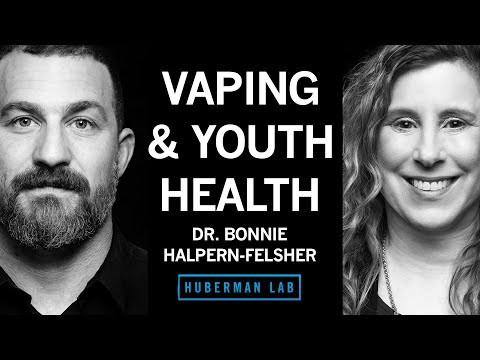
Vaping, Alcohol Use & Other Risky Youth Behaviors | Dr. Bonnie Halpern-Felsher
Andrew Huberman (host), Bonnie Halpern-Felsher (guest), Narrator
In this episode of Huberman Lab, featuring Andrew Huberman and Bonnie Halpern-Felsher, Vaping, Alcohol Use & Other Risky Youth Behaviors | Dr. Bonnie Halpern-Felsher explores teens, Vapes, and Fentanyl: Inside Today’s Hidden Youth Risk Crisis Andrew Huberman and developmental psychologist Dr. Bonni Halpern‑Felsher explore modern adolescent risk behaviors, with a major focus on nicotine vaping, cannabis use, and their interaction with social media and marketing. They explain how adolescent brain development, stress, and peer dynamics interact with predatory product design—flavors, device shapes, and social media campaigns—to drive early initiation and addiction, now seen even in elementary school. The conversation details concrete health risks to brain, heart, and lungs, including high-dose nicotine exposure, vaping-related lung injury, and cannabis-associated psychosis in predisposed youth. They close with practical strategies for parents, educators, and teens: shifting from “Just Say No” to honest, comprehensive education, harm reduction, and ongoing, nonjudgmental conversations that leverage teens’ strengths, values, and long-term goals.
Teens, Vapes, and Fentanyl: Inside Today’s Hidden Youth Risk Crisis
Andrew Huberman and developmental psychologist Dr. Bonni Halpern‑Felsher explore modern adolescent risk behaviors, with a major focus on nicotine vaping, cannabis use, and their interaction with social media and marketing. They explain how adolescent brain development, stress, and peer dynamics interact with predatory product design—flavors, device shapes, and social media campaigns—to drive early initiation and addiction, now seen even in elementary school. The conversation details concrete health risks to brain, heart, and lungs, including high-dose nicotine exposure, vaping-related lung injury, and cannabis-associated psychosis in predisposed youth. They close with practical strategies for parents, educators, and teens: shifting from “Just Say No” to honest, comprehensive education, harm reduction, and ongoing, nonjudgmental conversations that leverage teens’ strengths, values, and long-term goals.
Key Takeaways
Youth nicotine exposure is far higher and earlier than most adults realize
Traditional cigarette smoking among teens is under 5–10%, but e‑cigarette use has surged. ...
Get the full analysis with uListen AI
E‑cigarettes are engineered and marketed to hook children, not just adult smokers
Product design and marketing are clearly youth‑targeted: devices disguised as highlighters, juice boxes, and USB sticks; flavors named Unicorn Poop, Sugar Booger, and boba drinks; colorful cartoon-style ads; and devices that function as actual school supplies (e. ...
Get the full analysis with uListen AI
Nicotine and cannabis fundamentally alter the developing adolescent brain
Brain development continues into the mid‑20s. ...
Get the full analysis with uListen AI
Vaping is not a “safe” alternative: it carries serious lung, heart, and systemic risks
While e‑cigs lack tar, they deliver aldehydes (including formaldehyde-like compounds), heavy metals (lead, cadmium), propylene glycol, glycerin, and inhaled flavor chemicals like cinnamon aldehyde and diacetyl (the “buttery” flavor). ...
Get the full analysis with uListen AI
Harm reduction and honest, nuanced messaging work better than “Just Say No”
Fear-based, future-only messages (“you’ll get cancer at 60”) and abstinence-only slogans (e. ...
Get the full analysis with uListen AI
Quitting is possible but difficult; teens need multi-layered support, not punishment
Many teens are addicted and want to stop but lack tools. ...
Get the full analysis with uListen AI
Conversation, not confrontation, is the cornerstone of effective prevention
Teens already know about drugs, sex, and social media; silence only leaves them with misinformation from peers and the internet. ...
Get the full analysis with uListen AI
Notable Quotes
“We’re seeing elementary school teachers calling us for help. They are catching second and third graders using nicotine e‑cigarettes.”
— Dr. Bonni Halpern‑Felsher
“Teens are going from ‘I like it’ to ‘I need it’ very rapidly.”
— Dr. Bonni Halpern‑Felsher
“If we only come from a risk model and a Just Say No model, that never works for teens.”
— Dr. Bonni Halpern‑Felsher
“Having teens learn about sex from porn is like having them learn physics from Transformers, or learn to drive from Fast and Furious.”
— Dr. Bonni Halpern‑Felsher
“Teens are fundamentally fantastic—creative, passionate, and they care more about social justice and the environment than most adults.”
— Dr. Bonni Halpern‑Felsher
Questions Answered in This Episode
You mentioned that many schools report 40–60% of students vaping despite CDC estimates under 10%. What specific methodological changes would you make to national surveys to better capture real-world youth use?
Andrew Huberman and developmental psychologist Dr. ...
Get the full analysis with uListen AI
For a teen who is already heavily addicted to salt-nicotine vapes (e.g., a pod a day), what would an ideal, step-by-step 12‑week tapering and support plan actually look like in practice—doses, behavioral tools, and social strategies?
Get the full analysis with uListen AI
Given the emerging evidence that high‑THC cannabis can trigger psychosis in predisposed youth, should there be legal THC potency caps or warning labels specific to under‑25s, and how would you design those policies to be both effective and enforceable?
Get the full analysis with uListen AI
You advocated for Narcan and even fentanyl test strips in schools, despite the risk of appearing to “green-light” drug use. Where do you personally draw the line on harm reduction—for example, are there interventions you would *not* support because you feel they cross into enabling?
Get the full analysis with uListen AI
Some teens are now organizing phone‑free hangouts and anti‑vape peer movements. If you had resources to seed a national youth-led campaign, how would you structure it so that the message of not using—or quitting—actually boosts teens’ social status rather than marginalizes them?
Get the full analysis with uListen AI
Transcript Preview
Welcome to the Huberman Lab podcast, where we discuss science and science-based tools for everyday life. I'm Andrew Huberman, and I'm a professor of neurobiology and ophthalmology at Stanford School of Medicine. My guest today is Dr. Bonnie Halpern-Felsher. Dr. Bonnie Halpern-Felsher is a professor of pediatrics and adolescent medicine at Stanford University School of Medicine. A developmental psychologist by training, Dr. Halpern-Felsher is a world expert in the risk behaviors that adolescents, teens, and young adults participate in. Today, we discuss nicotine use, both by way of smoking as well as vaping and e-cigarette use. We also discuss cannabis and some of the correlative as well as possibly causal data linking cannabis use to psychosis in young adults. And we discuss some of the other common risky behaviors that adolescents, teens, and young adults participate in, including risky driving behavior, alcohol consumption, and risky sexual behavior. We discuss the various factors that impact whether or not a young person will participate in risky behaviors, including the family and home, as well as peer group and social media. And as we discuss social media, we get into a deep discussion about how marketing is combining with peer pressure in order to drive youth toward particular risky behaviors. By the end of today's conversation, you will have learned from Dr. Halpern-Felsher the latest research on risk-taking behavior in adolescents, teens, and young adults and what we can each and all do to ensure that they either avoid these behaviors or, if they are already engaging in these behaviors, that we can mitigate some of the potential harms and potentially get them to eliminate these behaviors toward having a life of enhanced mental and physical health. Before we begin, I'd like to emphasize that this podcast is separate from my teaching and research roles at Stanford. It is, however, part of my desire and effort to bring zero-cost-to-consumer information about science and science-related tools to the general public. In keeping with that theme, I'd like to thank the sponsors of today's podcast. Our first sponsor is Eight Sleep. Eight Sleep makes smart mattress covers with cooling, heating, and sleep tracking capacity. Now, I've spoken many times before on this podcast about the critical need to get sleep, both enough sleep and enough quality sleep. When we do that, everything, our mental health, our physical health, performance in any sports or school, et cetera, all get better. And when we're not sleeping well or enough, all those things suffer. One of the key things to getting a great night's sleep is that your body temperature actually has to drop by about one to three degrees in order to fall and stay deeply asleep, and in order to wake up feeling refreshed, your body temperature actually has to increase by about one to three degrees. One of the best ways to ensure that happens is to control the temperature of your sleeping environment, and with Eight Sleep, it makes it very easy to do that. You program in the temperature that you want at the beginning, middle, and end of the night. You can even divide the temperature for two different people w- if you have two different people sleeping in the bed, and it tracks your sleep. It tells you how much slow wave sleep and rapid eye movement sleep you're getting. It really helps you dial in the correct parameters to get the best possible night's sleep for you. I've been sleeping on an Eight Sleep mattress cover for well over three years now, and it has completely transformed my sleep for the better. If you'd like to try Eight Sleep, you can go to EightSleep.com/Huberman and save $150 off their Pod 3 cover. Eight Sleep currently ships in the USA, Canada, UK, select countries in the EU, and Australia. Again, that's EightSleep.com/Huberman. Today's episode is also brought to us by Mateina. Mateina makes loose-leaf and ready-to-drink yerba mate. I often discuss yerba mate's benefits, such as regulating blood sugar, its high antioxidant content, the ways that it can improve digestion, and possible neuroprotective effects. I also drink yerba mate because I love the taste. While there are a lot of different choices of yerba mate drinks out there, I love Mateina because, again, they have the no-sugar variety, as well as the fact that both their loose-leaf and their canned varieties are of the absolute best quality, so much so that I decided to become a partial owner in the company. Although I must say, even if they hadn't allowed me to do that, I would be drinking Mateina. It is the cleanest-tasting and best yerba mate you can find. I love the taste of brewed loose-leaf Mateina yerba mate, and I particularly love the taste of Mateina's new canned cold brew zero-sugar yerba mate, which I personally helped them develop. If you'd like to try Mateina, go to DrinkMateina.com/Huberman. Right now, Mateina is offering a free one-pound bag of loose-leaf yerba mate tea and free shipping with the purchase of two cases of their cold brew yerba mate. Again, that's DrinkMateina.com/Huberman to get the free bag of yerba mate loose-leaf tea and free shipping. Today's episode is also brought to us by LMNT. LMNT is an electrolyte drink that has everything you need and nothing you don't. That means zero sugar and the appropriate ratios of the electrolytes sodium, magnesium, and potassium. And that correct ratio of electrolytes is extremely important because every cell in your body, but especially your nerve cells, your neurons, relies on electrolytes in order to function properly. So when you're well-hydrated and your hydration also includes the appropriate ratios of electrolytes, your mental functioning and your physical functioning is improved. I drink one packet of LMNT dissolved in about 16 to 32 ounces of water when I wake up in the morning, as well as while I exercise, and if I've sweat a lot during that exercise, I often will drink a third LMNT packet dissolved in about 32 ounces of water after I exercise. If you'd like to try LMNT, you can go to Drink LMNT, spelled L-M-N-T, .com/Huberman to try a free sample pack. Again, that's DrinkLMNT.com/Huberman. And now for my discussion with Dr. Bonnie Halpern-Felsher. Dr. Halpern-Felsher, welcome.
Install uListen to search the full transcript and get AI-powered insights
Get Full TranscriptGet more from every podcast
AI summaries, searchable transcripts, and fact-checking. Free forever.
Add to Chrome