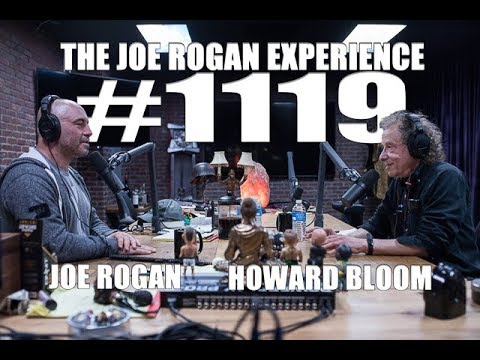
Joe Rogan Experience #1119 - Howard Bloom
Joe Rogan (host), Howard Bloom (guest)
In this episode of The Joe Rogan Experience, featuring Joe Rogan and Howard Bloom, Joe Rogan Experience #1119 - Howard Bloom explores from Bedridden Atheist to Cosmic Theorist: Howard Bloom Unleashed Joe Rogan interviews author and thinker Howard Bloom, who recounts his 15-year battle with severe ME/CFS that left him unable to talk or tolerate human presence, and how he rebuilt his life, work, and personality entirely from bed via the early internet.
From Bedridden Atheist to Cosmic Theorist: Howard Bloom Unleashed
Joe Rogan interviews author and thinker Howard Bloom, who recounts his 15-year battle with severe ME/CFS that left him unable to talk or tolerate human presence, and how he rebuilt his life, work, and personality entirely from bed via the early internet.
Bloom details the experimental drug, supplement, sleep, and lifestyle protocol that pulled him out of illness and now lets him do 400–700 pushups a day in his mid-70s while writing books and working on space projects.
The conversation ranges from ecstatic states, Hitler’s mass psychology, rock stars as secular shamans, global brain and bacterial intelligence, to his heretical views on entropy, quantum physics, extraterrestrials, and climate change as an end-times-style belief system.
Throughout, Bloom frames himself as an “eagle” synthesizing many fields at once, arguing that humans are tools-using, meaning-seeking animals who must own their technological role in shaping both civilization and the planet’s future.
Key Takeaways
Severe chronic illness can force a total reinvention of identity and work.
Bedridden for 15 years with ME/CFS, Bloom lost his ability to talk or be around people and had to rebuild a new ‘self’ online, working horizontally from bed with jury‑rigged computers, ultimately founding scientific groups and writing multiple books.
Get the full analysis with uListen AI
Recovery from complex conditions may depend on individualized, iterative protocols.
With doctors largely at a loss, Bloom self‑experimented with a CFS specialist, ending up on a tailored regimen (oxytocin, magnesium, B12 injections, gabapentin, amitriptyline, strict sleep and walking routines) that worked for him but that he stresses is not a universal cure.
Get the full analysis with uListen AI
Ecstasy and transcendence are powerful social forces that can be used for good or evil.
Bloom argues Hitler deliberately engineered mass ecstasies similar in structure to religious revivals and rock concerts, and that artists and performers tap the same circuitry—his job in music PR was to find the ‘soul that dances you’ and make it accessible on and off stage.
Get the full analysis with uListen AI
Human intelligence is deeply collective, extending beyond individual brains.
He describes a ‘global brain’ in which humans, microbes, animals (like bees and baboons), and technologies co‑evolve, exchanging information and shaping each other’s behavior—down to gut bacteria influencing cravings and mood.
Get the full analysis with uListen AI
Some scientific “laws” may be closer to cultural metaphors than eternal truths.
Bloom contests the standard view of entropy and aspects of quantum theory that rely on isolated particles, arguing the universe is fundamentally social and anti‑entropic—constantly building larger, more complex structures instead of inexorably sliding into disorder.
Get the full analysis with uListen AI
Private space ventures may be more transformative than state-led programs.
He contrasts NASA’s expensive, disposable Space Launch System with reusable rockets from SpaceX and Blue Origin, arguing political job‑program dynamics cripple NASA while Musk and Bezos are opening a “platinum highway in the sky” and a potential space economy.
Get the full analysis with uListen AI
Modern environmentalism can function like an apocalyptic religion if unexamined.
Bloom claims climate discourse often mirrors end‑times narratives—sin, doom, and promised salvation—arguing we should honestly acknowledge that climate stabilization is a human choice and focus on technological solutions (e. ...
Get the full analysis with uListen AI
Notable Quotes
“The first rule of science is the truth at any price, including the price of your life.”
— Howard Bloom
“You have no idea how much of your personality is your body and your vocal cords until they’re gone.”
— Howard Bloom
“My job in rock and roll was secular shamanism: find that soul inside you that dances you.”
— Howard Bloom
“This universe doesn’t run on entropy; it takes every form of waste and turns it into an opportunity.”
— Howard Bloom
“A country that dreams big goes big. A country that looks up goes up. A country that looks down goes down.”
— Howard Bloom
Questions Answered in This Episode
How much of Bloom’s recovery from ME/CFS seems plausibly attributable to biology versus mindset, structure, and purpose?
Joe Rogan interviews author and thinker Howard Bloom, who recounts his 15-year battle with severe ME/CFS that left him unable to talk or tolerate human presence, and how he rebuilt his life, work, and personality entirely from bed via the early internet.
Get the full analysis with uListen AI
Are his critiques of entropy and quantum mechanics taken seriously by any mainstream physicists, or are they more philosophical provocations?
Bloom details the experimental drug, supplement, sleep, and lifestyle protocol that pulled him out of illness and now lets him do 400–700 pushups a day in his mid-70s while writing books and working on space projects.
Get the full analysis with uListen AI
To what extent is it ethical or dangerous to consciously design mass ecstatic experiences, knowing how they were used by figures like Hitler?
The conversation ranges from ecstatic states, Hitler’s mass psychology, rock stars as secular shamans, global brain and bacterial intelligence, to his heretical views on entropy, quantum physics, extraterrestrials, and climate change as an end-times-style belief system.
Get the full analysis with uListen AI
Does Bloom underplay genuine climate risks by framing environmentalism as an end-times religion, or is he exposing a real dogmatic blind spot?
Throughout, Bloom frames himself as an “eagle” synthesizing many fields at once, arguing that humans are tools-using, meaning-seeking animals who must own their technological role in shaping both civilization and the planet’s future.
Get the full analysis with uListen AI
If humans, microbes, and machines form a ‘global brain,’ how should that change the way we think about personal agency and responsibility?
Get the full analysis with uListen AI
Transcript Preview
Try to keep this, uh, about a fist away from your face-
Okay.
... is the best, the best length.
How's this?
A little closer, if you can.
Okay.
Yeah. Good? We're live? Oh, we ... That was quick. He turned away. Oh. You're, you're a wizard over there.
(laughs) Mr. Bloom. Yes, Joe. It's great to see you.
Thanks for doing this, man. Appreciate it.
Well, we were in a film together, so we've been like right next to each other on celluloid. Uh-
What film were we in?
Um, that was The Culture High.
Oh, that's right.
Uh, Brett Harvey, and it's, uh, you, me, Richard Branson, and Snoop Dogg.
Oh. G- good company.
Yes, right. (laughs)
(laughs) Yeah, so, um, you were just saying right before we did the podcast, you were in bed for 15 years.
Yeah. I was in ... I got sick in 1988. I wasn't able to make it out of that bed until 2003. But, Joe, I was absolutely certain I would never make it out of that bed again.
What was? What did you have?
It's called ... These days, this month, it's called, uh, ME/CFS. Uh, up until now, it was just known as chronic fatigue syndrome, CFS. But it's real serious if you get a bad case of it. So, I was too weak to talk for five years. Too weak to talk.
You didn't talk at all?
Not a bit.
How did you communicate with people?
I didn't have the strength to puff out even a syllable.
Whoa.
Um, and, um, I was too weak to have another person in the room with me for five years, so-
You couldn't have a person in the room?
My stress levels were off the charts, and the slightest thing would ... Just a crack ... My wife tried to keep me company. So, we have this big king-size bed, and she would lay in bed reading a newspaper, and the sound of the page turning went through me like a cannonball. And she ... It just tore me to pieces. And she had to build a separate room in the front of the house, and live there because I couldn't tolerate anything.
Did you think it was over?
Yeah, I thought, first of all, something you don't know. You have a sense of humanity, and you don't know it. And something like this that wipes out your entire future, every dream you ever had for yourself, robs you of your sense of humanity. And you don't know there is a sense of humanity until it disappears. So, it took me three years. I had to rebuild a personality-
(laughs)
... from just about scratch.
Wow.
Because the one area I could handle, at least most of the time, was the internet. You know, the internet hit the music industry in 1983. And I had been lusting after it for years, 'cause only academics had access to this real high-tech thing. And, um, I had ... It took me three years to realize that every day I was trying to go up to my f- front room office and work, and that sitting was draining me of my energy. And since I only had a tiny amount of energy, if I lay there, horizontal in the bed, my voice would eventually come back. So, I had an assistant take two computers, 'cause in those days two computers was about half the size ... The processing power was half the size of your cell phone. And I had him hook up two computers and a Chinese box. Don't let the Ch- anybody tell you the Chine- Chinese don't invent things. They do. And this was a box that allowed me to control both computers from one monitor and one keyboard. So, we had the keyboard up on foam bolsters so that I could see it when I was laying perfectly horizontal in bed. So, I could still see the keys. And I rebuilt a personality online, 'cause I couldn't get any further than to the bathroom and back. That was it.
Install uListen to search the full transcript and get AI-powered insights
Get Full TranscriptGet more from every podcast
AI summaries, searchable transcripts, and fact-checking. Free forever.
Add to Chrome