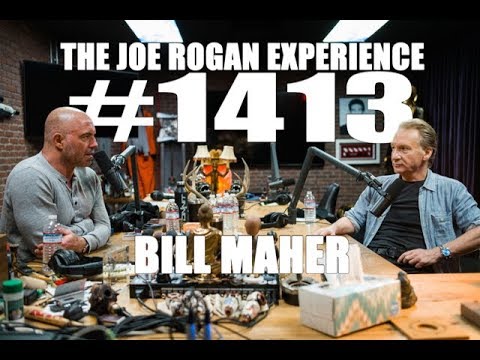
Joe Rogan Experience #1413 - Bill Maher
Joe Rogan (host), Bill Maher (guest), Narrator, Narrator, Narrator
In this episode of The Joe Rogan Experience, featuring Joe Rogan and Bill Maher, Joe Rogan Experience #1413 - Bill Maher explores bill Maher and Joe Rogan Debate Comedy, Outrage Culture, and Progress Joe Rogan and Bill Maher have a long-form, freewheeling conversation covering Maher’s TV career, stand-up roots, and the evolution of his HBO show in a changing media landscape.
Bill Maher and Joe Rogan Debate Comedy, Outrage Culture, and Progress
Joe Rogan and Bill Maher have a long-form, freewheeling conversation covering Maher’s TV career, stand-up roots, and the evolution of his HBO show in a changing media landscape.
They dive deeply into modern attention spans, streaming formats, how stand-up is misrepresented on film, and why long, unstructured conversations feel more honest than traditional talk shows.
A large portion centers on cultural politics: cancel culture, MeToo inconsistencies, social media mobs, political correctness, health and obesity, pornography, dating apps, and how all of these intersect with progressive values.
They close by discussing marriage, divorce law as a financial system, what a fair “sentence” for Louis C.K. might be, and Maher persuades Rogan to appear on Real Time as a one‑on‑one guest.
Key Takeaways
Condensed formats and long-form conversations both serve different audience needs.
Maher sees his HBO hour as a curated weekly digest for busy people, while admiring Rogan’s three-hour, unscripted style for allowing topics to breathe and feel more natural.
Get the full analysis with uListen AI
Stand‑up comedy almost never translates authentically to scripted film or TV.
Both argue that staged stand-up with actors and fake laughing audiences feels inherently false because it removes the involuntary, live nature of laughter that defines real comedy.
Get the full analysis with uListen AI
Modern outrage culture punishes inconsistently and often ignores proportionality.
They contrast Louis C. ...
Get the full analysis with uListen AI
Political tribes routinely override facts, even on the self‑proclaimed ‘science’ side.
Using examples from climate change to crime statistics to political correctness, they argue both left and right now lead with ideology and team loyalty, then retrofit or deny data to match.
Get the full analysis with uListen AI
Health crises like obesity can’t be solved without personal responsibility.
Maher insists that any sustainable healthcare reform must include limits on price‑gouging AND cultural honesty about diet, exercise, and the fact that being markedly overweight is medically dangerous, regardless of body-positivity messaging.
Get the full analysis with uListen AI
Social media amplifies performative morality and an addiction to validation.
They describe how people shape posts to maximize likes, adopt stances they don’t fully believe, and how online shaming—especially on Twitter—has driven some public figures to breakdowns or even suicide.
Get the full analysis with uListen AI
Marriage and divorce laws create powerful financial incentives and distortions.
Rogan details friends ruined by alimony and one-sided settlements, arguing that lawyers profit most from drawn‑out conflict, while Maher questions why the state is invited so deeply into personal relationships.
Get the full analysis with uListen AI
Notable Quotes
“America’s attention span is either seven seconds or three hours.”
— Bill Maher
“What you’re seeing in porn, don’t think women really like that.”
— Bill Maher
“It’s a horrible hallmark of our era that facts almost always come second now.”
— Bill Maher
“Why would I invite the federal and state government into my love life?”
— Bill Maher
“We’re not designed for permanence like that… it’s just talk, but written down.”
— Joe Rogan (paraphrasing Louis C.K.’s point about tweets)
Questions Answered in This Episode
How should we decide what a ‘proportionate’ social or professional punishment is for different kinds of misconduct?
Joe Rogan and Bill Maher have a long-form, freewheeling conversation covering Maher’s TV career, stand-up roots, and the evolution of his HBO show in a changing media landscape.
Get the full analysis with uListen AI
Can a large, modern government-run healthcare system realistically integrate personal responsibility without being seen as shaming or punitive?
They dive deeply into modern attention spans, streaming formats, how stand-up is misrepresented on film, and why long, unstructured conversations feel more honest than traditional talk shows.
Get the full analysis with uListen AI
Does long-form, unedited conversation actually reduce misinformation, or does it just create a different kind of unfiltered bias?
A large portion centers on cultural politics: cancel culture, MeToo inconsistencies, social media mobs, political correctness, health and obesity, pornography, dating apps, and how all of these intersect with progressive values.
Get the full analysis with uListen AI
How might we redesign divorce and alimony laws to protect vulnerable spouses and children without creating perverse financial incentives?
They close by discussing marriage, divorce law as a financial system, what a fair “sentence” for Louis C. ...
Get the full analysis with uListen AI
Where should progressives draw the line between legitimate inclusion/body-positivity and denial of medical or empirical reality?
Get the full analysis with uListen AI
Transcript Preview
Hello, Bill.
Great to be here in the man cave.
(laughs) This is the, uh, professional extension of the man cave. This part is, uh, this is where real work gets done. This is the only part in the building.
It's worth it just to see it.
(laughs)
No, really. I, I thought I was ... And I did not expect this. But, you know, as I was just telling you off the air, I invited myself on this show.
Yes.
I-
Well, you requested it, and I-
I, I did. I said-
... I would have invited you.
... I said, "What are you doing? We're coming back on the air. Real Time's coming back in a few days, and we always do something to promote it." I went, "Let's, let's do that show." You know? "I like that show. Why can't I do the shows I listen to?" Wow.
Got that in Mexico.
You should put that in a r- uh, uh, it looks like it should be a ring for a-
(laughs) Maybe if you slash-
... for, for a, for a roadie.
(laughs) For a roadie.
Yeah.
What y- ... What season are you guys coming into?
Oh, fuck. I'm, uh ...
(laughs)
I don't know. Seasons, it's hard to ... Yeah, I could just go by years. I mean, we started on HBO in 2003, but then we used to do ... For the first few years, they had us do two seasons. They took u- ... took them a while to get the idea that this is not like The Sopranos or any other show. Thi- this kind of show is a habit show. It has to be on most of the year. We used to do a season from February to, like, uh, May, and then we'd be off for four months and come back for a few months in the fall. That's not the way you can do it when you're following events, a live show.
Right.
So finally, somewhere in there, they just ... Okay, so then it was one long season as opposed to two, so I guess they counted the early years as two. We've been on HBO since 2003, but of course, w- ... I started ... You were on the old show, Politically Incorrect. Somebody sent me a clip of that. Wow. I couldn't even bear to watch it, just from the way we looked.
(laughs)
It was too sad.
Time is cruel.
I- it, it's ... (laughs) Actually, we look better now just 'cause we look douchier.
(laughs)
Uh, younger, of course. I mean, that's the trade-off in life-
Yes.
... is that you're douchier when you're younger-
Yeah.
... but you do look m- more pristine, shall we say. Um-
You're less beaten down by time?
Install uListen to search the full transcript and get AI-powered insights
Get Full TranscriptGet more from every podcast
AI summaries, searchable transcripts, and fact-checking. Free forever.
Add to Chrome