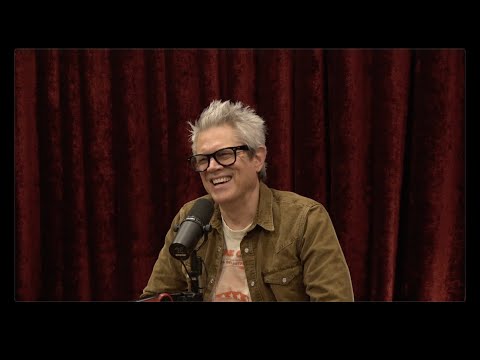
Joe Rogan Experience #2439 - Johnny Knoxville
Joe Rogan (host), Joe Rogan (host)
In this episode of The Joe Rogan Experience, featuring Joe Rogan and Joe Rogan, Joe Rogan Experience #2439 - Johnny Knoxville explores johnny Knoxville on Jackass origins, injuries, fear, and accountability today Johnny Knoxville recounts how financial pressure and a magazine assignment testing self-defense gear (including shooting himself with a .38 into a cheap vest) snowballed into the Jackass concept with Jeff Tremaine.
Johnny Knoxville on Jackass origins, injuries, fear, and accountability today
Johnny Knoxville recounts how financial pressure and a magazine assignment testing self-defense gear (including shooting himself with a .38 into a cheap vest) snowballed into the Jackass concept with Jeff Tremaine.
They unpack the constant tension between “being funny” and escalating risk, sharing multiple near-death close calls, the realities of insurance/waivers, and why animals and uncontrolled environments are uniquely dangerous.
A major thread is head trauma: Knoxville details repeated knockouts, a bull-ring concussion with brain hemorrhage, lingering memory concerns, and a severe post-concussion mental health episode involving catastrophic thinking and depression.
The conversation branches into Fear Factor (and its infamous “donkey cum” cancellation), stunt-set culture and “no negativity” rules, plus Knoxville’s documentary work (Wild and Wonderful Whites of West Virginia) and future project interests.
Key Takeaways
Jackass began as necessity-driven experimentation, not a long-term plan.
Knoxville describes looming fatherhood, limited prospects, and a magazine article that escalated into filmed self-testing (stun gun/taser/pepper spray, then a . ...
Get the full analysis with uListen AI
Comedy—not escalation—was the stated goal, but escalation still became the engine.
Knoxville initially resisted a second film because he couldn’t “top” the first; Tremaine reframed it as “we just have to be funny,” which reduced anxiety—before admitting they’d ultimately have to top it anyway.
Get the full analysis with uListen AI
Uncontrolled variables (animals, heavy objects, miscommunication) create the true life-or-death moments.
Stories include a 20-foot steel wall drop that nearly killed Knoxville due to a timing mistake, a rocket explosion sending metal rods near crew, and bulls where ground conditions and timing errors led to severe concussion and hemorrhage.
Get the full analysis with uListen AI
Repeated head trauma changes both body and mind—often in delayed, nonlinear ways.
Knoxville reports ~16 knockouts, increased susceptibility (“glass jaw”), uncertain memory effects, and a post-concussion period of depression/anxiety with catastrophic rumination; he also notes CTE can’t be confirmed until post-mortem.
Get the full analysis with uListen AI
Stunt culture relies on commitment and psychological “clean focus,” not just gear.
Knoxville emphasizes that half-committing is dangerous; he also cites bull handler Gary Leffew’s “no negativity” rule on set as a way to keep everyone present when consequences can be permanent.
Get the full analysis with uListen AI
TV networks can normalize extreme content—until public perception flips instantly.
Rogan recounts Fear Factor’s “donkey cum” challenge being approved by NBC standards, then leaked online, triggering backlash and cancelation—illustrating how internal desensitization clashes with audience thresholds.
Get the full analysis with uListen AI
Documentary work can be compelling but ethically fraught when subjects live in hardship.
Discussing Wild and Wonderful Whites of West Virginia, Knoxville frames it as charismatic yet tragic—coal-company exploitation, pill devastation, disability dependence—and says a follow-up feels exploitative despite ongoing interest from viewers.
Get the full analysis with uListen AI
Notable Quotes
““The short answer is my then girlfriend got pregnant… I have to support a daughter. I need to do something quick.””
— Johnny Knoxville
““Tremaine said, ‘You don’t, we don’t have to top it. We just have to be funny.’… A couple months later, he told me he was lying.””
— Johnny Knoxville
““I got a concussion with a brain hemorrhage, a broken rib, and a broken wrist out of the deal.””
— Johnny Knoxville
““When we have bulls on the set, I don’t want anyone… any kind of negativity going around the set.””
— Johnny Knoxville (quoting bull supplier Gary Leffew)
““I’ve probably seen more people get the fuck beaten out of them than anybody who’s ever lived.””
— Joe Rogan
Questions Answered in This Episode
Knoxville says he can’t do anything that risks concussion—what concrete rules does he use now for risk assessment (and who has veto power on set)?
Johnny Knoxville recounts how financial pressure and a magazine assignment testing self-defense gear (including shooting himself with a . ...
Get the full analysis with uListen AI
He estimates ~16 knockouts and mentions worsening susceptibility; what specific neurological testing (baseline, cognitive, vestibular) has he done beyond “brain scans,” and what did clinicians recommend?
They unpack the constant tension between “being funny” and escalating risk, sharing multiple near-death close calls, the realities of insurance/waivers, and why animals and uncontrolled environments are uniquely dangerous.
Get the full analysis with uListen AI
On the bull-ring magician stunt, he noticed the ground felt like concrete but proceeded anyway—what production pressures (time, cost, crew expectations) most commonly override safety instincts?
A major thread is head trauma: Knoxville details repeated knockouts, a bull-ring concussion with brain hemorrhage, lingering memory concerns, and a severe post-concussion mental health episode involving catastrophic thinking and depression.
Get the full analysis with uListen AI
The ‘no negativity’ bull-set rule: is that primarily superstition, human-factors management, or both—and how is it enforced operationally on a real shoot day?
The conversation branches into Fear Factor (and its infamous “donkey cum” cancellation), stunt-set culture and “no negativity” rules, plus Knoxville’s documentary work (Wild and Wonderful Whites of West Virginia) and future project interests.
Get the full analysis with uListen AI
Fear Factor’s cancellation hinged on leaked footage and outrage; what would Rogan change today about standards & practices, informed consent, or contestant protection?
Get the full analysis with uListen AI
Transcript Preview
[upbeat music] Joe Rogan Podcast, check it out! The Joe Rogan Experience. Train by day, Joe Rogan Podcast by night. All day! [upbeat music]
Yeah. Yeah, he's the dude who said, "Fuck you," all day, and he choked you to sleep.
Oh. [laughing] I would pay for to see that.
How did you meet judo Gene LeBell?
I met him first on Men in Black II.
Oh, he was-
He was a stuntman.
Oh, okay.
A stunt- And, uh, people would... The stunt people would line up outside his trailer, so they, uh... So he would choke them out.
[laughing]
And he would give you that little-- he would give you a patch afterwards. "You've been choked out by judo Gene LeBell."
Oh, God. [groans] He had all those cartoonish patches.
Yeah.
He'd, like, give you a bunch of those. He's a character, man.
He, uh... One guy, I saw one, uh, the stuntman, right before Gene choked him out, he goes, "One second," this Irish dude. And he, and he turned around, and he slapped Gene in the face. And Gene's like... "Okay."
[laughing]
And then, w- after Gene choked him, they were standing up, Gene just dropped him- [laughing]
Oh!
... straight to the ground for slapping him. [laughing]
Ooh. You can get hurt like that.
Yeah, well, that's what you get for slapping Gene LeBell.
Yeah, don't slap him. Give him a kiss. Kiss him on the cheek before he chokes you out.
Oh, God.
Don't slap him. [laughing] Do you remember, he had one of the very first ever mixed martial arts fights.
Oh, yeah, it was the... He fought-
Milo Savage.
Yes!
Yeah.
And didn't Milo Savage grease himself up-
Uh-huh
... beforehand?
Oh, yeah. But also, G- Gene was wearing a gi, which kinda negates most of the, the grease-
Yeah
... 'cause you're wearing this, like, very friction-y gi. So he grabbed him.
And where was... I guess the rumor was Milo Savage's gloves were loaded?
Uh, I don't know. I would do that, though, if I was Milo Savage. [laughing]
Oh, yeah.
Like, get away with it.
I would have some kind of weapon against Gene LeBell.
Well, most people that have never grappled a guy like that, they... You don't have any idea how helpless you actually are until, like... You think, "I'll be able to push him away from me."
[laughing]
"I'll be able to push him away and get some punches off." You really don't know until that guy grabs you, and it's like being grabbed by an orangutan.
Yeah, 'cause his mom ran the Grand Olympic Auditorium, right? And he grew up training with all the disciplines of fighters that came through there.
Well, he definitely knew pretty much everything. He knew a lot, but, you know, obviously, he was a judo specialist. But he's the guy who taught Bruce Lee about the importance of grappling.
Yeah, 'cause he worked with him on The Green Hornet?
Yeah, he wor- I think he worked with him on that. Um, but when he locked up with Bruce Lee, like, Bruce Lee was like, "Oh, okay, I'm helpless."
Install uListen to search the full transcript and get AI-powered insights
Get Full TranscriptGet more from every podcast
AI summaries, searchable transcripts, and fact-checking. Free forever.
Add to Chrome